Cracked window pane: your three real replacement options
A cracked window pane almost never means you replace the whole window. You have three fixes, in rising cost: glass-only (re-glaze a single-pane sash), insulated-glass-unit-only (swap the sealed double-pane unit while keeping the frame and sash), or full-unit replacement. Which one you need depends on whether the window is single-pane or double-pane, whether the frame is sound, and whether code requires tempered glass in that spot.

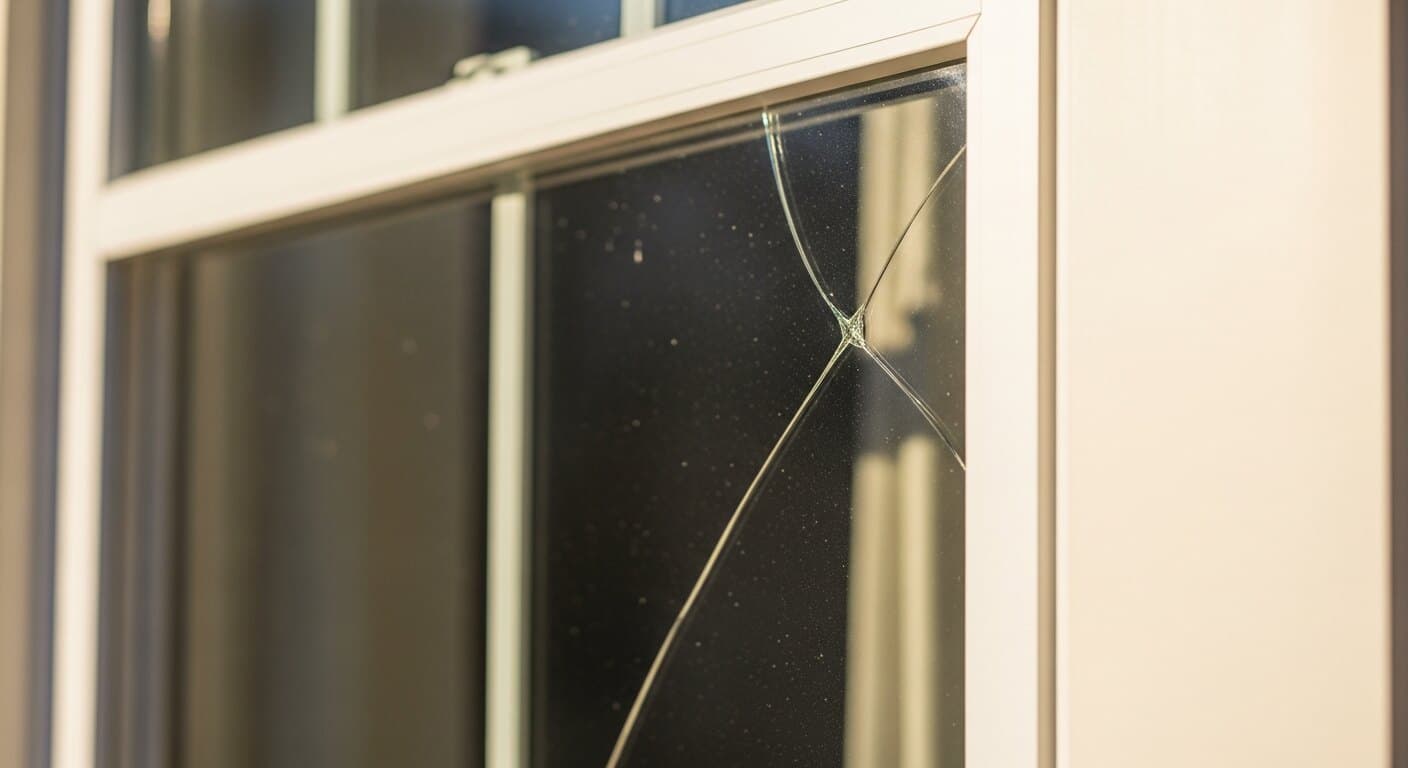
Across my years measuring window openings in person for replacement quotes, the cracked-pane call was the one homeowners almost always got backwards. They assumed a crack meant a new window, and a rep was happy to quote one. Standing at the actual glass with a tape measure, the honest answer was usually smaller: re-glaze a single pane, or swap the sealed glass unit and leave the frame alone. That is the lens for this page. Not "is your window ruined," but which of three repairs the crack actually calls for, and how a single-pane crack and a double-pane crack are two different decisions.
The first thing to settle, before anyone quotes you anything, is what kind of glass cracked. Put your finger on the inside of the pane and a pen point on the same spot outside. If the reflections of the two tips touch, you have single-pane glass. If there is a visible gap between them, you have a double-pane (insulated) unit with two layers of glass and a sealed air or argon space between. That one test decides everything below, because the two are repaired in completely different ways.
What are my options for a cracked window pane?
There are three, and they climb in cost: glass-only re-glazing, insulated-glass-unit (IGU) replacement, and full-unit replacement. The right one is set by your glass type and the condition of the frame, not by the size of the crack.
Here is how the three map out:
| Option | What it replaces | Best when | Relative cost |
|---|---|---|---|
| Glass-only (re-glaze) | A single pane of glass in a single-pane sash | Older single-pane window, sound sash and frame | Lowest |
| IGU-only | The whole sealed double-pane glass unit; frame and sash stay | Double-pane window with a sound, intact frame and enough life left to be worth keeping | Middle |
| Full-unit | The entire window: glass, sash, and frame | Rotted or out-of-square frame, obsolete window, or you want a spec upgrade | Highest |
The trap is assuming a crack forces the most expensive option. It rarely does. A crack is a glass problem first. You only move up to a full-unit replacement when something beyond the glass is wrong (a failing frame, a window so old replacement parts no longer exist) or when you are choosing to upgrade the whole opening's energy performance while it is open anyway. Read the next three sections in order and you will land on your answer.
Can you replace just one pane of a double-pane window?
No, not a single pane. In a double-pane window the two layers of glass and the spacer between them are fused into one sealed insulated glass unit, so when one pane cracks you replace the entire sealed unit (both panes), not the one that broke. The good news: you usually keep the frame and sash, which is most of the cost.
This is the single most misunderstood part of a cracked window pane. People picture a glazier popping out the cracked layer and sliding in a new one. That is not how a sealed unit works. The two panes, the spacer bar, the desiccant, and the perimeter seal are manufactured as one piece in a factory. There is no way to open it, replace half, and re-seal it on site to its original rating. So the "pane" you replace is really the whole IGU.
What makes this affordable is that the IGU drops into your existing sash. A glazier measures the unit (glass width, height, and overall thickness, which sets the spacer size), orders a matching unit, and swaps it in. You keep the frame, the sash, the hardware, and the trim. That is why IGU-only replacement typically runs roughly half to a third the cost of a full new window when the frame is sound. If your window is also fogged or hazed between the panes, that is a separate seal-failure issue covered on the foggy windows and failed window seal pages, and the fix overlaps with this one.
When should you replace the whole window instead of the glass?
Replace the whole window, not just the glass, when the problem is bigger than the glass: a rotted or out-of-square frame, a window so old that matching glass or parts are unavailable, or hardware and seals that are failing alongside the crack. If the only thing wrong is the crack and the frame is solid, glass or IGU replacement is the smarter spend.
Here is when a cracked window pane genuinely justifies a full-unit replacement:
- The frame is compromised. Wood rot, water damage, or a frame racked badly out of square. Putting new glass in a failing frame hides the real problem behind it. See the rotted window frame decision if you suspect rot.
- The window is obsolete. Very old or off-brand units where a matching sash or IGU can no longer be sourced. At that point glass-only becomes a custom-fab job that closes the cost gap to a new window.
- Multiple things are failing at once. A crack plus a failed seal plus balances that no longer hold the sash up means you are paying three repair visits to keep a window already near end of life.
- You are upgrading on purpose. If you would replace this window within a few years anyway, doing it now (while it is already opened up) can fold a single-pane to double-pane or double to triple-pane energy upgrade into one job.
One number worth knowing before you decide: [data pending: OneStep average installed price delta between IGU-only repair and a comparable full-unit replacement in DC/MD/VA]. Glass-only is almost always the cheaper line item; the question is whether the rest of the window has enough life left to be worth keeping.
Get an honest price, no salesperson
Tell us your address and window and get itemized pricing — no in-home pitch, no surprises.
Does a cracked window pane have to be replaced with tempered glass?
Sometimes, yes, and this is the part DIY guides skip. If the window sits in what building code calls a hazardous location (next to a door, low to the floor, near a tub or shower, or beside a stairway), code requires safety glazing, which usually means tempered glass. A replacement pane in those spots has to match that requirement, and tempered costs more and cannot be cut on site.
The governing rule is IRC Section R308.4, adopted across DC, Maryland, and Virginia. It flags glazing as a hazardous location and requires safety glazing in cases including: glass in and immediately adjacent to doors; large panes (over 9 square feet) with the bottom edge under 18 inches off the floor and a walking surface within 36 inches; glass within 60 inches of a tub, shower, or pool surface; and glass low to a stairway or its bottom landing (IRC 2021 R308.4).
Two practical consequences. First, tempered glass is heat-treated at the factory and cannot be field-cut, so a tempered replacement is made to order, which adds lead time and cost over plain annealed glass. Second, look at the corner of your existing pane for a small etched stamp ("tempered" or a manufacturer's safety mark). If the cracked pane was tempered, the replacement must be too. If you are unsure whether your opening triggers the rule, that is exactly the kind of measurement question to confirm before ordering, and you can ask Zig in the chat or have the opening measured during a OneStep quote.
How much does it cost to fix a cracked window pane?
Far less than a whole new window in most cases. Nationally, glass-only and IGU replacement run a wide range depending on size, glass type, and tempered-vs-annealed, while a full replacement window installed runs several times that. The frame condition, not the crack, drives which bucket you land in.
The honest version of the numbers, drawn from national cost aggregators rather than any OneStep quote:
| Fix | Typical installed range (national) | Source |
|---|---|---|
| Glass-only / IGU replacement | about $150 to $700 per standard unit | HomeGuide window repair |
| Full replacement window | about $400 to $2,000+ installed | HomeGuide window repair |
Treat those as budget brackets, not bids. Tempered glass, oversized panes, low-E coatings, argon fill, and obscure or obsolete unit sizes all push the glass-repair number toward the top of its range and can occasionally make full replacement the better value. For our region's full pricing picture, the cost to replace a single window page breaks down what drives a one-window job, and the broader window replacement cost guide puts whole-home numbers in context. One thing I will say plainly from the sales side: a rep paid on full-window jobs has no incentive to quote you a $200 glass repair, which is exactly why getting an itemized, no-rep number first protects you.
Start your measurement in 5 minutes
Snap a photo with your phone, get AI measurements and an honest price — no salesperson, no in-home pitch.
Single-pane crack vs double-pane crack: why they are different decisions
A single-pane crack and a double-pane crack lead to different fixes, costs, and timelines, so diagnosing which you have is step one. Single-pane is a straightforward re-glaze; double-pane means ordering a sealed unit. The decision tree splits right there.
For a single-pane window (common in pre-1960s DC row houses and older outbuildings), a glazier removes the broken glass, cleans the rabbet, sets a new pane, and re-glazes it. It is the cheapest of all the fixes, but a single-pane window is also a poor insulator to begin with, so a crack is a fair moment to ask whether you would rather upgrade the whole opening to an insulated unit while you are spending money on it.
For a double-pane window, you are ordering a custom-built IGU sized to your sash. On the jobs I quoted, those units took anywhere from days to a couple of weeks to fabricate and arrive. You cannot fix it the same afternoon the way a single-pane re-glaze sometimes can be. You also have to match the original spec (overall thickness, low-E coating, argon fill, tempered or not) so the new unit performs and fits like the old one. Get the spec wrong and the unit either does not fit the sash or quietly underperforms the rest of your windows. If you are weighing whether to go double or triple-pane on the upgrade, the energy-efficient windows guide and the triple-pane window cost page lay out the trade-offs for our Zone 4 climate.
How OneStep handles a cracked-pane decision
OneStep measures your opening by phone-video, prices the fix transparently, and lets you compare an IGU-only repair against a full-unit replacement side by side before you commit. Because there is no in-home rep working a commission, nothing pushes you toward the more expensive option than the window actually needs.
The measurement is the part that matters most here, and it is also the part homeowners dread because the traditional version means a sales appointment. OneStep replaces that with AI-guided phone-video measurement: you walk your phone past the window, and the system captures the opening dimensions that determine whether an off-the-shelf IGU fits or a full custom unit is required. From there the 3D configurator prices your actual window so you can see the IGU-repair line and the full-replacement line next to each other in real dollars. If you are unsure whether your opening triggers the tempered-glass rule or whether your frame is sound enough to keep, that is a good question for Zig before you decide.
What does not change is the craftsmanship. A precise final measurement still happens before any glass or unit is ordered, because an IGU built to a wrong thickness will not seat in the sash no matter how fast you ordered it.
See it on your own house first
Preview a clean replacement on a photo of your actual window and get itemized pricing before you decide.
Frequently asked questions
Can you replace just the cracked pane in a double-pane window?
Not a single pane. A double-pane window is one sealed insulated glass unit, so when one layer cracks you replace the entire sealed unit, both panes and the spacer together. You usually keep the existing frame, sash, and hardware, which is why it costs far less than a whole new window.
Is it cheaper to replace the glass or the whole window?
Glass-only or insulated-glass-unit replacement is almost always cheaper than a full new window when the frame is sound, often half to a third of the cost. You only spend more on a full-unit replacement when the frame is rotted or out of square, the window is obsolete, or you are choosing to upgrade the opening's energy performance.
How do I tell if my window is single-pane or double-pane?
Hold a pen point against the outside of the glass and a finger on the inside at the same spot. If the two reflections touch, it is single-pane. If there is a visible gap between the reflections, it is a double-pane insulated unit with two layers of glass and a sealed space between them.
Does a replacement pane have to be tempered glass?
Sometimes. Building code (IRC R308.4) requires safety glazing, usually tempered glass, in hazardous locations such as next to doors, low to the floor, near tubs and showers, or beside stairways. If the cracked pane carries an etched tempered stamp in its corner, the replacement must be tempered too, which costs more and is made to order.
How long does it take to replace a cracked window pane?
A single-pane re-glaze can sometimes be done same-day. A double-pane insulated unit has to be custom-fabricated to your sash size, and on the replacement jobs I quoted those units took several days to a couple of weeks to arrive, longer if the glass must be tempered or has a special low-E or argon spec to match.
Should I replace a cracked single-pane window with a double-pane unit?
It can be worth it. A single-pane re-glaze is the cheapest fix, but single-pane glass insulates poorly, so a crack is a reasonable moment to consider upgrading the opening to an insulated double-pane or triple-pane unit while you are already paying to work on it. Compare the re-glaze cost against the upgrade for that specific window.
Next step
The fastest way to settle a cracked-pane decision is to measure the opening and see the IGU-repair price and the full-replacement price side by side, with no rep on the couch steering you to the bigger job. Our configurator prices your actual window so you choose the fix on real numbers.
See it on your own house first
Preview a clean replacement on a photo of your actual window and get itemized pricing before you decide.
Keep diagnosing: the full window problems hub covers every issue from condensation to water leaking, the window materials guide explains what a replacement unit is made of, and the person behind every page here is Anthony Moorman.