Window condensation: inside, outside, or between the panes?
Window condensation is diagnosed by where the water sits. On the inside surface you can wipe, it is your indoor air hitting cold glass, a humidity issue, not a broken window. On the outside surface, it is harmless dew and often means the glass is efficient. Sealed between the panes where you cannot wipe it, the insulated glass seal has failed. The location tells you the cause.

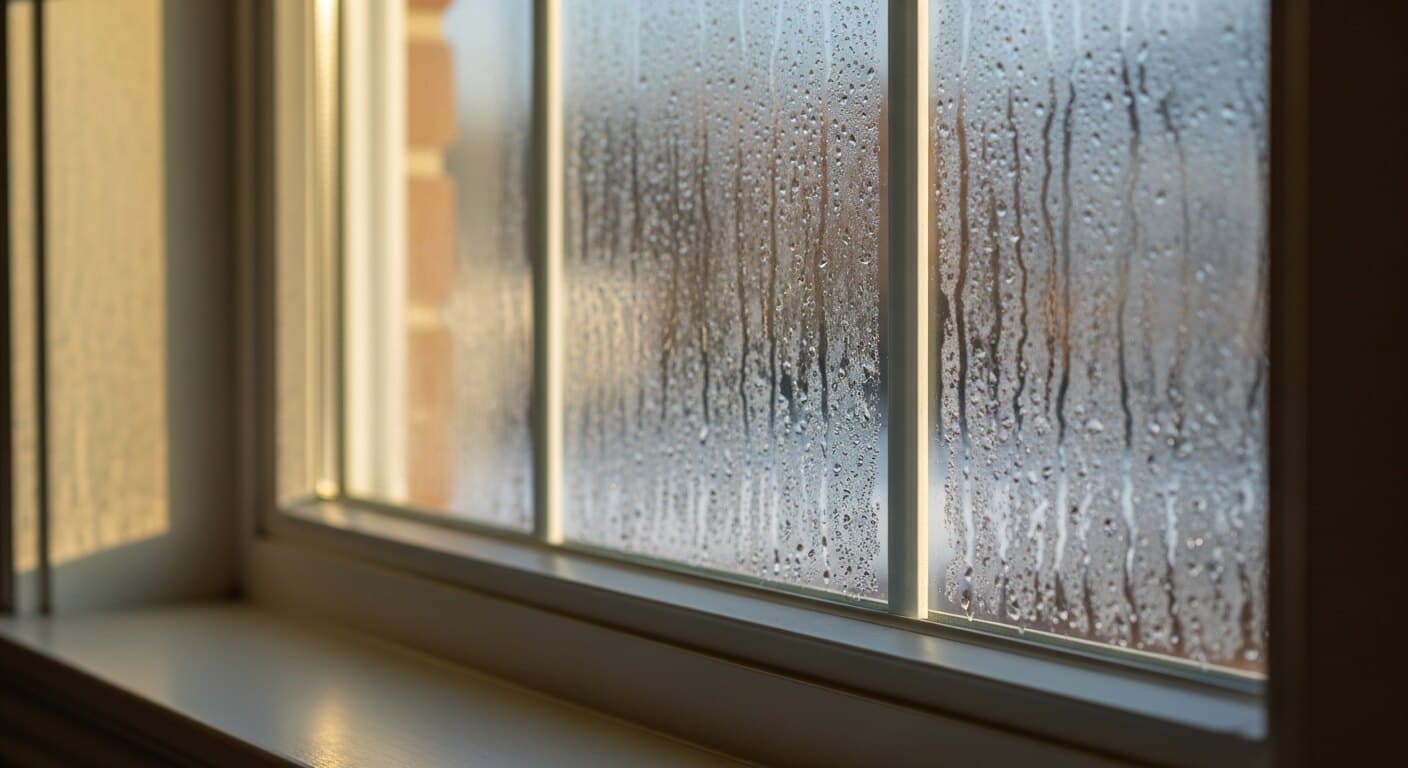
Across years diagnosing windows with DC, Maryland, and Virginia homeowners, condensation is the symptom people most consistently misread, usually into the most expensive conclusion. The fix starts with a piece of building science most reps never explain: water forms on a window when the glass surface drops below the dew point of the air touching it. Once you understand that one sentence, you can tell which of the three condensation problems you actually have, and most of the time it is not the one that costs you a new window.
This page is the diagnostic. I will walk you through each of the three locations, what each one means, and what (if anything) to do about it in our specific climate. If you have already confirmed the moisture is sealed between the panes, the repair-versus-replace math lives on two sibling pages I will point you to.
Window condensation: which surface is it on?
The first move with any window condensation is to figure out which surface holds the water, because each of the three answers points to a completely different cause and fix. Touch the glass. If you can wipe the moisture away, it is on a surface you can reach. If you cannot, it is sealed inside the unit.
There are exactly three places moisture shows up on a modern double-pane window, and they are not interchangeable:
- Inside surface (the pane facing your room): Your warm, humid indoor air is condensing on cold glass. This is a humidity issue in your house, not a defect in the window. Wipeable.
- Outside surface (the pane facing the yard): Dew, the same stuff on your car and your grass on a cool morning. On efficient windows this is normal and often a sign the glass is doing its job. Wipeable.
- Between the panes (sealed in the middle): The seal around the insulated glass unit has failed, letting humid air into the sealed cavity. This is the only one that means the window itself has a problem. You cannot wipe it.
The wipe test sorts the first two from the third in about five seconds. From there, the question on inside-surface condensation is "how humid is my house and how cold is the glass," and the question on between-pane condensation is "repair the glass or replace the window." Same fog on the glass, three different problems. Getting this right is the difference between buying a $20 hygrometer and buying a window you did not need.
Condensation on the inside of the glass: a humidity problem, not a window problem
Condensation on the room-side surface of the glass, the kind you can wipe off, almost always means the air inside your house is too humid for how cold the glass is, not that the window is broken. It is the same physics as a cold glass of iced tea sweating on a summer counter.
Here is what is happening. Warm air holds more water vapor than cold air. When that warm, moist indoor air touches a cold window surface, the air right at the glass cools, can no longer hold its moisture, and the excess condenses out as water. The window did not create the moisture. It is just the coldest surface in the room, so it is where the water shows up first. In winter, the glass is the cold spot; in a humid house, that is enough.
What is actually pushing your indoor humidity up: showers and cooking, a humidifier running too high, drying clothes indoors, a finished basement, a lot of houseplants, a new-construction or recently-renovated home still drying out, or simply a tight, well-sealed house that traps the moisture you generate. Counterintuitively, the better-sealed and more efficient your home is, the more inside-surface condensation you can get, because the moisture has nowhere to escape.
The fix is humidity control, not glass replacement: run bathroom and kitchen exhaust fans, crack a window briefly, lower a whole-house humidifier, and add ventilation.
What indoor humidity level prevents window condensation?
To prevent inside-surface window condensation in winter, keep indoor relative humidity on the lower side, roughly 30 to 40 percent when it is cold out, per University of Minnesota Extension guidance. The EPA recommends keeping indoor relative humidity ideally between 30 and 50 percent (and below 60 percent) for health and to control mold, and the colder the outdoor temperature, the lower in that band you need to sit to keep glass dry.
The reason the target drops as it gets colder is the dew point. The colder the outside air, the colder your window glass gets, and the lower the humidity has to be before that cold glass stops sweating. A house at 45 percent humidity might be perfectly dry-glassed in October and dripping in January, same humidity, colder glass. So the practical move is to watch a cheap indoor hygrometer and ease the humidity down on the coldest nights.
University of Minnesota guidance lays it out in bands, assuming an indoor temperature around 70 F. The coldest rows rarely apply in our Zone 4 winters, but the pattern is the point: the colder it gets outside, the drier you keep the house.
| Outdoor temperature | Maximum indoor humidity |
|---|---|
| 20 to 40 F | 40 percent |
| 10 to 20 F | 35 percent |
| 0 to 10 F | 30 percent |
| -10 to 0 F | 25 percent |
| -20 to -10 F | 20 percent |
| Below -20 F | 15 percent |
If you are seeing inside-surface condensation at humidity levels well inside the EPA's healthy band, the issue is usually that your glass is running unusually cold, which points at old single-pane or failed double-pane units. That is the moment inside-surface condensation becomes a real argument for new windows, because efficient glass keeps the interior surface warmer and condenses less. Our energy-efficient windows guide covers how Low-E coatings and warm-edge spacers raise that interior surface temperature.
Condensation on the outside of the glass: usually a good sign
Condensation on the exterior surface of your window, on a cool, clear morning, is almost always harmless dew and frequently a sign that your windows are efficient, not failing. It forms for the same reason dew forms on your lawn and car: the surface radiated its heat to a clear night sky and dropped below the dew point of the outdoor air.
This is the one that surprises people, so it is worth understanding the mechanism. On an efficient, Low-E, gas-filled window, very little of your indoor heat leaks out through the glass. That is the whole point: the window keeps your heat inside. But it also means the outer pane is not being warmed from inside, so on a still, clear morning that outer pane can cool below the outdoor dew point and collect dew, exactly like grass does. An old, leaky window leaks enough heat outward to keep its exterior pane warmer, so it stays dry, which is why a brand-new high-performance window can fog outside on a morning the old one never did.
It is most common in spring and fall, when nights are cool and daytime humidity is high, and it usually burns off as the sun warms the glass. Nothing to fix and nothing to worry about. If it bothers you, the only real levers are situational: more direct morning sun on the glass, a little air movement, and trimming back shrubs or overhangs that hold the cool, still air against the window overnight. But functionally, exterior dew is your window working as designed.
Condensation between the panes: the only kind that means the window failed
Condensation trapped between the panes, the haze you cannot wipe from either side, is the only one of the three that means the window itself has a problem. It means the seal around the insulated glass unit has failed, letting humid air into the sealed cavity where it condenses on the inner glass surfaces.
The reason you cannot wipe this one is that the moisture is sealed inside a place no rag reaches: the cavity between the two (or three) panes of an insulated unit, the dry, gas-filled gap that does the actual insulating. As long as the edge seal holds, that gap stays bone-dry. Once it fatigues (decades of heat cycling, standing water in the frame, or a build defect), outdoor humidity works its way in and the argon works its way out. What you are left with is permanent haze and a window that now performs more like plain glass than the energy-rated unit you paid for. The full mechanics live on a dedicated page; here it is enough to know this is the only fog you cannot clean.
Two things to know. First, no spray, tape, or DIY "defog" trick reliably restores a failed unit, so this is a glass-replacement or window-replacement decision, not a cleaning one. Second, this is genuinely the only condensation type that is a defect, which is exactly why the wipe test matters so much before you spend money. I keep this section short here on purpose, because the full repair-versus-replace math, the warranty angle, and the costs already live on two dedicated pages: foggy windows: repair or replace walks the decision, and failed window seals covers what is mechanically gone and what your warranty owes you.
How dew point drives window condensation in our Zone 4 climate
Every kind of window condensation traces back to one rule: water appears when a surface cools below the dew point of the air touching it. DC, Maryland, and Virginia sit in IECC Climate Zone 4A, a mixed-humid climate, which means we run real humidity in summer, real cold in winter, and big swings in spring and fall, so all three condensation types show up here across the year.
The dew point is just the temperature at which air is so saturated it cannot hold any more water, so the next bit of cooling forces water out as liquid. Warm summer air in our region carries a lot of moisture, so its dew point is high, that is why a cold drink sweats instantly in a DC August. Winter indoor air is drier but your glass gets much colder, so a modest indoor humidity can still beat the dew point at the glass. Spring and fall mornings combine cool surfaces with humid air, which is prime exterior-dew season on efficient windows.
So our climate is why a single home can see inside-surface condensation in January, exterior dew in April, and between-pane haze whenever a seal finally gives out, all on different windows, all from the same dew-point rule. The diagnostic does not change with the season; only which surface loses the race to the dew point does. Local first-party detail on how often each type shows up here: [data pending: OneStep DC/MD/VA seasonal condensation diagnostic data: share of inside-surface vs exterior-dew vs between-pane cases by season, from measurement/consultation logs]. If you are unsure which type you are looking at, you can ask Zig to walk the wipe test and the humidity question with you.
When window condensation means it is time to replace
Window condensation justifies replacement in two specific cases: when it is sealed between the panes (a failed unit) or when inside-surface condensation persists despite reasonable humidity control, which points to glass running too cold. Exterior dew never calls for replacement on its own.
Here is the honest decision frame, by where the water is:
- Between the panes: The unit has failed. Decide between a glass-only swap (if the frame is sound) and full window replacement (if the frame is rotted or several units have gone). Check your warranty first; seal failure is commonly covered.
- Inside surface, but only on the coldest nights and you run humid: Lower the humidity first. This is usually not a window problem yet.
- Inside surface, at normal humidity, on old or failed glass: Strong case for replacement. Efficient Low-E glass keeps the interior surface warmer and condenses far less, so new windows genuinely fix this one.
- Outside surface: Leave it alone. It is dew, and on efficient glass it is a feature, not a fault.
The trap I watched homeowners fall into for years was replacing windows to chase inside-surface condensation without ever touching the humidity, then being frustrated when the new windows still fogged on the coldest mornings, or when the moisture simply moved to a cold closet wall. If your real problem is air leakage and cold rather than humidity, read drafty windows: repair or replace before you spend, since drafts and condensation can share a root cause but call for different fixes. And for the broader map of window issues, the window problems hub sorts repair problems from replacement ones.
If your diagnosis does land on replacement, the most useful next step is real numbers on your actual openings rather than a guess. You can preview styles and get itemized pricing on your own home in the 3D configurator, or compare what a new energy package would cost across the window replacement cost guide and the energy-efficient window cost page.
See it on your own house first
Preview a clean replacement on a photo of your actual window and get itemized pricing before you decide.
Is OneStep right for you?
Frequently asked questions
Why is there condensation on the inside of my windows?
Your indoor air is too humid for how cold the glass is. Warm, moist air touches the cold window surface, cools, and drops its moisture as water. It is a humidity issue in your house, not a broken window, and it is most common in winter. Lowering indoor humidity with exhaust fans and ventilation usually fixes it.
Is condensation on the outside of my windows bad?
No. Exterior condensation is harmless dew that forms when the outer pane cools below the outdoor dew point on a cool, clear morning. On efficient Low-E windows it is common and often a sign the glass is insulating well, because little indoor heat leaks out to warm the outer pane. It usually burns off as the morning sun warms the glass.
How do I tell the difference between condensation and a failed window seal?
Try to wipe the moisture away. If you can wipe it from the inside or outside surface, it is ordinary condensation and the window is fine. If the haze is sealed between the panes and no cleaning reaches it, the insulated glass seal has failed and the unit needs glass or full replacement.
What indoor humidity stops window condensation in winter?
Roughly 30 to 40 percent relative humidity in cold weather per University of Minnesota Extension guidance, and lower on the coldest nights. The EPA recommends keeping indoor humidity ideally between 30 and 50 percent and below 60 percent. Because colder glass sweats at lower humidity, ease the level down as the outdoor temperature drops, using an inexpensive hygrometer to guide you.
Will new windows stop condensation?
It depends on the type. New efficient windows reduce inside-surface condensation because the warmer interior glass surface sweats less, and they fix between-pane fog by replacing the failed unit. But they will not stop it if your indoor humidity is simply too high, in which case the moisture moves to the next coldest surface, so address humidity too.
Is window condensation dangerous?
Surface condensation itself is not dangerous, but persistent inside-surface moisture can feed mold on sills, frames, and nearby walls if it is never controlled. Between-pane fog is only a performance and appearance problem, not a safety hazard. The real risk is ignoring chronic indoor humidity, not the water on the glass on any single morning.
Next step
Diagnose before you spend a dollar: do the wipe test, watch a cheap hygrometer against the outdoor cold, and let the location of the water tell you whether you have a humidity habit to break, harmless dew to ignore, or a failed unit to replace. Only the third one is a window problem, and only then is it worth pricing a replacement on your own openings before any salesperson gets involved.
Start your measurement in 5 minutes
Snap a photo with your phone, get AI measurements and an honest price — no salesperson, no in-home pitch.
Keep diagnosing: the window problems hub covers every common window issue, foggy windows and failed window seals handle the between-pane repair-or-replace call, and you can ask Zig which kind of condensation you are looking at. The person behind every page on this site is Anthony Moorman.