How to choose the right window type for your home
The right window type follows the room and the house, not the brochure. Choose by function first: casement over a kitchen sink, awning in a basement or bath, double-hung on a DC row house, picture where you want a view. Match the operation to how you use the space, match the style to your home's era, then pick material and brand last.

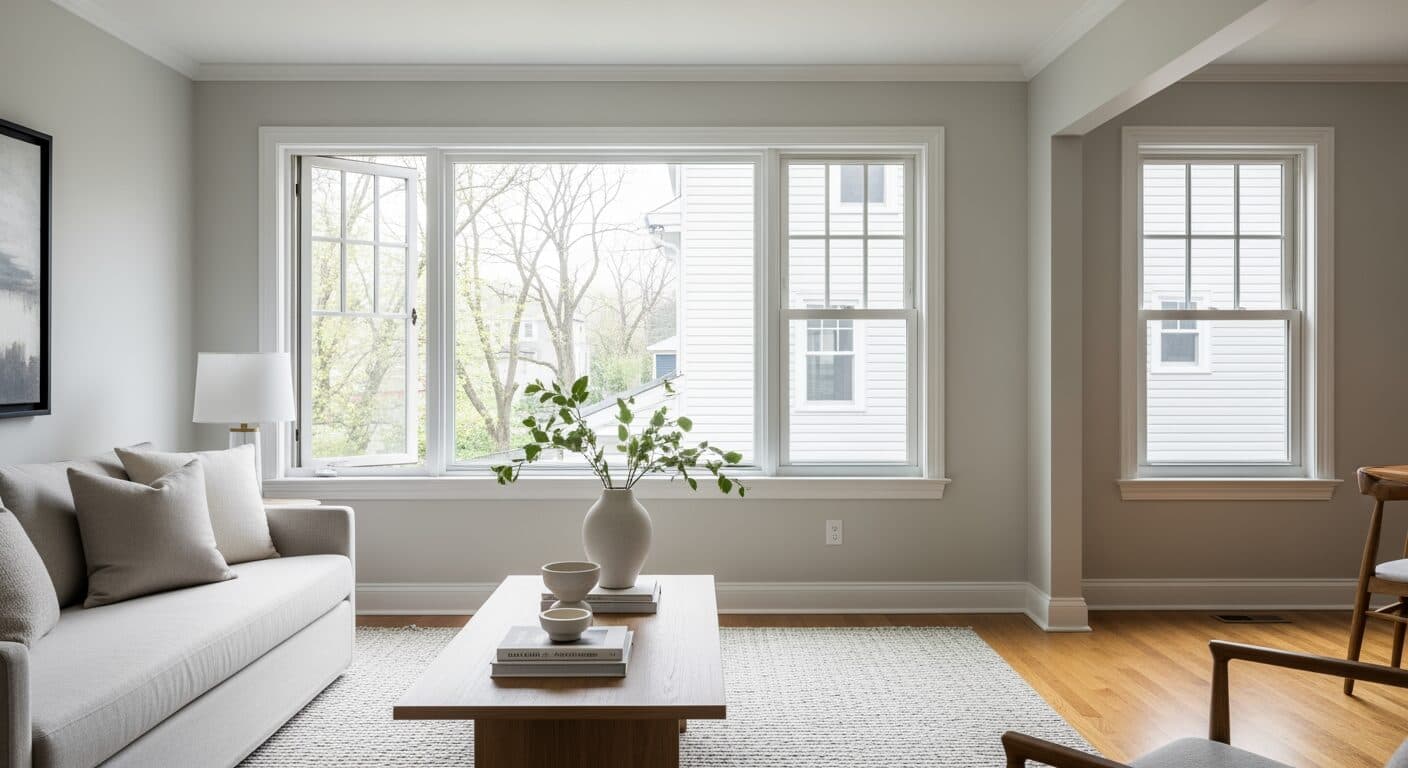
Most homeowners come to window shopping with the order backwards. They start with a brand name they saw on TV, then a material they read was "best," and only at the end think about what the window actually needs to do in each room. That's how you end up with a heavy double-hung over a sink you can barely reach, or a fixed picture window in a bedroom that legally needs an exit.
This guide flips it. We start with the room and the house, because those two things decide more than any spec sheet will. After 12+ years walking buyers and sellers through DC-area homes as a real estate agent, I can tell you the facade and the room drive this choice far more than the spec sheet. By the end you'll be able to look at any opening in your house and name the window type that belongs there.
The 8 window types, in one minute
There are only eight window types OneStep installs, and each one exists to solve a specific problem. Learn what each does and the room-by-room decisions get easy.
| Window type | How it opens | What it's best at | Typical home |
|---|---|---|---|
| Double-hung | Two sashes slide vertically; both tilt in | Classic look, easy cleaning, screens stay inside | Colonial, row house, Cape Cod |
| Casement | Cranks outward on a side hinge | Tightest air seal, full-opening ventilation | Kitchens, modern homes, hard-to-reach spots |
| Awning | Cranks outward on a top hinge | Ventilation in light rain, high or low placement | Basements, baths, above doors |
| Picture | Does not open (fixed) | Maximum glass, lowest cost per square foot | Living rooms, stairwells, view walls |
| Sliding | One sash slides horizontally | Wide openings, low headroom, easy operation | Ramblers, contemporary homes, basements |
| Bay | Three-panel angled projection | Curb appeal, a shelf or seat, more light | Colonials, Victorians, living/dining rooms |
| Bow | Four-or-more-panel curved projection | A softer, wider arc than a bay | Larger facades, formal rooms |
| Patio doors | Slide or swing open as a door | Connecting indoor and outdoor space | Decks, patios, walk-out basements |
The deeper specs for each type live on the individual window pages, and a fuller materials breakdown lives in our window materials guide. For now, hold one rule in your head: operation first. How a window opens matters more to daily life than the brand stamped on the frame. The rest of this guide walks the major rooms and the three dominant DC-area home styles, and names the type that belongs in each.
Pick by function before you pick by looks
Start with what the window needs to do, because the wrong operation is the mistake you live with every day. A window that looks right in a photo but fights you every time you open it is a worse buy than a plain one that works.
Run any opening through three questions. First, do you need it to open at all? A view wall or a stairwell often doesn't, and a fixed picture window gives you more glass for less money. Second, can you reach it easily? Over a sink, a counter, or a tub, reaching across to push up a heavy sash is miserable, so a crank-out casement wins. Third, how much air do you want? Casements and awnings open their full area; double-hungs and sliders open half. For a bedroom you want to sleep with cracked open, half is fine. For a stuffy kitchen, full ventilation matters. The point of the three questions is to disqualify the wrong types fast, so you're choosing between two good options instead of eight.
Most rooms answer all three the same way once you look at them honestly. A kitchen sink answers "hard to reach" and "wants full air," which lands you on a casement before you've even thought about looks. A stairwell landing answers "doesn't need to open" and points straight at a fixed picture window. The mistake homeowners make is skipping the questions and reaching for whatever the rest of the house already has, then living with a sash they can't comfortably operate. Walk every opening through the three questions on its own terms first, and only then check whether the answer fits the facade. Where function and looks disagree, this guide tells you which one usually wins in each room.
There's also a code question that overrides taste. Bedrooms and basements used as sleeping space need an egress window, an opening large enough to climb out of in a fire. The IRC minimum is a 5.7-square-foot clear opening (5.0 sq ft at grade level), at least 20 inches wide and 24 inches high, with the sill no more than 44 inches off the floor. A fixed picture window can never be egress, no matter how large the glass is, because it does not open. This is why bedroom and basement choices are constrained in ways a living-room choice isn't, and why you should settle the egress question before you fall in love with a look.
The kitchen: casement almost always wins
For the window over a kitchen sink, a crank-out casement is usually the right window type. You turn a handle instead of leaning across the counter to wrestle a sash, and the casement seals tighter than any other operating window.
The reach problem is the whole story here. A double-hung over a sink means stretching over the faucet and dishes to lift a sash that may be stiff or painted shut by the next owner. A casement's crank sits at the bottom, within easy reach, and swings the whole sash outward like a door. That same outward swing is why casements seal best: the sash compresses against the frame when latched, where a double-hung relies on a sliding fit that loosens over time. In the mixed-humid zone 4 climate the 2021 IECC assigns this region, that tighter seal is worth having on the room that already runs hot from cooking.
There are two cases where a casement isn't right in a kitchen. If the window opens onto a deck, walkway, or anywhere people pass, an outward-swinging sash is a hazard, so a sliding window or double-hung is safer because nothing projects into the path. And if your kitchen is traditional and the rest of the house is double-hung, a single casement can look out of place from the street; some homeowners accept the small reach trade-off to keep the facade consistent, which is a reasonable call on a home you plan to sell.
There's a middle path worth knowing about. If the kitchen window is wide, a twin or triple casement (two or three crank-out sashes side by side under one head) reads less like an oddity against a double-hung facade than a single tall casement does, because the horizontal proportion sits more comfortably above a counter. A sliding window is the other compromise: it keeps everything inside the wall plane, so it never projects over a walkway, and it's easy to operate one-handed over a sink even though it only opens half its area. When a homeowner I was working with couldn't reconcile the casement's reach advantage with a strict traditional exterior, the slider was usually the call we landed on.
Bathrooms and basements: awning for rain-safe air
For bathrooms and below-grade spaces, an awning window is usually the best type. It's hinged at the top and cranks outward from the bottom, so the open sash acts like a small roof. You get ventilation even in light rain, and you can place it high on a wall for privacy.
Bathrooms need to vent moisture without sacrificing privacy, and an awning solves both. Set high on the wall above eye level, it clears steam while no one can see in, which is why it pairs well with obscured or frosted glass on the lower portion. The rain-shedding shape matters more than people expect in our climate; a Zone 4 summer storm blows through fast, and an awning lets you leave it cracked without water coming in across the sill. For a basement, an awning placed near the top of a below-grade wall pulls stale air without giving up the lower wall space you'd want for shelving, a workbench, or finished trim. Awnings also pair naturally above a picture window or a door, venting a room where the main glass is fixed.
The big exception is a basement bedroom or any below-grade sleeping room. Those need egress, and a standard awning rarely meets IRC R310's 5.7-square-foot clear-opening minimum. A basement bedroom usually wants a casement or a large sliding window in a proper egress well instead. The well itself is part of the requirement, not an afterthought: a below-grade egress window has to open into a window well deep and wide enough for an adult to climb out, with a ladder or steps if the well is more than 44 inches deep, a requirement that comes from the same IRC R310 egress rules. That's why the window type and the excavation outside it get decided together, and why a basement-bedroom opening costs more than a comparable above-grade one. If you're finishing a basement to add a bedroom in Maryland or Virginia, confirm the egress requirement with your county before you choose the window. It's the one place a wrong type fails inspection, and the fix after drywall is expensive.
Bedrooms: balance egress, quiet, and easy operation
For most bedrooms, a double-hung or a casement is the right window type. Both can meet egress, both are easy to operate, and the choice comes down to your home's style and how much air you want.
Every bedroom used for sleeping needs an egress window, so the first filter is whether a type can hit IRC R310's 5.7-square-foot clear opening at a reachable sill height. Double-hungs can, in larger sizes, but a small bedroom double-hung may not. This is a common surprise, since cutting a double-hung in half vertically can drop each sash below the egress minimum. Casements hit it easily because the whole sash swings clear, which is why narrow bedrooms often default to a casement. After egress, think about operation and noise. A double-hung lets you open the top sash to vent warm air near the ceiling while keeping the bottom closed for security, useful in a kid's room or a ground-floor bedroom on a busy street. A casement opens fully for maximum airflow and seals tightest when closed, which also means a bit less street noise getting in at night.
Sill height is the detail people forget. Egress isn't just about the size of the opening; the sill has to sit low enough that someone can actually get to it, which is why a high transom-style window over a bed never qualifies no matter how it operates. In an existing bedroom you're rarely moving the rough opening, so the practical question is whether the type you want clears the egress minimum within the hole that's already in the wall. That's the moment a casement earns its keep: where a double-hung would split the opening and fall short, a single casement uses the whole opening as one clear path. If you're unsure whether your bedroom opening passes as-is, the safest move is to measure the existing daylight opening before you shop, because the type that fits a 30-inch-wide opening is not always the type that fits a 24-inch one.
Living rooms: picture glass framed by operating windows
For a living room with a view, the strongest layout is a large fixed picture window flanked by two operating windows, usually casements or double-hungs. You get the maximum glass and the lowest cost per square foot from the fixed center, plus real ventilation from the sides.
A picture window is fixed, so all its cost goes into glass and frame rather than hardware and seals. That's why it's the cheapest window per square foot and the one that delivers the most uninterrupted view. The catch is it doesn't open, so on its own it can make a room stuffy. Flanking it with two operating units fixes that: casements for the tightest seal and full airflow, or double-hungs to match a traditional facade. This combination is also how you get a big, dramatic opening while still meeting any egress requirement, since the flanking operable units can carry the code load. It's the layout I steered the most living rooms toward in the field, because it gives you the view without giving up ventilation or code compliance.
If the living room is the front face of the house, bay and bow windows are worth considering too. A bay projects outward in three angled panels and adds a shelf or window seat plus noticeable curb appeal; a bow uses four or more panels in a gentler curve for a softer, wider look. Both cost more than a flat picture-plus-flankers layout and are their own line item. A bay or bow runs well above a comparable flat configuration, partly because they need a supported sill and sometimes a small roof of their own. They earn it on resale appeal in the right home, but they're an upgrade, not a default.
Matching the window type to your home's style
Beyond the room, your home's architectural style narrows the choice fast, because the wrong type on the wrong facade reads as cheap even when the window itself is good. Here's how the three dominant DC-area styles map to the eight types.
DC row house
A DC row house (Federal, Victorian, or Wardman) almost always wants double-hung windows. The tall, narrow, vertically-proportioned double-hung is the original window on these homes, and anything else fights the facade. If you're inside a historic district (Georgetown, Capitol Hill, parts of Logan and Dupont), the Historic Preservation Office typically requires you to match the original profile, and vinyl is generally not approved, which can push you toward a fiberglass or wood-clad double-hung. Picture and casement windows belong on the rear or interior light wells, not the street-facing facade. Before you choose anything for a historic-district row house, confirm what the HPO will approve; it overrides every other preference.
Maryland colonial
A Maryland colonial, the most common owner-occupied home across Montgomery, Howard, and Anne Arundel counties, is built around symmetry, and double-hung windows are what hold that symmetry together. Use double-hungs across the main facade to keep the grid even. Then a bay window on the living or dining room front adds the curb appeal colonials wear well, and awning units handle the basement. Casements work fine on the rear or in a modernized kitchen, but keep the street-facing elevation double-hung so the symmetry reads clean. A colonial is the home style where mid-tier vinyl makes the most sense for the most owners. The look is forgiving and the volume of windows is high, so the per-window savings add up fast across a dozen-plus openings.
Virginia Cape Cod and rambler
Virginia's postwar Cape Cods and 1960s ramblers are more flexible, and that's where sliding windows come into their own. A rambler's long, low, horizontal lines suit a horizontal slider, which also works well where there's limited headroom above the opening. Cape Cods often mix double-hungs on the main floor with smaller units in the dormers, where a slider or a short double-hung fits the tight dormer wall. A walk-out basement in a Virginia rambler is the classic case for patio doors, turning a below-grade room into real living space. These homes carry contemporary types far better than a colonial or row house does, so you have room to choose by function without fighting the architecture. That's a freedom you should use, because the function-first choice is usually also the cheaper one here.
For a wider look at how style, era, and material interact, our complete guide to replacement windows covers the full picture from type through install.
See it on your own house first
Preview a clean replacement on a photo of your actual window and get itemized pricing before you decide.
Material and brand come after type
Once the type is settled, choose material, then brand, in that order, never the reverse. The type decides whether the window works in the room; material decides how long it lasts and what it costs; brand decides warranty enforcement and finish options, which matter least.
For most DC/MD/VA homes, mid-tier vinyl is the right material once the type is set. It's the best value, holds up well in Zone 4's mixed-humid climate, and comes in every one of the eight types. The real cases for upgrading are specific: a historic district that won't approve vinyl (fiberglass or wood-clad), or a 15-plus-year hold where you want a more permanent finish. Dark exterior colors are the one material caveat. Dark vinyl can warp under direct DC summer sun, so if you want black or bronze frames, fiberglass holds the color more reliably.
The reason the order matters, and not just the choices, is that reversing it quietly costs you money. Pick the brand first and you've anchored on a price tier before you know whether the room even needs that window's strengths. Pick the material first and you can end up paying for fiberglass on a back-of-house opening that a forgiving vinyl would have served just as well. When you settle the type first, you've already narrowed which materials are in play, because not every type is worth upgrading: a fixed picture window has no moving seal to wear out, so the case for premium material on it is weaker than on a hard-working casement you crank every day. Let the room set the type, let the type and your hold time set the material, and treat brand as the last and smallest decision.
Brand matters less than any in-home pitch will tell you. Within a tier, a mid-tier Pella, an Andersen 100, and a strong regional vinyl perform similarly; what actually varies is warranty enforcement, which is invisible at the table. Some brands honor claims freely, others fight every one. Renewal by Andersen's Fibrex composite is genuinely good and its warranty is excellent (fair credit there), but you're paying a premium for the in-home service model as much as the product, so don't let the brand decide the type. The full cost picture, including what each type runs installed, lives on our window replacement cost page.
What it costs by type, and where OneStep fits
Cost tracks closely with type, and knowing the rough order of expense helps you budget before you ever get a quote. Fixed glass is cheapest per square foot; projection windows are the most expensive.
From least to most expensive, the rough order is: picture (fixed, all glass, cheapest per square foot), awning and casement (small-to-mid sizes with a crank), double-hung and sliding (the volume types most homes use most), then bay, bow, and patio doors as their own larger line items. A standard double-hung in mid-tier vinyl runs [data pending: standard double-hung installed price range] installed; a comparable casement runs [data pending: standard casement installed price range]; bay and bow units run [data pending: bay/bow installed price range]. Type-specific numbers live at double-hung cost and casement cost, with the full breakdown on the cost hub.
Where OneStep fits: our model is transparent, itemized pricing with no in-home rep and no manager-approval theater. You see the per-type number before you talk to anyone. That's a better fit for homeowners who'd rather research and decide on their own than schedule an in-home appointment to find out what each type costs.
See your window types on your actual house
Reading about types only gets you so far. The fastest way to decide is to see each one on your own home. Our 3D configurator pulls up your house, lets you place each window type opening by opening, and gives you an itemized number per type. No phone call, no rep, no manager approval.
If you'd rather start from measurements, our phone-video measurement flow captures every opening from your phone in a few minutes, and Zig can answer "which type belongs here?" against your specific rooms. For the full library of homeowner guides, see /guides, and the parent commercial page for everything we do is /window-replacement.
Start your measurement in 5 minutes
Snap a photo with your phone, get AI measurements and an honest price — no salesperson, no in-home pitch.
Frequently asked questions
What is the most popular window type?
The double-hung is the most popular window type in DC, Maryland, and Virginia, because it fits the colonial, row-house, and Cape Cod styles that dominate the region. Both sashes slide and tilt in for cleaning, screens stay inside, and the proportions match traditional facades. Casement is the most popular second choice, especially for kitchens.
Which window type is most energy efficient?
Casement windows generally seal tightest because the sash compresses against the frame when you crank it shut, where sliding types like double-hung and sliding windows rely on a looser sliding fit. For maximum efficiency, the glass package (Low-E coating and argon fill) matters as much as the type. Ask Zig which glass package fits Zone 4 if you're unsure.
What window type is best for a kitchen over the sink?
A casement is almost always best over a kitchen sink. You turn a crank instead of reaching across the counter to lift a heavy sash, and it opens fully for ventilation while you cook. The exception is a window that opens onto a deck or walkway, where an outward-swinging sash is a hazard and a sliding window is safer.
What window type do I need for a basement bedroom?
A basement bedroom needs an egress window, typically a large casement or a sliding window in a proper egress well, sized to the IRC minimum 5.7-square-foot clear opening. A standard awning or small fixed window will not pass inspection. Confirm the exact requirement with your Maryland or Virginia county before you choose.
How do I choose between a double-hung and a casement?
Choose by reach and style. Over a sink, counter, or tub, the crank-out casement wins because you don't have to lean across to open it. On a traditional row house or colonial facade, the double-hung keeps the look right and has no crank to wear out. If neither constraint applies, the casement seals tighter and the double-hung is easier to match across a whole house.
What window type is best for a DC row house?
A DC row house almost always wants double-hung windows, because the tall, narrow proportions are original to these homes. Inside a historic district, the Historic Preservation Office usually requires you to match the original profile and generally won't approve vinyl, which can push you toward fiberglass or wood-clad double-hungs. Confirm what the HPO allows before choosing.
Are bay and bow windows worth the extra cost?
Bay and bow windows cost meaningfully more than a flat picture-plus-flankers layout and are billed as their own line item, but they add curb appeal, interior space, and resale value on the right facade, such as colonials, Victorians, and larger fronts. On a plain wall or a budget project, a picture window flanked by operating windows delivers most of the light for far less.