Patio door replacement
Patio door replacement swaps a worn sliding glass, French, or multi-slide door for a new insulated unit with modern weatherstripping, multi-point locks, and Energy Star glass. Most DC/MD/VA homeowners are replacing a tired 1970s-to-90s slider on a rear wall, and the three configurations to choose from are sliding (gliding), French (hinged), and multi-slide (panoramic). Pick by opening width, swing clearance, and how much glass you want when the door is closed.

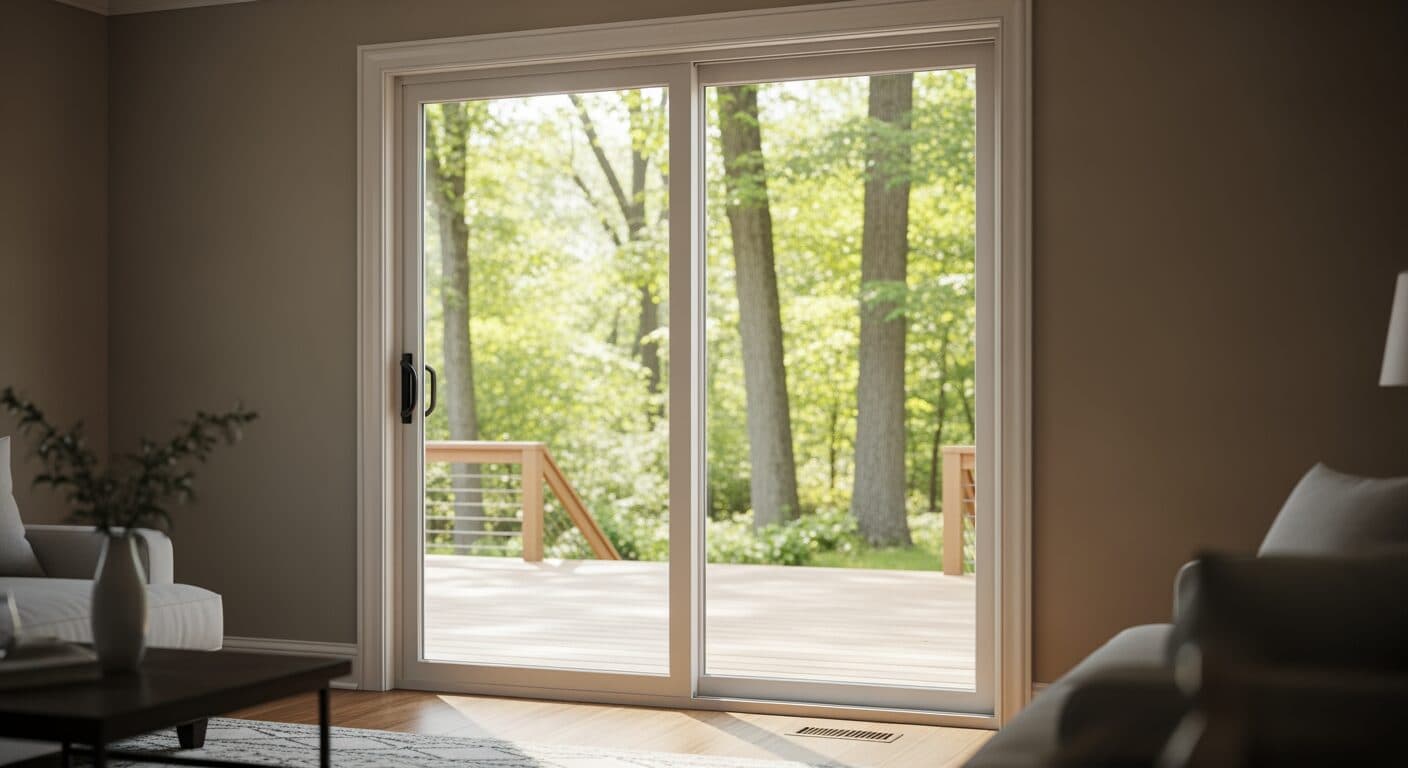
Patio doors are technically doors, not windows, but the way OneStep sells and installs them is identical to the window flow. Same brands. Same glass packages. Same NFRC ratings. Same phone-video measurement. The only thing that changes is the size of the opening and the amount of daily abuse the unit takes. A typical bedroom window opens a few times a season. A patio door opens every day, gets leaned on by kids and dogs, and holds back weather across the largest expanse of glass in the house. Spec accordingly.
Of all the openings in a typical project, the patio door is usually the one homeowners have been ignoring the longest and resent the most: sticking rollers, fogged panes, a lock that hadn't engaged cleanly since 2014. It was also the unit that delivered the most immediate "I can feel the difference" reaction the day after install. Of all the units in a project, this is the one where the upgrade is most visceral.
What are the three patio door configurations?
Three configurations cover almost every DC/MD/VA replacement: sliding (gliding), French (hinged), and multi-slide (panoramic). Sliding is the volume play, French is the traditional look, multi-slide is the premium remodel.
- Sliding (gliding) patio door. Two or three panels in a track; one or two panels slide, the rest are fixed. Typical opening 6' to 12' wide. The most common replacement by a wide margin, since most homeowners are swapping out a 1970s-to-90s slider that has earned its retirement.
- French (hinged) patio door. Two hinged panels that swing inward or outward like a pair of doors. Narrower openings, typically 5' to 6' wide. Traditional aesthetic, no track to trip on, more glass per panel because there is no overlap. Costs more than a comparable slider.
- Multi-slide / panoramic. Three to six panels that slide and stack to one side, or pocket into the wall cavity entirely. Premium tier, typical openings 10' to 24'. Common in new construction and major rear-addition remodels in Bethesda, Potomac, McLean, and DC row house additions.
Which patio door is right for which opening?
The right configuration depends on opening width, the space outside and inside the door, and whether you want maximum glass or maximum opening. The cheat sheet:
| Configuration | Typical width | Best for | Skip if |
|---|---|---|---|
| Sliding (2-panel) | 6' to 8' | Most rear-deck and patio openings; replacing an existing slider | You want a doorway with no track at the floor |
| Sliding (3-panel) | 9' to 12' | Wider openings where one fixed panel keeps the cost in check | Opening is under 8' |
| French (in-swing) | 5' to 6' | Traditional facades; openings where exterior space is tight | You have furniture inside the swing arc |
| French (out-swing) | 5' to 6' | Coastal/storm exposure; need to keep interior floor clear | Deck or porch sits within the swing arc |
| Multi-slide | 10' to 24' | Modern remodels and additions; openings where you want the whole wall to open | Budget is mid-tier or below |
A few patterns I see most often in DC/MD/VA:
- MD colonial rear walls (Bethesda, Silver Spring, Rockville). Almost always a 6' or 8' two-panel slider replacing a 1980s slider that opens to a deck. Vinyl mid-tier with double-pane Low-E argon hits the budget and the energy targets without overspending.
- VA rambler and Cape rear yards (Falls Church, Vienna, Springfield). Mix of sliders and French. French is more common here because the openings are often narrower (5' to 6') and the homes have a more traditional feel.
- DC row house rear additions. Increasingly multi-slide or a 9' to 12' three-panel slider in modern rear additions; traditional 6' slider in unrenovated row houses. HPO approval applies on visible facades; rear additions usually have more latitude.
- Newer construction and major remodels. Multi-slide and pocket-stacking systems are the upgrade everyone wants and not everyone budgets for.
How patio door replacement compares to a standard window
Three things change when you spec a patio door instead of a window: daily wear, glass area, and security exposure. All three push you toward better hardware than you'd buy for a same-budget window.
- Daily wear. A patio door opens hundreds of times a year. The rollers (on a slider) or the hinges (on a French) take real load. Budget-tier rollers tend to bind by year 7 to 10; premium rollers (tandem stainless on a steel track) can run smoothly past year 20. The difference is [data pending: roller upgrade upcharge on patio door] and is the single best long-term spec on a slider.
- Glass area. A typical patio door is 60 to 100+ square feet of glass, the size of three or four windows. The glass package decision matters more in dollar terms here than on any single window. Triple-pane upcharges scale with glass area, but so does the comfort and energy payback.
- Security exposure. Patio doors are the entry point burglars actually use. Multi-point locking, reinforced sills, and laminated glass (which holds together when struck) materially change the security profile. On any patio door at ground level, multi-point lock is non-negotiable on a modern spec.
The other thing patio doors get that windows don't, because they need it: impact-rated glass for storm exposure, pet/kid impact resistance, and reinforced thresholds that don't telegraph wear under daily foot traffic. None of that is upsell. It's the spec the unit needs to do its job.
What patio door replacement costs
A standard 6' two-panel sliding patio door in mid-tier vinyl with double-pane Low-E argon runs [data pending: standard 6ft slider installed range, mid-tier vinyl] installed in the DC/MD/VA market. French and multi-slide configurations cost meaningfully more.
| Configuration | Tier | Per-unit installed | Notes |
|---|---|---|---|
| Sliding 6' (2-panel) | Mid-tier vinyl | [data pending: 6ft slider mid-tier vinyl installed] | The volume replacement; fits most rear-deck openings |
| Sliding 9' to 12' (3-panel) | Mid-tier vinyl / composite | [data pending: 9-12ft slider installed range] | Wider openings with one fixed panel |
| French 5' to 6' (hinged pair) | Mid-tier vinyl / composite | [data pending: French door installed range] | Adds 20 to 40% over comparable slider |
| Sliding or French | Fiberglass / Fibrex composite | [data pending: fiberglass patio door installed range] | Renewal by Andersen, Marvin Essential, ProVia |
| Multi-slide (3 to 6 panel) | Premium | [data pending: multi-slide patio door installed range] | Andersen, Marvin, Pella; often $15k to $50k+ |
| Wood interior / clad | Premium | [data pending: wood/clad patio door installed range] | Marvin Signature, Pella Reserve, traditional interiors |
The deeper cost breakdown by material and brand lives at /cost. For the full commercial picture of how OneStep prices, installs, and warranties patio doors alongside the rest of a project, start at /window-replacement.
Get an honest price, no salesperson
Tell us your address and window and get itemized pricing — no in-home pitch, no surprises.
The spec sheet that actually matters
Five specs separate a patio door that ages well from one you replace early: rollers (on a slider) or hinges (on a French), multi-point locking, glass package, threshold, and reinforced sill.
- Rollers (slider) or hinges (French). On a slider, tandem stainless rollers on a stainless track substantially outlast stamped budget rollers (published durability comparison: [data pending: sourced durability comparison, tandem stainless vs stamped budget patio door rollers]). On a French door, ball-bearing hinges sized for the panel weight are the spec. Budget hinges sag, drop the panel out of square, and bind the latch early.
- Multi-point locking. A single deadbolt on a patio door is the 1985 spec. Modern multi-point systems lock the active panel at multiple points along the lock stile, pulling the panel tight against the frame and weatherstripping. This is both a security and a seal improvement.
- Glass package. Double-pane Low-E with argon is the modern baseline. For DC/MD/VA's Zone 4 mixed-humid climate, target [data pending: recommended patio door U-factor for Zone 4] or lower. Triple-pane is worth considering on west-facing doors and homes you plan to hold long-term. Laminated glass for security or sound is a meaningful upgrade on street-facing doors and ground-floor exposures.
- Threshold. The threshold (the floor strip at the bottom of the door) takes the most wear of any part of the unit. Aluminum-capped composite is the durable spec; budget aluminum-only dents and telegraphs scratches. ADA-compliant low-profile thresholds exist if you need them for accessibility.
- Reinforced sill. The sill below the threshold is the structural floor of the unit. Steel- or composite-reinforced sills handle furniture, traffic, and the small impacts that come with daily use. Hollow vinyl sills flex under load and eventually crack.
[IMAGE: Close-up of a tandem stainless roller on a stainless track at the bottom of a sliding patio door, viewed from the interior. Alt: "Tandem stainless roller and stainless track on a sliding patio door, shown from inside the home."]
Glass packages and security
Patio doors get more wear than any window. The glass package decision is where you protect against the wear you can predict: kids, pets, weather, attempted entry.
- Double-pane Low-E with argon. The baseline. Hits ENERGY STAR North-Central in most patio door product lines. Right for most DC/MD/VA homes.
- Triple-pane Low-E with argon or krypton. Worth considering on west-facing doors with afternoon sun, doors next to a noisy street, or homes held long-term. Adds [data pending: triple-pane upcharge on patio door].
- Laminated glass. Two glass layers bonded with a plastic interlayer. Holds together when struck, which is meaningful for both security (a burglar swinging a brick gets through the glass but not the interlayer in any reasonable time) and impact protection (kids, pets, lawn debris).
- Impact-rated glass. Required in true coastal hurricane zones; meaningful in the DC/MD/VA market mostly for severe-storm exposure and security. Adds [data pending: impact glass upcharge on patio door].
- Tempered glass. Code-required on patio doors essentially by definition: under 2021 IRC R308.4.2, glazing within a 24-inch arc of a door edge with its bottom edge less than 60 inches above the floor must be safety glazed. Always included in the base quote.
Pair that glass package with a multi-point lock, a reinforced sill, and an upgraded threshold and you have a unit that will absorb 20 years of daily use without complaint.
Installation: insert vs. full-frame, and what changes from a window
Most patio door replacements are full-frame, not insert. The existing frame on a 1970s-to-90s slider is rarely sound enough to leave in place, and the sill almost always needs to be replaced regardless. Plan for full-frame on most older patio doors and any unit with visible threshold wear.
Full-frame patio door installs include:
- Removing the old door, frame, threshold, and sill
- Inspecting (and usually replacing) the framing and sub-sill below
- Setting and flashing the new frame
- Installing the new threshold and reinforced sill
- Trimming the interior and exterior
- Caulking, sealing, and final adjustment of the rollers or hinges and the multi-point lock
A typical 6' to 8' slider replacement is a one-day install; that's how these projects were scheduled in the quotes I wrote at Renewal by Andersen. Multi-slide and pocket-stacking systems typically take 2 to 3 days and require additional structural work, especially if the existing rough opening needs to change.
The measurement step matters more on a patio door than a window. The opening is bigger, the load on the frame is higher, and an out-of-square opening that a window can absorb in trim will telegraph to a patio door as a sticking panel. Phone-video measurement captures the corners, the floor-to-header dimensions, and the squareness in three passes. If anything reads ambiguous, the OneStep system flags it for a confirmation pass before the unit is ordered.
Start your measurement in 5 minutes
Snap a photo with your phone, get AI measurements and an honest price — no salesperson, no in-home pitch.
Patio doors compared to the related window types
If you're picking between a patio door and a wider window opening for the same wall:
- Patio door vs. picture window. Picture wins on energy and per-square-foot cost; patio door wins because you can actually walk through it. If the room already has another door to the outside, a picture window flanked by smaller operating units is the better energy spec.
- Patio door vs. sliding window. Same operating mechanism, different scale. Sliding window is for openings 3' to 6' wide where you don't need to walk through; patio door is for openings 5' to 12'+ where you do.
- Patio door vs. bay window or bow window. Different jobs entirely. Bay and bow project outward to add interior space and a wider sightline; patio doors provide access. Some MD colonials end up with a bay window on one rear wall and a sliding patio door on an adjacent wall, which is a great pattern.
The full picture of which window or door type fits where in your home lives at the windows hub. If you want a head-to-head comparison of how casement or double-hung units flank a patio door in the same wall, see /windows/casement and /windows/double-hung.
Frequently asked questions
How much does a patio door replacement cost?
A standard 6-foot two-panel sliding patio door in mid-tier vinyl with double-pane Low-E argon runs in OneStep's mid-tier installed range in the DC, Maryland, and Virginia market. French doors add 20 to 40 percent over a comparable slider, and multi-slide configurations start at premium tier and scale with panel count and width.
Sliding vs. French patio door, which is better?
Neither is universally better. Sliding doors fit wider openings (6 to 12 feet), do not intrude into the interior or exterior space when open, and cost less per square foot of opening. French doors fit narrower openings (5 to 6 feet), have a more traditional look, and offer more glass per panel because there is no overlap between panels. Pick by opening width, swing clearance, and aesthetic.
How long does a patio door last?
Frame and glass age on different clocks: the InterNACHI life-expectancy chart puts window and door frames at 20 to 40 years and double-pane insulated glass units at 8 to 20 years before seal failure. The rollers on a slider or hinges on a French typically need service sooner, often at 10 to 15 years on budget-tier hardware and 20-plus years on premium hardware. The threshold and multi-point lock are the next wear items, and both can be serviced rather than replaced when the rest of the door is sound.
Can I replace a sliding patio door with a French door?
Usually yes, but the rough opening dimensions are different. A 6-foot slider opening can sometimes accept a 5 to 6-foot French door directly; a wider slider opening (8 to 12 feet) will need to be reframed if you want a French door. Going from French to slider almost always requires reframing. Budget for the structural work on top of the door cost.
Are patio doors energy efficient?
Modern patio doors with double-pane Low-E argon glass can meet ENERGY STAR North-Central ratings, the climate zone covering the DC/MD/VA market. The multi-point lock and modern weatherstripping are what make the difference over a 1980s slider, which leaked at the lock stile, the meeting rail, and the threshold all at once. Triple-pane is a meaningful upgrade on west-facing doors and long-term holds.
Do I need impact-rated glass on a patio door in DC/MD/VA?
Not for code in most of the region, but it is a meaningful upgrade for security and severe-storm protection. Impact-rated or laminated glass holds together when struck. Worth considering on ground-floor doors and street-facing exposures.
Is a patio door the same as a sliding glass door?
A sliding glass door is one configuration of patio door, the most common one. Patio door is the broader category that also includes French (hinged) and multi-slide (panoramic) configurations. When most homeowners say patio door, they mean a sliding glass door, because that is what they are replacing.
Will a new patio door fit my existing opening?
Usually, but the install is almost always full-frame rather than insert. Existing patio door frames are rarely sound enough to leave in place, and the threshold and sill almost always need to be replaced regardless. The phone-video measurement captures the opening dimensions and squareness so the new unit is ordered to fit cleanly.
Next step
The fastest way to know what a patio door replacement costs for your specific opening is to measure it. OneStep's phone-video measurement takes about five minutes and produces a real, buildable quote you can review on your own time, with no rep scheduling a visit to your house.
See it on your own house first
Preview a clean replacement on a photo of your actual window and get itemized pricing before you decide.
If you're not sure whether sliding, French, or multi-slide is right for your opening, ask Zig. Zig has the full patio door catalog and can match the configuration to your opening width, your interior layout, and your budget.
Related: the parent commercial page is window replacement, the full set of window types we install is at the windows hub, and the honest cost breakdown is at the cost pillar. The person behind every page on this site is at Anthony Moorman's profile.