Bow window replacement
A bow window replacement is a curved arc of 4-6 equal panels (usually all double-hungs or all casements) that projects outward from a flat wall in a gentle radius. Bows trade the bay's two hard angles for a softer line and more glass, spread that projection across more units, and cost more because there are more units to build and the framing is curved. Bows are most at home on Victorian and Queen Anne facades in DC/MD/VA.

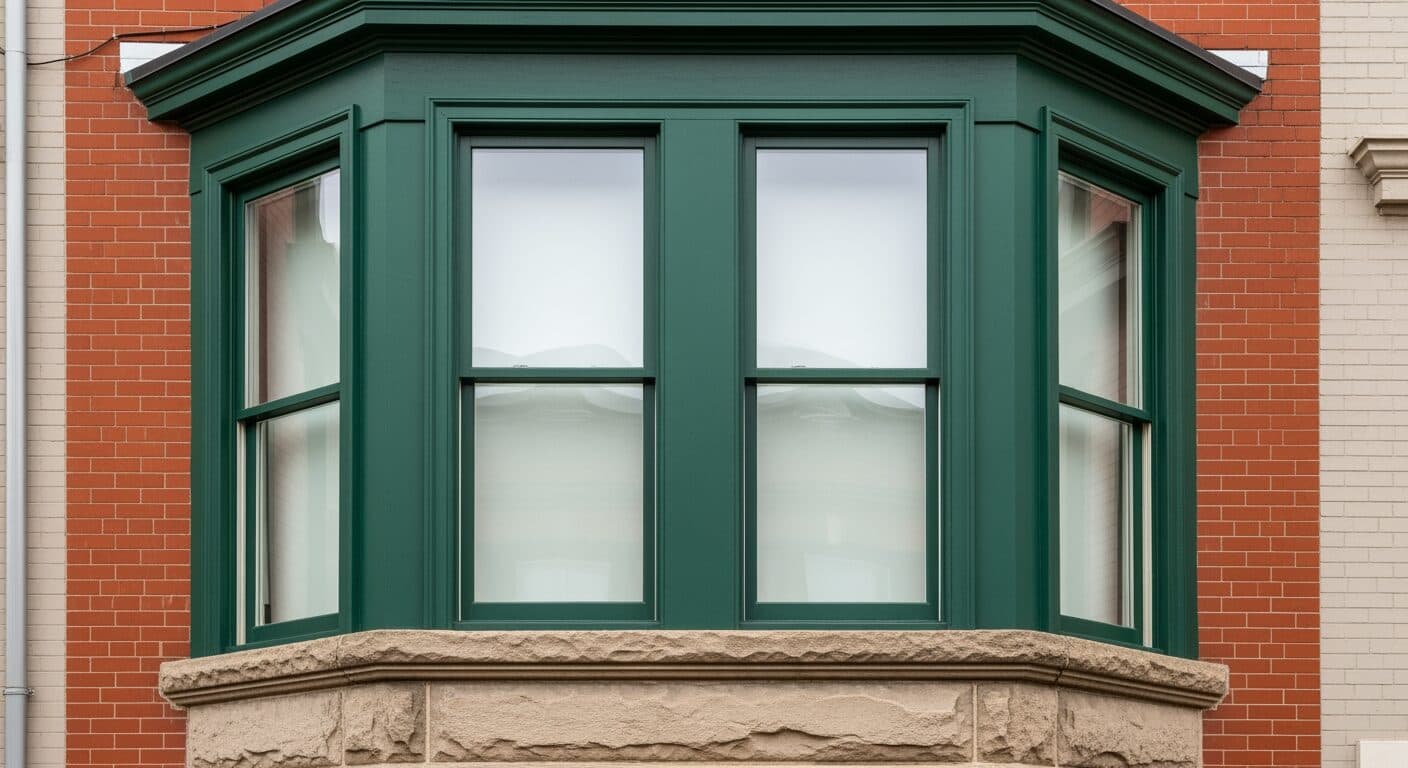
A bow is the window most homeowners describe as a bay until they look closer. Same idea (a window that projects outward and adds floor area and light), but where a bay has two visible corners, a bow has none. The panels step around a curve at roughly 10 to 15 degrees apiece, and the result is a softer architectural line that reads as more traditional than a bay's contemporary geometry. Across the DC/MD/VA market, bows come up most often on three home types: Maryland and Virginia Victorians, Queen Annes with curved corner turrets, and late-Victorian DC row houses where the original parlor window was already a curved bay.
What a bow window replacement is
A bow window is a single projecting window assembly made of four, five, or six equal-width panels mulled together at small angles (usually 10° per joint on a 6-panel, up to about 15° on a 4-panel). The panels can be any operating style, but in practice they're almost always all double-hungs or all casements (never a mix), and you almost never see a fixed picture unit in the middle the way you do on a bay.
Geometrically, the difference from a bay is that the bow distributes its projection across more, smaller angles. A standard 30°/30° bay projects [data pending: typical 30-degree bay projection depth from the wall plane (manufacturer spec)] from the wall plane and lands at two hard mitered corners. A 4-panel bow at 15° each side projects roughly [data pending: typical 4-panel bow projection range in inches] and lands as a smooth arc. A 5- or 6-panel bow projects similarly but with even softer joints. The end visual is a window that hugs the curve of a turret or softens a flat facade in a way a bay simply can't.
When a bow window is the right call
Bows are the right call when the facade is Victorian or Queen Anne, when an existing curved parlor or turret opening is being replaced like-for-like, or when you want more glass and a softer line than a bay can give you.
The Victorian and Queen Anne case is the most common. Late-19th-century homes in Capitol Hill, Mount Pleasant, Takoma Park, and Old Town Alexandria were often designed with curved corner turrets at the parlor level, and bows fit that geometry natively. Dropping a bay into a turret reads as wrong; the corners fight the curve. A bow steps gently around it.
The replacement-in-kind case is the second most common. If your home already has a bow, replacing it with a bow is almost always the right move, both for facade consistency and (in historic districts) for HPO approval. DC's Historic Preservation Office, Annapolis's Historic Preservation Commission, and Old Town Alexandria's Board of Architectural Review all treat like-for-like replacement of an existing bow far more favorably than a bow-to-bay swap.
The "more glass, softer line" case is the third. A bow gives you measurably more glass area than a comparable bay because four to six panels of glass beat three. On a south-facing parlor wall in a Bethesda or Chevy Chase colonial revival, that's noticeably brighter morning and afternoon light. The softer arc also makes the projecting window read as part of the wall rather than as a feature bolted onto it.
When a bow window is the wrong call
Bows are the wrong call when the existing opening is a true rectangular flat window, when budget is the binding constraint, or when the facade is a strict colonial or Federal where projecting curved geometry doesn't belong.
The flat-opening case is the underrated one. Converting a flat double-hung opening into a bow is a major structural job. It needs a new header sized for the projection, a curved roof or seat (the "knee" and the "shed" above the window), interior framing for the seat board, and exterior cladding to wrap the roof. That work typically runs [data pending: bow window structural conversion cost range] on top of the windows themselves. Most homeowners who think they want a bow on a flat wall settle for a bay once the conversion cost is on the table.
The budget case is straightforward. A bow is more units of window plus curved framing plus a custom roof. Even with the same glass and frame material, a bow priced against a comparable bay in the same line typically runs [data pending: bow vs bay price premium percentage] more. If you're optimizing dollars-per-square-foot of new view, a bay is almost always cheaper.
The wrong-facade case is the aesthetic one. A 1920s Cape Cod, a strict Federal townhouse, or a mid-century rambler doesn't want a bow. The curved projection reads as Victorian on a non-Victorian wall, and once you see it that way, you can't unsee it. For colonial and traditional facades that want projection, a bay is the right call; for flat facades that don't, a picture window flanked by double-hungs usually wins.
Bow vs. bay: the comparison most homeowners actually want
Bow and bay are the natural compare-point. Both project outward, both add floor area and light, both create a seat. They differ in three measurable ways: panel count, angle geometry, and cost.
| Spec | Bow | Bay |
|---|---|---|
| Panels | 4 to 6 equal panels | 3 panels (center + two flankers) |
| Angle geometry | Typically 10 to 15° per joint, smooth arc | Two hard angles (typically 30° or 45°) |
| Projection from wall | Spread across the arc | Concentrated at center |
| Typical projection depth | [data pending: typical bow projection depth range] | [data pending: typical bay projection depth range] |
| Glass area (same wall opening) | More (4 to 6 panels of glass) | Less (3 panels, often with fixed center) |
| Cost in the same line | Higher (more units, curved framing) | Lower (3 units, mitered framing) |
| Facade fit | Victorian, Queen Anne, existing curved openings | Colonial, traditional, contemporary projections |
| Common interior use | Reading nook, parlor seat, turret room | Living room seat, breakfast nook |
For a deeper read on the bay side, see the bay window replacement page. That's the page to go to if your facade is a colonial or your budget is the binding constraint.
The short version: pick a bow if the facade calls for the curve or you're replacing an existing bow. Pick a bay if the facade calls for hard angles or you're working to a budget. The two windows are not interchangeable.
What bow window replacement costs
A bow costs more than a bay in the same line because there are more units and the framing connects curved joints rather than mitered ones. Expect [data pending: bow window installed price range, mid-tier vinyl] for a mid-tier vinyl 4-panel bow installed, scaling up with panel count, frame material, and glass package.
| Tier | Brand examples | 4-panel bow installed | When it makes sense |
|---|---|---|---|
| Budget vinyl | [data pending: budget vinyl bow brand examples] | [data pending: budget vinyl bow installed range] | Rental, secondary, behind-the-house projects |
| Mid-tier vinyl | [data pending: mid-tier vinyl bow brand examples] | [data pending: mid-tier vinyl bow installed range] | Most owner-occupied DC/MD/VA Victorians |
| Premium vinyl / composite | [data pending: premium bow brand examples] | [data pending: premium bow installed range] | Long-term hold, energy-focused, parlor-facing |
| Fiberglass / Fibrex composite | Marvin Essential, Renewal by Andersen | [data pending: fiberglass bow installed range] | Historic districts requiring wood-look exterior |
| Wood interior / clad | Marvin Signature, Pella Reserve | [data pending: wood/clad bow installed range] | High-end Victorian and Queen Anne restorations |
Beyond the windows themselves, two cost categories that catch homeowners off guard: the seat board and head board (the interior horizontal surfaces inside the projection, usually oak or birch ply with a finish to match the interior trim) and the exterior roof (a small shed or hip roof above the bow assembly, with flashing and shingles to match the home). Together these typically add [data pending: bow seat board and exterior roof cost range].
A deeper cost breakdown by tier lives at /cost. For the full picture on what drives an itemized window quote, start at the parent commercial page at /window-replacement.
Get an honest price, no salesperson
Tell us your address and window and get itemized pricing — no in-home pitch, no surprises.
The spec sheet that actually matters
Bows live or die on four specs: structural sizing, sash type consistency, glass package, and the support detail underneath. The first is design, the second is aesthetic discipline, the third is energy, the fourth is what keeps the bow from sagging in year 12.
- Structural sizing. A bow assembly has weight: four to six full window units plus a glass load plus a seat board plus an exterior roof. Manufacturers publish a maximum unsupported span, typically [data pending: max unsupported bow span]. Beyond that, the assembly needs either cable supports (steel cables from the ceiling above to the bow's top corners) or a knee brace from the wall below the seat. Confirm what the spec calls for, because a bow without proper support can sag visibly within a decade.
- Sash type consistency. All double-hungs, all casements, or all picture units, never a mix. A bow with mixed sash types reads as confused. The most common configuration in DC/MD/VA Victorians is all double-hungs (matches the rest of the facade); the second most common is all casements (more glass, fewer visible rails).
- Glass package. Same logic as any other window: double-pane Low-E with argon is the modern baseline for Zone 4 (DC/MD/VA). Upgrade to triple-pane on west-facing bow assemblies that take afternoon sun, where the larger glass area amplifies any energy penalty. For street-facing bows on busy DC blocks, laminated glass on the front-facing panels is worth considering for sound.
- Support detail underneath. A bow needs either a knee brace, a cable support, or a deep cantilevered floor framing detail. Cheap installs skip this. Sagging bows are almost always a support-detail failure, not a window failure.
[IMAGE: A 5-panel casement bow window with all casement sashes cranked partway open, viewed from outside, on a Queen Anne corner turret. Alt: "Five-panel bow window with all casement sashes on a Queen Anne corner turret."]
How a bow compares to other window types
If you're picking between a bow and another configuration for the same wall:
- Bow vs. bay. Bow gives a softer arc and more glass; bay gives hard angles and lower cost. Pick by facade and budget. This is the most natural compare and covered in detail above.
- Bow vs. picture flanked by operating units. A picture flanked by two double-hungs or casements is the flat-wall version of a bow's effect: more glass, less projection. Costs significantly less because there's no curved framing or projecting roof. Right call when the wall is flat and you don't want the structural conversion.
- Bow vs. all double-hungs in a row. A row of three or four double-hungs mulled flat reads as a traditional band of windows and costs less than a bow because there's no projection. Right call on a colonial facade where the line should stay flat.
- Bow vs. casements in a row. Same logic as double-hungs but with casement airflow and energy performance. Right call on a kitchen or breakfast wall that wants ventilation more than projection.
The full guide to picking type by room and home style lives at /windows.
Installation considerations specific to bows
Bow installs are full-frame replacements, not insert. The existing opening, header, and (if it's a replacement-in-kind) the existing seat and exterior roof all get assessed before the new unit goes in.
Three install-specific things to flag:
- Like-for-like vs. flat-to-bow conversion. Replacing an existing bow with a new bow is the cleaner job, because the structural opening, the support detail, and the exterior roof all already exist. Converting a flat wall to a bow is a different scale of project: header, framing, interior finish, exterior cladding, roof. Budget accordingly: on the project timelines I quoted in my in-home sales years, a conversion ran 2 to 4 days versus 1 day for like-for-like.
- HPO approval in DC historic districts. Bow windows on front facades of DC historic-district properties almost always require HPO review. Like-for-like replacement is routinely approved if the new unit matches the historic profile (panel count, sash configuration, divided lites, exterior trim). Bow-to-bay or bay-to-bow swaps are reviewed more skeptically.
- The exterior roof. A bow has its own small roof above the projection: a shed roof on a 4-panel bow, sometimes a hip roof on a larger one. That roof's flashing and shingle-to-wall transition is the most common leak point on a bow assembly. Verify the install crew is replacing the flashing, not just the window.
Bow measurements are also where OneStep's phone-video measurement workflow has the most ground to cover. You'll walk your phone around the exterior face of the existing bow and the interior, and the system extracts the angle of the joints, the projection depth, and the panel widths. If you're not sure whether your existing window is a 4-panel or 5-panel bow (or a bow at all rather than a bay), ask Zig, which has the full configuration library and can identify it from a photo.
Start your measurement in 5 minutes
Snap a photo with your phone, get AI measurements and an honest price — no salesperson, no in-home pitch.
Frequently asked questions
What is the difference between a bow window and a bay window?
A bow window is a curved arc of 4 to 6 equal panels, usually all the same sash type (typically all double-hungs or all casements), typically joined at small angles of 10 to 15 degrees. A bay window is three panels: a larger center unit flanked by two angled side units, joined at two hard angles, typically 30 or 45 degrees. Bows project less depth but spread it across more panels for a softer line, while bays project more depth at a sharper geometry.
How much does a bow window cost?
A 4-panel mid-tier vinyl bow installed in DC, Maryland, or Virginia typically runs more than a comparable bay in the same line because there are more units and the framing is curved. Premium vinyl, fiberglass, and wood-clad bows scale up substantially from there. Beyond the windows themselves, the interior seat and head boards and the exterior roof above the bow add meaningfully to the total.
Can I convert a flat window opening into a bow window?
Yes, but it is a major structural job, not a window swap. Converting requires a new header sized for the projection, framing for the seat below and head above, exterior cladding for the projecting roof, and interior finish work. The conversion cost typically rivals or exceeds the cost of the bow itself, so most homeowners exploring this end up either choosing a bay or staying flat with a picture window flanked by operating units.
How long do bow windows last?
Frame and glass age on different clocks: the InterNACHI life-expectancy chart puts vinyl and fiberglass window frames at 20 to 40 years and double-pane insulated glass units at 8 to 20 years before seal failure. The failure points specific to a bow are the exterior roof flashing, the cable or knee support if installed, and the crank operators if the bow is all casements, and all of those tend to need attention before the frames themselves wear out.
Do bow windows work in historic districts?
Yes, especially when you are replacing an existing bow with a new bow that matches the historic profile. DC's Historic Preservation Office, Annapolis's HPC, and Old Town Alexandria's BAR all favor like-for-like replacement. Bow-to-bay or bay-to-bow facade changes get more scrutiny and sometimes get rejected on front facades, so confirm with the relevant board before specifying.
Are bow windows energy efficient?
A bow's energy performance depends on the panel type and glass package, not the bow geometry. A bow of all-casement sashes with double-pane Low-E argon will hit similar U-factor and air infiltration numbers to a standalone casement in the same line. The energy variable specific to bows is the larger total glass area, which amplifies both gain on south-facing bows and loss on north-facing bows. Triple-pane is worth considering on bows facing west or north in DC/MD/VA's Zone 4 climate.
What kind of homes have bow windows?
Bow windows are most at home on Victorian and Queen Anne facades, late-Victorian DC row houses with curved parlor bays, and any home with an existing turret or curved wall at the window plane. They are less at home on strict colonial, Federal, mid-century, and contemporary facades, where the curved projection reads as visually out of place.
Next step
The most useful thing you can do before talking to any installer is to see real numbers for a bow in your specific opening: 4-panel vs. 5-panel vs. 6-panel, all-double-hung vs. all-casement, vinyl vs. fiberglass vs. wood-clad. OneStep's 3D configurator handles bows directly and shows the price impact of each choice in real time. No rep coming to your parlor, and no sitting through a sales presentation.
See it on your own house first
Preview a clean replacement on a photo of your actual window and get itemized pricing before you decide.
If you're not sure whether your existing window is a bow or a bay (it's a common mix-up), or whether your facade should keep the bow it has, ask Zig. Our window consultant has the full configuration library and the DC/MD/VA historic-district reference for HPO, HPC, and BAR.
Related: the parent commercial page is /window-replacement, the full set of window types we install is at /windows, and the most natural sibling compare is /windows/bay. The person behind every page on this site is at /about/anthony-moorman.