Bay window replacement
A bay window replacement is a three-panel projecting unit: a fixed center picture window flanked by two operating windows (usually double-hung or casement) typically set at 30 or 45 degree angles. It pushes living space outward, adds a seat-board ledge, and reads as a feature wall. In DC/MD/VA it costs meaningfully more than a flat window because the projection needs structural support.

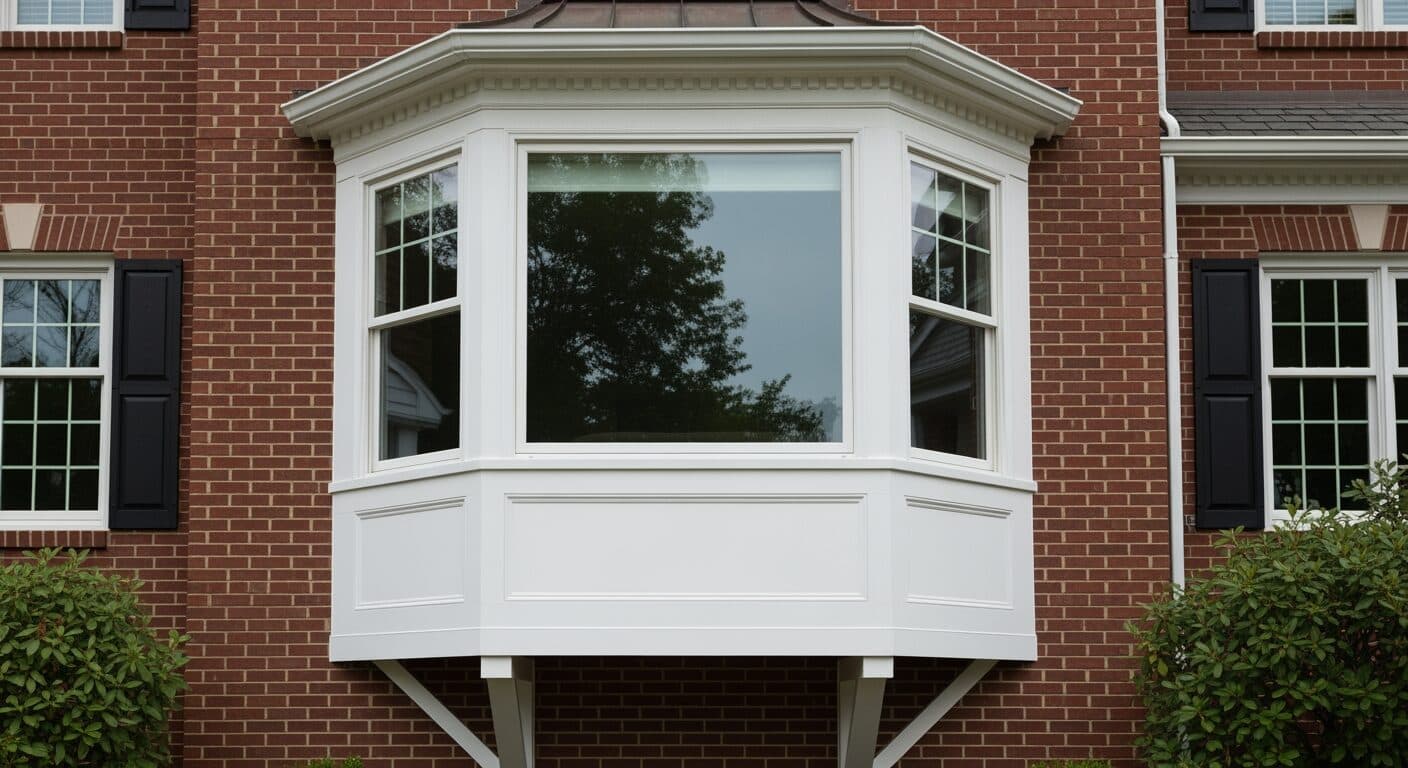
If you've gotten a bay window quote and the number knocked the wind out of you, that's because a bay isn't really one window. It's three windows plus a head board, a seat board, exterior cladding for the projection, a roof tie-in, and (usually) support brackets or cable suspension. Of all the units in a typical project, the bay is the one homeowners push back on hardest, almost always for the right reason: nobody walked them through what they were actually paying for. This page does that.
What is a bay window?
A bay window is a three-panel unit that projects outward from the wall plane, with a fixed center sash flanked by two operating sashes (double-hung or casement) typically angled at 30 or 45 degrees off the center plane. The 30-degree configuration projects less and reads narrower; the 45-degree projects further and reads more dramatic. The center panel is almost always a picture window, since it doesn't need to open because the flankers handle airflow.
The "bay" name describes the architectural shape: the wall bays out into the yard. From inside, you get a small alcove with a seat-board ledge along the bottom and a head board across the top; in the bay units I quoted at Renewal by Andersen, that alcove usually ran 12 to 24 inches deep. That ledge is where the bay earns its reputation in kitchens (breakfast nook cushion seat) and living rooms (plant shelf, display surface, reading bench).
A bay is structurally different from a bow window. A bow is four to six panels in a continuous curved arc; a bay is three panels at hard angles. The compare on that decision lives at /windows/bow.
When a bay is the right call
Bays are the right call for three situations: replacing an existing bay where the structure is already there, upgrading a flat front-facing window on a colonial or traditional facade where the projection adds curb appeal, and converting a flat kitchen window into a breakfast nook bumpout with a built-in seat.
The replace-an-existing-bay case is the most common and the most straightforward. The header is already reinforced, the brackets or cables are already in place, the roof tie-in already exists. You're swapping the unit, not building the structure. This is the lowest-cost bay scenario by a wide margin.
The colonial-facade upgrade is the second pattern. MD center-hall colonials in Bethesda, Chevy Chase, Potomac, and Silver Spring frequently have a flat picture window or pair of double-hungs on the front living room wall. Converting that opening to a bay gives the facade a feature and the living room a window seat. The aesthetic payoff is real, and so is the structural cost.
The kitchen bumpout is the third pattern. A flat kitchen window over a dinette becomes a bay with a deep seat-board that often gets a custom cushion or a small countertop extension. Common across the region in 1970s to 90s colonials and ranches that originally had a single small flat window in the kitchen.
When a bay is the wrong call
Bays are the wrong call when the existing opening is flat and the budget doesn't account for the structural work, when the projection would extend into a setback or easement, or when the roof above the proposed bay can't accommodate a clean tie-in.
The budget mismatch is the most common. A flat-to-bay conversion isn't a window replacement. It's a small bumpout addition. You're cutting a larger rough opening, reinforcing the header to span it, adding either exterior knee braces or interior cable suspension to carry the projection's load, building or extending a roof structure above the bay, and cladding the projection's exterior sides and underside. In the flat-to-bay conversions I priced during my Renewal by Andersen years, the window itself was often less than half the total project cost.
The setback issue is the second. The projection typically sticks out 12 to 24 inches from the wall. If your house already sits close to the property line or a required setback, the bay's projection can push you into a variance request. This is more common in DC and inner-arlington/Alexandria lots than out in Potomac or Vienna, but it's worth checking before specifying.
The roof tie-in is the third. A bay needs its own small roof, a sloped cap that sheds water away from the wall. On a single-story home or under a wide eave overhang, that's straightforward. On a two-story home where the bay sits under the second-floor exterior wall, the tie-in gets more involved and the flashing detail becomes load-bearing for the whole project's water management.
What bay window replacement costs
A bay sits at the top of the residential window price ladder because you're buying three windows, a head/seat-board package, structural support, exterior cladding, and (often) roofing work. Quote ranges below assume mid-tier vinyl unless otherwise noted.
| Scenario | Per-bay installed | What's included | What's not |
|---|---|---|---|
| Bay-for-bay swap | [data pending: bay-for-bay swap installed range, mid-tier vinyl] | Unit, head/seat-board, insulation, exterior trim | Roof reframe, structural work |
| Flat-to-bay conversion (single story) | [data pending: flat-to-bay conversion installed range, single story] | Above plus header reinforcement, brackets or cables, small roof tie-in | Interior trim/drywall finish |
| Flat-to-bay conversion (two story) | [data pending: flat-to-bay conversion installed range, two story] | Above plus more involved roof and flashing detail | Interior trim/drywall finish |
| Premium tier (Renewal by Andersen, Marvin Signature) | [data pending: premium bay installed range] | Full structural plus higher-tier unit and warranty | Interior finish |
A deeper itemized breakdown of what drives a bay quote lives on the master window replacement cost pillar.
Get an honest price, no salesperson
Tell us your address and window and get itemized pricing — no in-home pitch, no surprises.
The spec sheet that actually matters
Bays compound four spec decisions: the center panel glass, the flanker operating style, the projection angle, and the seat-board / head-board material. Get any one wrong and the whole unit reads off.
- Center panel glass. This is the biggest piece of glass on the unit, typically [data pending: typical bay center panel size range]. Spec it like a picture window: double-pane Low-E argon as the baseline, triple-pane upgrade worth considering on west- and south-facing bays where afternoon sun loads the room. The center's U-factor will be the lowest number on the unit.
- Flanker operating style. Double-hung flankers look traditional and right on colonials and historic facades. Casement flankers seal tighter, ventilate more aggressively, and read more contemporary. For DC row houses and MD colonials, double-hung. For VA traditional kitchens where airflow drives the decision, casement.
- Projection angle. 30 degrees is the lower-profile choice: less projection, less interior seat depth, and a more subtle exterior. 45 degrees projects further, gives a deeper interior seat, and reads as a more dramatic facade feature. The wider angle adds [data pending: 45 vs 30 degree bay price delta percentage] to the structural work because the brackets carry more cantilevered load.
- Seat-board and head-board. Standard is a hardwood-veneered MDF or particle-core board with a laminate or stain-grade veneer top. Upgrade options include solid hardwood, granite or quartz tops (common in kitchen bay applications where the seat becomes a countertop extension), and built-in cushion seat upholstery. Underside insulation matters, because an under-insulated bay seat is the coldest spot in a Zone 4 living room in February.
[IMAGE: Cross-section diagram showing a bay window's structural anatomy: header above, knee brace below the projection, roof cap, seat-board with insulation, and the 45-degree side panel. Alt: "Bay window cross-section showing header, knee brace, roof cap, seat-board insulation, and 45-degree angled flanker."]
Bay vs. bow vs. flat: picking the right shape
If the opening could be any of three shapes, the call usually comes down to facade vocabulary and budget.
- Bay vs. bow. Bay is three panels at hard angles; bow is four to six panels in a continuous curved arc. Bow reads softer and more Victorian; bay reads more colonial and more contemporary depending on the angle. Bows generally cost more (more glass, more frame, more complex curve) and are most at home on Queen Anne and Victorian facades in the older DC neighborhoods. Bays fit MD colonials and VA traditional better.
- Bay vs. flat (picture or picture-plus-flankers). A flat configuration with a picture center flanked by double-hung or casement units gives you most of the visual benefit of a bay for a fraction of the cost: no structural work, no roof tie-in, no exterior cladding. If the bay's seat-board isn't load-bearing on the decision (no breakfast nook, no reading bench), the flat configuration is usually the better value.
- Bay vs. garden window. A garden window is a small bay (typically 36 to 48 inches wide) with a glass top instead of a solid roof, designed for kitchen herb gardens. It projects less and costs less than a true bay but doesn't seat anyone. If you wanted the projection for plants more than for people, garden wins on cost.
The full guide to picking type by room and home style lives on the windows hub. For what installation actually looks like and how OneStep prices it, start at window replacement.
Installation: what people forget to budget for
On the project timelines I quoted at Renewal by Andersen, a bay install was two days at minimum on a like-for-like swap and four to six days on a flat-to-bay conversion. The hidden line items that show up after the homeowner signs:
- Interior finish work. The new head-board and seat-board need to integrate with the existing wall: drywall patch, paint touch-up, baseboard return at the seat. Budget [data pending: interior finish cost range per bay] beyond the window install.
- Exterior cladding and trim. The bay's projection has three exterior sides (two angled and one flat front below the windows) plus the underside. Vinyl, aluminum, or matching siding wrap the projection, with brick-veneer detail on the underside in some MD and VA configurations. Match this to the existing facade or the bay will read as a bolt-on.
- Roof cap and flashing. Asphalt-shingle or copper-cap finish on the bay roof, with step flashing where it ties into the main wall. This is the single most common leak point on a bay install, so pressure-test the installer on how they detail the head flashing before you commit.
- Insulation under the seat. The cavity below the seat-board needs spray foam or batt insulation. An under-insulated bay seat is the coldest spot in the room in a Bethesda or Chevy Chase January. Measured seat-surface temperature differential for an uninsulated bay seat in this climate: [data pending: measured seat-surface temperature differential, uninsulated bay seat, Zone 4 January].
- Cable suspension vs. exterior knee braces. Smaller bays (under [data pending: bay size threshold for cable vs brace support] wide) can suspend from above with steel cables anchored in the framing, hidden, with no exterior visual. Larger bays need exterior knee braces, which become a visible facade element you have to like.
See it on your own house first
Preview a clean replacement on a photo of your actual window and get itemized pricing before you decide.
How OneStep quotes a bay window replacement
OneStep's 3D configurator handles bays by letting you pick the projection angle, the flanker operating style, the seat-board material, and the glass package, then shows you the price impact of each decision in real time. For a flat-to-bay conversion, the configurator flags the structural work as a separate line item rather than burying it in the unit price.
The phone-video measurement captures the existing opening dimensions and (for replacements) the existing projection geometry. For a flat-to-bay conversion, we follow up with a quick virtual walkthrough to confirm the wall section, header span, and what's behind the wall (electrical, HVAC, plumbing that might need rerouting). No rep visit, but for bays specifically the structural complexity usually means a short scheduled call before the final quote locks.
If you're not sure whether a bay, bow, or flat picture-plus-flankers configuration fits your opening, ask Zig. The window consultant has the full configuration catalog and can flag which scenarios usually save money on the structural work and which ones absolutely will not.
Frequently asked questions
How much does a bay window cost installed?
A bay-for-bay swap, where the structural support is already in place, typically runs in the lower end of OneStep's installed range. A flat-to-bay conversion runs significantly higher because you're cutting a larger opening and adding header reinforcement, brackets or cables, a roof tie-in, and exterior cladding, so you're paying for a small structural bumpout, not just a window unit.
Can a bay window be installed in a flat opening?
Yes, but it's a structural project, not a window swap. You're enlarging the rough opening, reinforcing the header to span it, adding support (exterior knee braces or interior cable suspension) for the projection load, building or extending a small roof above the bay, and cladding the new exterior projection. In the flat-to-bay conversions OneStep founder Anthony Moorman priced during his Renewal by Andersen years, the window unit was often less than half the total project cost.
What is the difference between a bay and a bow window?
A bay window is three panels (a fixed center plus two operating flankers) set at hard 30 or 45 degree angles. A bow window is four to six panels arranged in a continuous curved arc. Bows read softer and more Victorian, bays read more colonial and more contemporary, and bows generally cost more per opening because of the additional glass area and more complex framing.
How much does a bay window project from the wall?
It depends on the angle and the unit width: a 30-degree bay projects less than a 45-degree bay of the same width, and manufacturers publish the exact projection depth for each unit size on their spec sheets. The wider angle gives a deeper interior seat and a more dramatic exterior but adds to the structural cost because the brackets or cables carry more cantilevered load.
Do bay windows need a roof?
Yes. Every bay has a small sloped roof cap above the projection, usually asphalt shingles matched to the main roof, copper for premium installs, or membrane on contemporary homes. The roof's job is to shed water away from the wall, and the flashing where it ties into the main wall is the single most common leak point on a bay.
Are bay windows energy efficient?
A bay is as energy efficient as its weakest panel and as well as it's insulated underneath. The center fixed panel typically has the lowest U-factor on the unit, the operating flankers come in slightly higher, and the under-seat cavity has to be spray-foamed or batt-insulated or the seat-board becomes the coldest spot in the room in winter. A well-installed bay matches a quality picture window on energy, and a badly installed one is a year-round comfort problem.
Can a bay window seat hold weight?
Yes, a properly supported bay seat-board is engineered to hold an adult's weight. For kitchen bay installations that double as breakfast nook seating, the seat-board substrate and the support framing below should be specified for the intended use. Confirm the rated load capacity with the installer before treating it as permanent seating.
Will my homeowners insurance care that I added a bay window?
A bay added to a flat opening is technically a small addition and may need to be reflected in your dwelling coverage value. The change is usually modest, but if you're going from a flat 36-inch window to a 6-foot bay with a built-in seat, mention it to your carrier at next renewal. DC, MD, and VA carriers handle this consistently, so it's the conversation, not the policy change, that matters.
Next step
The fastest way to know if a bay fits your opening, and what the structural work will actually cost, is to see real numbers on your house. OneStep's 3D configurator pulls up your home, lets you swap the existing window for a bay configuration, and shows you the itemized price including the structural line items most quotes hide.
Start your measurement in 5 minutes
Snap a photo with your phone, get AI measurements and an honest price — no salesperson, no in-home pitch.
Related: the parent commercial pillar is window replacement, the full set of window types we install is at the windows hub, and the closest siblings on the operating-style decision are bow windows, picture windows, double-hung windows, and casement windows. The person behind every page on this site is Anthony Moorman.