Casement windows
Casement windows are hinged on one side and crank outward like a door. They seal tighter than any other operating style (the sash compresses against the frame when closed), which makes them the most energy-efficient and the easiest to operate over a kitchen sink or in a hard-to-reach opening. They cost a little more than a comparable double-hung, and they don't suit every wall.

If you've been told a casement is just a "fancier" window than your existing double-hung, that's the in-home pitch talking. Casements are a different mechanism with real trade-offs, and in the openings I quoted across 2.5 years at Renewal by Andersen they were the right call for maybe one in five, not the default upgrade a rep makes them sound like. They're the wrong call when the homeowner picks them for looks alone. This page is the honest version: where they win, where they don't, what they cost, and the spec to ask for.
What is a casement window?
A casement window is a single sash hinged on the left or right side that swings outward, driven by a hand crank (the operator) at the sill. There's no sliding sash and no movable bottom rail. The whole window pivots open as one piece. Because the sash pulls inward against the frame as you close it, the weatherstripping compresses on all four sides. That compression is why casements are routinely the lowest-U-factor operating window in any given product line.
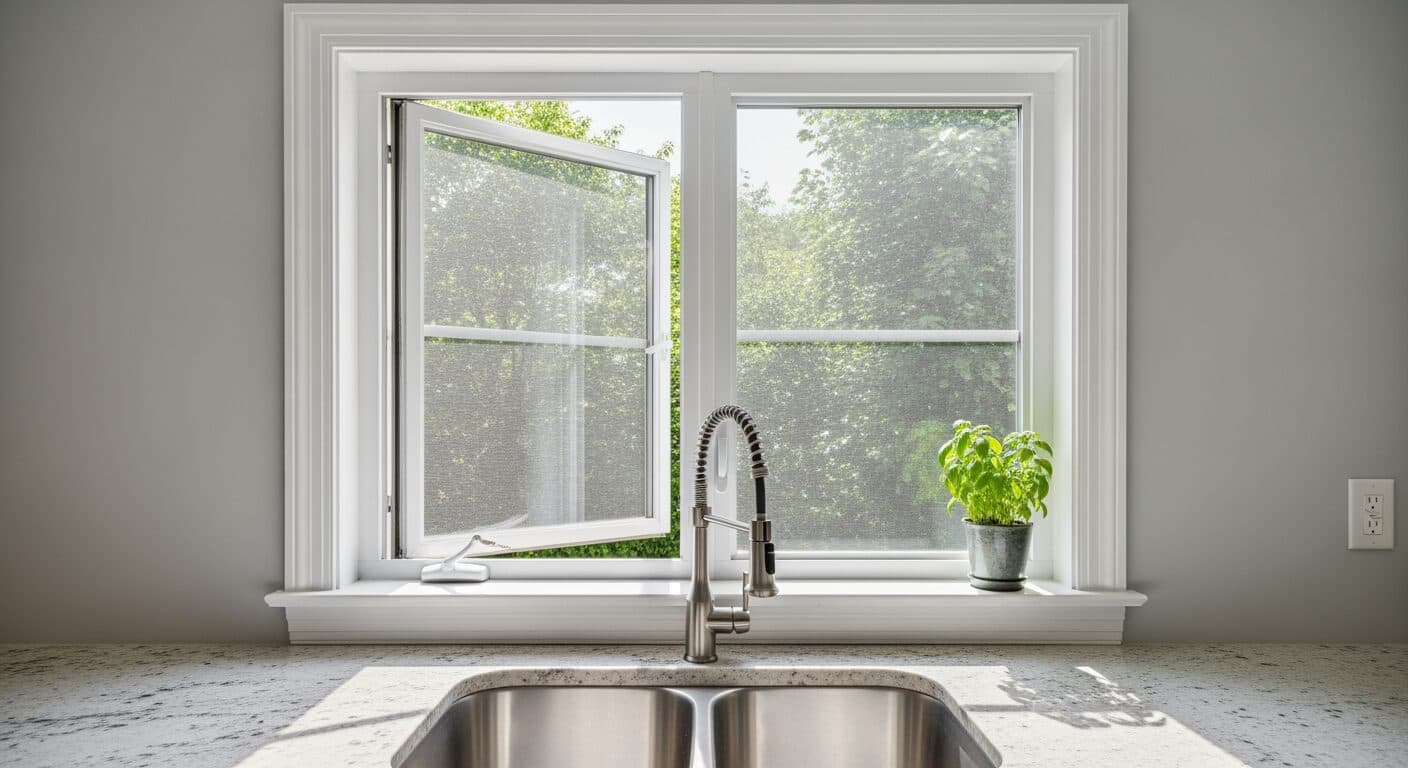
Operationally: turn the crank, the sash swings out, the screen sits on the interior side of the opening. To clean the exterior, you reach through the open sash from inside, which is the entire reason casements work over kitchen sinks. You're not leaning across a counter to push up a heavy bottom rail.
When a casement is the right call
Casements are the right call for three situations: hard-to-reach openings (over a kitchen sink, behind a tub, above a counter run), openings where you want the maximum possible airflow when open, and openings where you want the best operating-window energy performance in the product line.
The kitchen-over-sink case is the most common. A double-hung over a sink forces you to lean across the basin and lift a sash that, on the units I sold at Renewal by Andersen, typically weighed 15 to 25 pounds. A casement crank operates from a comfortable arm position. For older homeowners or anyone with shoulder issues, this is not a minor difference.
The airflow case is underrated. A double-hung opens half its window area at a time, either the top sash or the bottom sash. A casement opens the entire sash, up to 90 degrees, and because the open sash sticks out into the air stream, it scoops air into the room like a small sail. For a bedroom that needs cross-ventilation on a humid August night in DC, a casement moves measurably more air than a same-sized double-hung.
The energy case is the spec-sheet case. Within most major brands' product lines, the casement comes in with a lower U-factor than the double-hung in the same line, usually in the [data pending: casement U-factor range for DC/MD/VA mid-tier vinyl] range versus the double-hung's higher number. SHGC and air infiltration ratings are typically also better. If you're optimizing one opening for energy performance in a Zone 4 mixed-humid climate, casement is the spec-sheet winner.
When a casement is the wrong call
Casements are the wrong call when the window faces a walkway, deck, or anywhere a person could walk into a 90-degree-open sash. They're also the wrong call on a colonial or traditional facade where the sightlines should match the rest of the house, and on any opening too wide for a single sash to handle structurally.
The walkway issue is the one homeowners overlook most. A casement opens outward roughly 18 to 30 inches into the space outside the wall, depending on sash width. If that wall faces a porch, a deck, a sidewalk, or a side-yard path that the mailman uses, you've just installed a face-height obstacle every time the window is open. Code-wise it's fine. Liability-wise, in a side yard a few feet from a property line, it's a conversation.
The aesthetic issue is the second one. A 1920s DC row house wants double-hung sashes. That's the colonial vocabulary the facade was built in. Dropping a casement into that opening reads as wrong even if you can't name why. The pane configuration, the meeting-rail line that isn't there, the visible hinge hardware on one side, all of it tells the eye this is a modern window in a not-modern wall. For interior-facing rooms (a kitchen window over the sink that nobody sees from the street) it doesn't matter. For a front-facing window in a historic district, it usually does.
The structural issue is the third. Single casements top out around [data pending: max casement sash width before mulled] wide before the sash gets too heavy for its hinge and operator. Beyond that, you mull two casements side by side (a "twin" or "triple" casement) or you pick a different window type. Casements get heavy fast. The operator gear takes serious load, and budget-tier operators wear out faster than premium ones.
What casement windows cost
A standard casement runs slightly more than a comparable double-hung in the same line, typically [data pending: casement vs double-hung price premium percentage] more, because the operator hardware and the heavier hinges cost more than a balance system.
| Tier | Brand examples | Per-window installed | When it makes sense |
|---|---|---|---|
| Budget vinyl | [data pending: budget vinyl casement brand examples] | [data pending: budget vinyl casement installed range] | Rental, flip, secondary openings |
| Mid-tier vinyl | [data pending: mid-tier vinyl casement brand examples] | [data pending: mid-tier vinyl casement installed range] | Most owner-occupied DC/MD/VA homes |
| Premium vinyl / composite | ProVia, Andersen 100 Series | [data pending: premium casement installed range] | Long-term hold, energy focus |
| Fiberglass / Fibrex composite | Marvin Essential, Renewal by Andersen | [data pending: fiberglass casement installed range] | Historic districts that won't approve vinyl, 15+ year hold |
| Wood interior / clad | Marvin Signature, Pella Reserve | [data pending: wood/clad casement installed range] | High-end remodels, traditional interiors |
A deeper price breakdown by tier lives at /cost. For the bigger picture on what drives an itemized window quote (install type, glass package, color, brand markup), see the first-time window replacement guide.
Get an honest price, no salesperson
Tell us your address and window and get itemized pricing — no in-home pitch, no surprises.
The casement windows spec sheet that actually matters
Casements live or die on four specs: U-factor, SHGC, air infiltration, and operator quality. The first three are NFRC-printed and comparable across brands. The fourth is what separates a casement that still operates smoothly in year 18 from one that's stuck at year 8.
- U-factor. Lower is better. For DC/MD/VA's Zone 4 climate, target [data pending: recommended casement U-factor for Zone 4] or lower on a mid-tier vinyl. Casements in any given line should beat the double-hung in the same line.
- SHGC (solar heat gain coefficient). South- and west-facing casements want lower SHGC to keep summer heat out. East- and north-facing can take higher SHGC to gain a little winter sun.
- Air infiltration. This is where casements crush double-hungs. The compression seal lets a well-built casement hit [data pending: typical casement air infiltration rating] cfm/sq ft, meaningfully lower than a comparable double-hung. On a windy DC March day, you'll feel the difference.
- Operator hardware. The crank gear, the hinge arms, and the lock cam are the moving parts. Premium brands (ProVia, Marvin, Andersen, Renewal by Andersen) use cast metal operators with multi-point locking. Budget brands use stamped sheet metal: they work fine new and tend to start binding by year 7-10. If you're staying in the home long-term, this spec matters more than the price difference suggests.
[IMAGE: Close-up of a casement crank operator and multi-point lock hardware on a vinyl frame, viewed from the interior. Alt: "Casement window crank operator and multi-point locking hardware shown on the interior of a vinyl frame."]
Casement vs. the other operating styles
If you're picking between casement and another style for the same opening:
- Casement vs. double-hung. Casement seals tighter and operates easier; double-hung looks right on more facades and has fewer moving parts. For kitchens, baths, and energy-priority openings, casement. For front-facing colonial and row-house openings, double-hung.
- Casement vs. awning. Both crank out; awning is hinged at the top and opens outward at the bottom. Awnings ventilate in light rain (the open sash sheds water away from the opening). Casements move more air. For a basement or bathroom that needs ventilation in any weather, awning. For a kitchen, casement.
- Casement vs. sliding. Sliders open wide horizontally with no projection into the exterior space, which is good for walkway-adjacent openings. Casements seal much tighter. For energy, casement. For walkways and contemporary architecture, sliding.
- Casement vs. picture. Picture is fixed: no opening, no air, lowest cost per square foot, best energy because nothing moves. Casement opens. Pair them: a picture window flanked by two casements is one of the most common DC/MD/VA layouts for a wide opening.
The full guide to picking type by room and home style lives at /windows.
Installation considerations specific to casements
Casements are mostly installed insert (pocket): the existing jamb stays, and a new casement unit fits into the opening. The operator and hinge hardware add a small amount of extra clearance the installer needs to account for, but on a sound existing frame it's a normal insert install.
Full-frame installs are required if the existing opening was a different window type (e.g., replacing a stuck double-hung with a casement is technically a different frame configuration, and many installers will require full-frame for a clean job) or if the existing frame is rotted. Going double-hung-to-casement in the same opening is doable as insert in some cases, but ask the installer to inspect the opening before committing.
One detail that surprises first-timers: casement screens sit on the interior side of the window, not the exterior. Pets and small children can push on them more easily than an exterior screen. If you have either, ask about reinforced screens or interior screen restrictors. This is also why some homeowners with cats end up with one or two windows they never open.
[IMAGE: Two casement windows mulled side-by-side ("twin casement") in a vinyl frame, both cranked open, viewed from outside. Alt: "Twin casement window with two side-hinged sashes mulled in a single frame, both cranked open to 90 degrees."]
Frequently asked questions
Are casement windows more energy efficient than double-hung?
Yes, generally. Within most brand product lines the casement has a lower U-factor and a dramatically better air infiltration rating than the double-hung in the same line, because the casement sash compresses against the frame on all four sides when closed. The energy difference is real but modest in dollar terms over a heating season.
How much do casement windows cost?
A standard installed casement in DC, Maryland, and Virginia runs in OneStep's mid-tier vinyl range per opening, with premium tiers like Renewal by Andersen, Marvin, and Pella Reserve running 2 to 3 times that. Casements price 10 to 20 percent above a comparable double-hung in the same line because the operator and hinge hardware cost more than a balance system.
How long do casement windows last?
Frame and glass age on different clocks: the InterNACHI life-expectancy chart puts vinyl and fiberglass window frames at 20 to 40 years and double-pane insulated glass units at 8 to 20 years before seal failure. The operator hardware (the crank gear, hinges, and lock cam) often needs service or replacement within 10 to 20 years, with budget-tier operators failing earlier and premium cast-metal operators on brands like ProVia, Marvin, and Andersen lasting longest.
Can I clean the outside of a casement window from inside?
Yes. With the sash cranked fully open, you can reach through the opening and wipe the exterior glass from inside the room. This is one of the main reasons casements are specified for second-story bedrooms and over kitchen sinks.
Do casement windows work with screens?
Yes, but the screen sits on the interior side of the window, opposite from a double-hung or slider. Pets and small children can push interior screens more easily than exterior screens. Most manufacturers offer reinforced or restrictor-equipped screens for households where this matters.
Are casement windows good for kitchens?
Casements are the most common upgrade for kitchen-over-sink windows. The crank operator means you don't have to lean across a sink to push up a heavy sash, and the full-opening sash moves more air than a double-hung in the same opening. For most DC/MD/VA kitchens, casement is the right call over the sink.
Will a casement window work on a colonial or row house?
Sometimes, but not usually as a front-facade window. Colonial and DC row-house facades are designed around double-hung sightlines: the meeting rail, the divided lites, and the consistent vertical proportions. A casement on a front colonial window typically reads as wrong even if the homeowner can't name why. On side and rear elevations, especially kitchens and baths, casements work fine.
Are casement windows good for security?
Casements have multi-point locking standard on most mid-tier and premium brands. The lock cam pulls the sash tight against the frame at multiple points along the lock stile, which is harder to defeat than a single double-hung sash lock. The trade-off is the exposed crank operator.
Next step
The most useful thing you can do before talking to any installer is to see real numbers for casements in your specific opening. Our 3D configurator pulls up your home, lets you place casements where you actually want them, and gives you an itemized price per opening, with no rep visit.
See it on your own house first
Preview a clean replacement on a photo of your actual window and get itemized pricing before you decide.
If you're not sure whether casement, double-hung, or awning is right for a specific opening, ask Zig. Our window consultant has the full spec catalog and can match the type to your room, climate, and budget.
The parent commercial page for everything we do is window replacement, and the eight window types we install live at the windows hub. The honest cost breakdown is at /cost. The person behind every page on this site is at /about/anthony-moorman.