Picture windows: when fixed glass is the right call
Picture windows are fixed (non-operating) units that prioritize the view, the daylight, and the energy seal over ventilation. They cost less per square foot than any operating window, hit the lowest U-factors in a comparable glass package, and are the right call when the opening exists for the view, not the airflow. In DC/MD/VA, that usually means living room walls, dormer flanks, and the back wall of a row house.

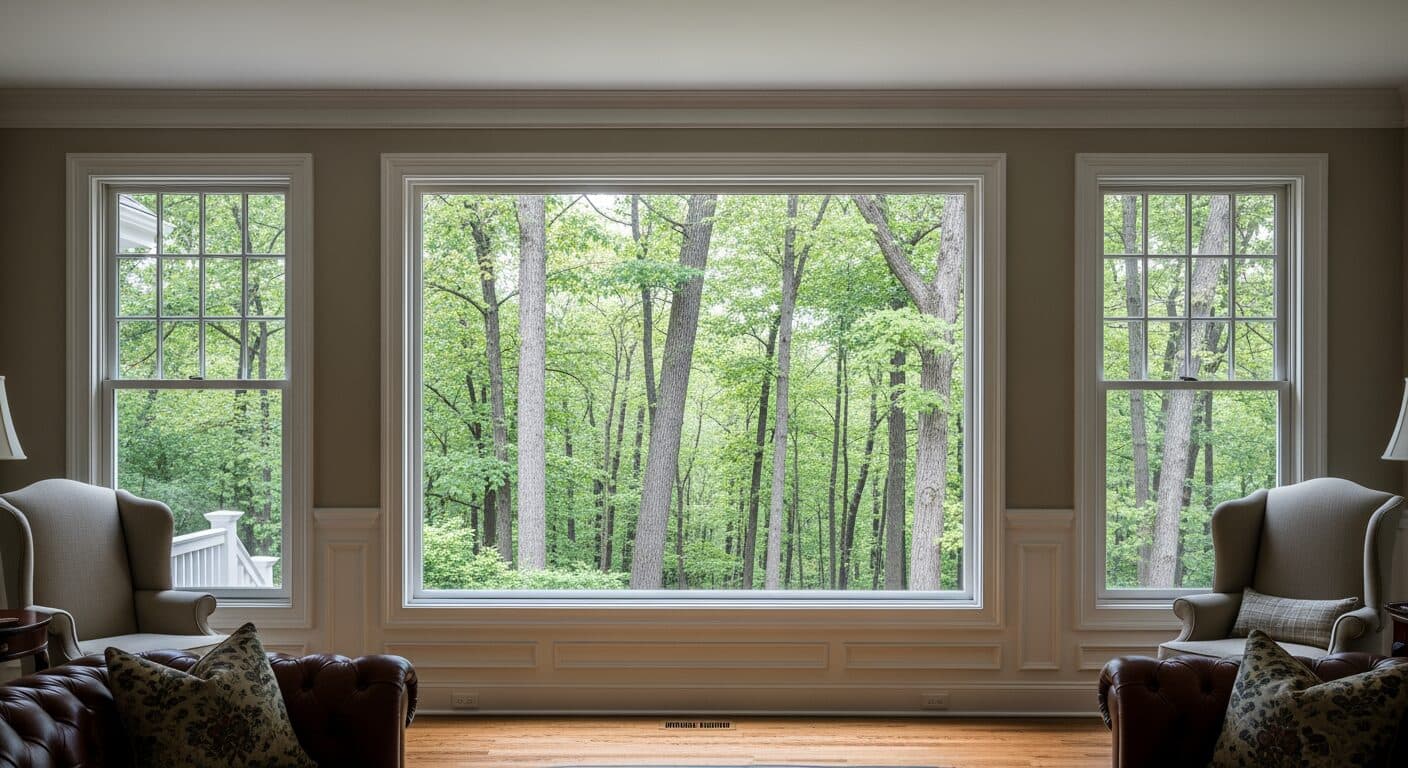
If you've ever looked at a window and thought "I'd take more glass and less frame here," you're describing a picture window. No sash. No lock. No crank. Just the largest sheet of insulated glass the opening will hold, sealed into a frame and left alone. The trade is simple. You lose ventilation, you gain everything else.
Most first-timers I sat across from at Renewal by Andersen ended up with at least one picture window in their final design, often without realizing they wanted it until I walked the room with them. The pattern is consistent: a wall with a real view, an adjacent operating window that already handles the airflow, and an old window in the middle that was working too hard to be a view and a vent.
When picture windows are the right call
Picture windows are the right call when the opening exists for the view and another window in the same room handles ventilation. They are wrong when they're the only window in a room, when egress code requires an operable unit, or when you'll regret losing the breeze.
The three patterns I see most often in DC/MD/VA:
- Center-of-three configurations. A picture window in the middle, double-hung or casement units flanking it. Common on colonial great-room walls in Bethesda, Potomac, and Fairfax. The center unit goes big; the flankers handle airflow and code.
- Dormer flanks and Cape Cod dormers. A picture window where a small bedroom dormer used to have a stuck single-hung that nobody opened anyway. The room gets dramatically more light. Common in VA Cape Cods in Arlington and Falls Church.
- Row house back walls. A DC row house with a back wall facing a yard, alley, or garden, historically split into two or three small operating windows. A single large picture (or picture-over-transom) reads contemporary and feels twice as bright. HPO approval applies; see the row-house note below.
A picture window is the wrong call if the opening is a bedroom's only window (egress codes in DC, MD, and VA require an operable window with specific minimum dimensions in sleeping rooms), if the room has no other source of fresh air, or if the window is over a kitchen counter where you currently open it for steam. A casement usually wins kitchen ventilation. An awning usually wins basement and bath ventilation. Picture is for openings that don't need to open.
How picture windows compare to operating windows
Picture windows beat every operating window on three measurable specs: energy efficiency, glass-to-frame ratio, and cost per square foot of glass. They lose on ventilation, cleaning, and egress.
| Spec | Picture | Double-hung | Casement | Awning |
|---|---|---|---|---|
| Glass area (relative) | Highest | Lower (sash rails) | Lower (sash frame) | Lower (sash frame) |
| Typical U-factor range | [data pending: picture window U-factor range] | [data pending: double-hung U-factor range] | [data pending: casement U-factor range] | [data pending: awning U-factor range] |
| Air infiltration | Lowest (no operating seal) | Higher | Low (compression seal) | Low (compression seal) |
| Ventilation | None | Top/bottom | Full opening | Top-hinged |
| Cleaning | Outside requires access | Tilt-in | Crank fully open | Awkward |
| Cost per sq ft of glass | Lowest | Mid | Higher | Higher |
The energy story is the underrated one. Operating windows have a moving seal that, no matter how well-engineered, leaks more air than a fixed gasket. A picture window's only seal is the one between the glass unit and the frame, with no compression strip, no balance, and no weatherstripping that wears out. In Zone 4 mixed-humid climate (all of DC/MD/VA), that translates to fewer drafts in winter and less infiltration of humid summer air. For a homeowner whose driver is comfort or energy bills, this matters more than the spec sheet implies.
The cost story is more practical. Glass is cheaper than mechanism. A picture window in the same line, same size, same glass package as a double-hung typically runs [data pending: picture vs double-hung price delta percentage] less. Pair that with the fact that picture windows scale up to sizes operating windows can't (single pictures are routinely built at sizes no double-hung line offers), and the per-square-foot-of-view math favors picture by a wide margin.
Glass packages, frame materials, and what to spec
Spec the glass first. The frame is mostly aesthetic; the glass is where the energy and comfort outcomes live.
Glass package: the variable that actually matters
A picture window is essentially a frame around a glass unit. That unit is where you can meaningfully upgrade.
- Double-pane Low-E with argon. The modern baseline. Right for most DC/MD/VA homes.
- Triple-pane Low-E with argon or krypton. A meaningful U-factor improvement (typically [data pending: triple-pane U-factor improvement over double]). Worth considering on west-facing pictures with afternoon sun, or homeowners holding the home 15+ years. Adds [data pending: triple-pane glass upcharge percentage] per unit.
- Tempered glass. Required by code in the two situations big picture windows usually hit: a pane larger than 9 sq ft with its bottom edge within 18" of the floor (2021 IRC R308.4.3, which adds further proximity conditions), and any glazing within a 24-inch arc of a door edge (2021 IRC R308.4.2). Most picture window quotes include this where required, but verify.
- Laminated glass. An upgrade for sound (street-facing DC row houses) or security (ground floor). Roughly [data pending: laminated glass upcharge per sq ft] per square foot.
Frame material
- Vinyl. Most common, best value, available in standard color range. The narrow-frame picture profiles look modern in white; dark vinyl on a large south-facing picture can warp over time in DC summer sun, which matters more on big units than small ones.
- Fiberglass / Fibrex composite. Paintable, stable in dark colors, narrower sightlines (more glass per inch of opening). Adds roughly 30 to 50% over vinyl. Worth it on featured picture windows where the frame is part of the look.
- Wood with exterior cladding. Best aesthetics, traditional homes, requires interior maintenance. Roughly 2x vinyl. Common in Chevy Chase historic homes and Old Town Alexandria where the interior trim matters as much as the exterior.
What about Energy Star and NFRC ratings
ENERGY STAR North-Central certification depends on the specific line and glass package; the certification status for the picture window lines in OneStep's catalog: [data pending: ENERGY STAR North-Central certification status per OneStep picture window line (default glass package)]. NFRC labels list U-factor, SHGC, VT, and air infiltration. For picture windows, expect U-factors at the low end of the unit's published range, because fixed glass is where these numbers are best.
[data pending: OneStep picture window specs: brand, frame options, glass options, U-factor, SHGC, VT, air infiltration]Sizing, configurations, and what fits a row house
Picture windows scale up further than operating windows but get expensive fast above ~36 sq ft per unit. Standard configurations are single picture, picture flanked by double-hungs or casements, or a transom (small fixed unit) above a primary picture or operating window.
For a DC row house considering a single large picture on the back wall, three things to flag:
- Tempered glass requirements trigger on large panes set low in the wall (2021 IRC R308.4.3: over 9 sq ft with the bottom edge within 18" of the floor, among other proximity conditions) and on any glazing within a 24-inch arc of a door edge (2021 IRC R308.4.2). Most row house back-wall picture windows hit one of these. Budget the tempered upcharge in.
- Historic Preservation Office approval in DC's historic districts (Georgetown, Capitol Hill, parts of Logan, Dupont, LeDroit Park) treats picture windows differently from operating units. A single large picture replacing the original two-over-two double-hungs typically won't get approved on a front facade; on a back facade, it usually will. Confirm with HPO before specifying.
- Structural headers. If you're replacing two or three small windows with one large picture, the rough opening changes. That's a full-frame install with a header recalculation, not an insert. Budget [data pending: header rework cost per opening] for the framing work on top of the window cost.
Standard configurations we install:
- Single picture, fixed. The simplest unit, the lowest per-square-foot cost.
- Picture flanked by double-hung or casement. The most common great-room and living-room pattern in MD colonials and VA Cape Cods.
- Picture with transom above. A small fixed unit above the main picture, often used to bring the top of the window up to a 9- or 10-foot ceiling without an oversized primary unit.
- Picture over operating. Picture on top, double-hung or casement below. Less common but useful in bedrooms where egress code requires an operating unit but you want the upper glass area.
A deeper breakdown of how to pick a window type by room and home style lives at /windows. For the commercial pillar (what installation actually looks like and how we price), start at /window-replacement.
See it on your own house first
Preview a clean replacement on a photo of your actual window and get itemized pricing before you decide.
How OneStep quotes a picture window
OneStep's 3D configurator handles picture windows the same way it handles operating windows: pick the opening, pick the size, pick the glass package, see the price. No rep coming to your house, no on-the-spot pressure.
For a typical 48"×60" picture window in mid-tier vinyl with double-pane Low-E argon, OneStep's installed range is [data pending: OneStep picture window installed range, 48x60 mid-tier vinyl]. Upsize to 72"×60" and the price scales roughly linearly until you hit oversize thresholds (typically 40+ sq ft of glass), where shipping and handling add a flat upcharge of [data pending: oversize shipping upcharge threshold and amount].
The measurement is phone-video. You walk your phone around the opening, our system extracts dimensions, and the quote that comes back is buildable without a tape measure or a site visit. If you're not sure whether your opening is a picture or a picture-with-flankers configuration, ask Zig. Zig has seen enough configurations across DC/MD/VA stock to flag the patterns that work.
Get an honest price, no salesperson
Tell us your address and window and get itemized pricing — no in-home pitch, no surprises.
Frequently asked questions
Are picture windows more energy efficient than operating windows?
Yes. Picture windows have no operating seal, no balance, and no weatherstripping that wears out, so they lose less heated or cooled air to infiltration than any operating window. In the same line and glass package, picture windows hit the lowest U-factor and air infiltration ratings the manufacturer publishes.
Can a picture window count as the egress window in a bedroom?
No. Egress codes in DC, Maryland, and Virginia require an operable window in sleeping rooms with specific minimum clear opening dimensions. A picture window is fixed, so it cannot serve as the egress unit. Most bedrooms with a picture window pair it with a casement or double-hung that meets the egress dimension.
How much does a picture window cost compared to a double-hung?
A picture window in the same line, size, and glass package typically costs less than a double-hung. The savings come from no operating mechanism, no balance system, and no weatherstripping. Picture windows also scale to larger sizes than double-hungs, which makes the per-square-foot-of-view math even more favorable.
Do picture windows need tempered glass?
Sometimes. The 2021 IRC requires safety glazing (tempered or laminated) on large panes set low in the wall, per section R308.4.3, which applies to panes over 9 square feet with a bottom edge within 18 inches of the floor among other proximity conditions, and on any glazing within a 24-inch arc of a door edge, per section R308.4.2. Many large picture windows hit at least one of these conditions. The tempered upcharge is modest and usually included in the base quote on units that require it.
Can I replace two small windows with one large picture window?
Usually yes, but it requires a full-frame install and a header recalculation, not a simple insert. The rough opening changes, the framing above the window needs to be sized for the new span, and in historic districts facade-side changes likely need HPO approval. Budget for the framing work on top of the window cost.
How do you clean the outside of a picture window?
From outside. There is no tilt-in mechanism. On a ground-floor picture window this is a hose and a squeegee; on a second-floor picture window it is an extension pole, a window-cleaning service, or scheduling it with the install crew's first-year touch-up visit. This is the underrated downside of picture windows and worth flagging before you commit.
Are picture windows allowed in DC historic districts?
It depends on the facade. On the front street-facing facade of a property in a DC historic district, picture windows replacing original operating units usually will not be approved, and HPO will require a matching operating configuration. On rear and side facades, picture windows are generally approved if they are proportional to the opening. Confirm with HPO before specifying.
Next step
The fastest way to know if a picture window fits your opening is to see it on your house. OneStep's 3D configurator pulls up your home's elevations, lets you swap operating units for picture units, and shows you the price impact in real time. No phone call. No rep visit. No pressure to decide tonight.
Start your measurement in 5 minutes
Snap a photo with your phone, get AI measurements and an honest price — no salesperson, no in-home pitch.
Related: the parent commercial page is /window-replacement, the full set of window types we install is at /windows, and the sibling product pages for the operating units that most often flank a picture are /windows/double-hung, /windows/casement, /windows/awning, and /windows/sliding.