Sliding windows
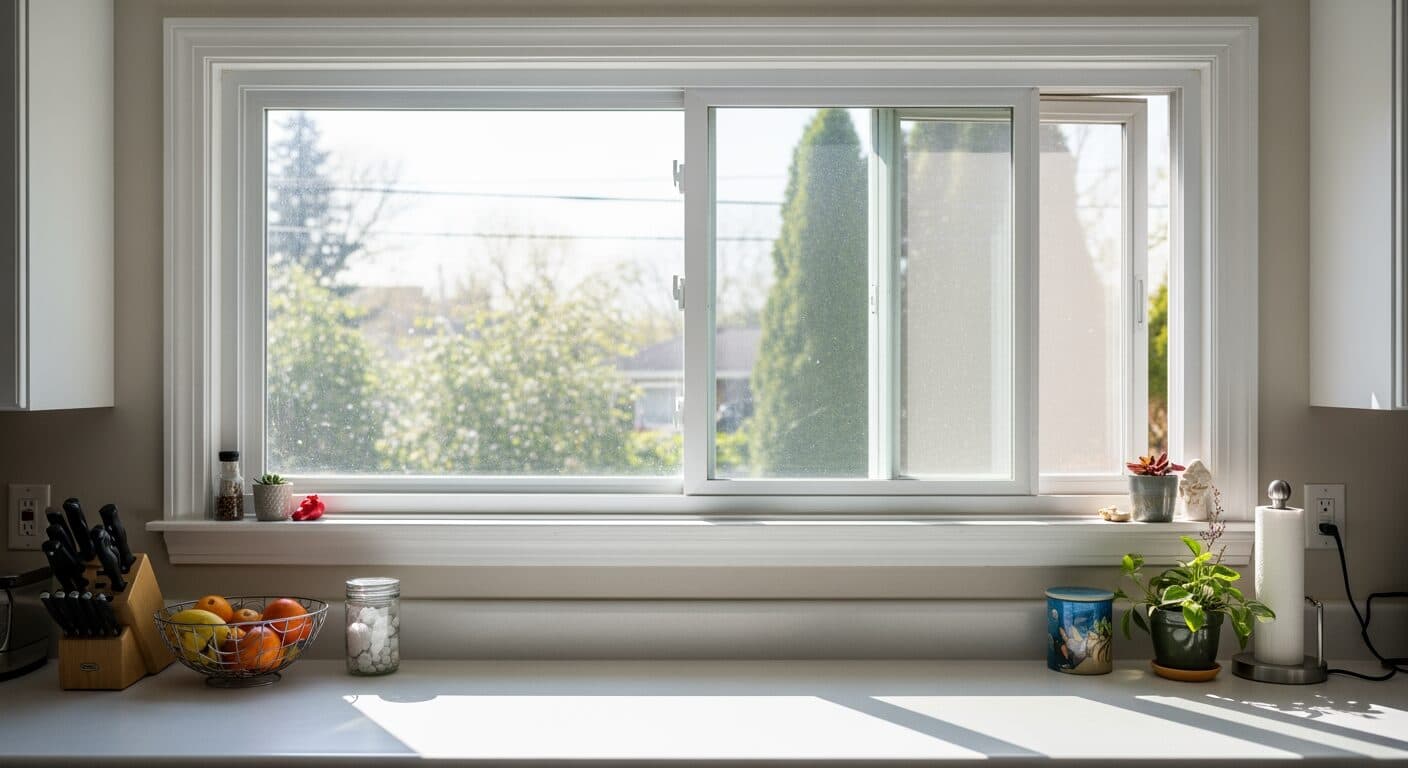
Sliding windows have one or two sashes that glide horizontally along a track inside a fixed frame. They suit wide openings where a tall double-hung looks wrong, fit naturally in mid-century ranches and ramblers, and project nothing into the yard or walkway when open. They cost less than casements, ventilate well, and seal a little less tightly than a compression-sealed window, a real trade you should make with your eyes open.

If your house is a 1960s VA rambler, a Reston-area planned-community split, or a DC condo with a balcony opening, there's a strong chance the original windows were sliders, and an even stronger chance someone has tried to talk you into replacing them with double-hungs. Slow down. The original spec was usually right for the wall. Having sold Renewal by Andersen, I can tell you sliders were the right call on more openings than that brand's product mix made convenient to admit.
What is a sliding window?
A sliding window (also called a slider, or technically a "horizontal slider") has one or more sashes that move side-to-side along a track within a fixed frame. The most common configuration is a two-lite slider: two sashes side-by-side, one fixed and one operable, or both operable on the same track. Three-lite sliders (XOX) put a fixed picture sash in the middle with two operable sashes flanking it, a great fit for wide rear-wall openings.
Operationally: unlock the latch, slide the sash sideways, the screen sits on the exterior side of the track that's now open. There's no lifting, no cranking, no projection into the exterior space. The window is wider than it is tall by design. The geometry favors horizontal openings, which is exactly why mid-century homes used them and why a tall vertical double-hung looks wrong in those same openings.
When sliding windows are the right call
Sliders are the right call for three situations: wide horizontal openings where a double-hung's vertical proportions would look wrong, walkway- and deck-adjacent openings where a casement's outward projection creates a hazard, and mid-century or contemporary architecture where the horizontal sightline matches the rest of the house.
The mid-century case is the most common in our service area. VA ramblers in Falls Church, Vienna, and Springfield were built around horizontal lines: long, low rooflines, ribbon windows, picture-plus-slider compositions on the front elevations. Drop a tall double-hung into one of those openings and the facade reads broken. The original slider was the right vocabulary; a modern slider keeps that vocabulary while adding Low-E glass, argon fill, and a real weatherstrip.
The walkway case is the second. A casement opens outward into the space outside the wall, often by a couple of feet depending on sash width. If that wall faces a deck, a porch, a side-yard path, or a DC condo balcony, you've added a face-height obstacle every time the window is open. A slider opens entirely within the frame, so nothing projects and there's nothing to walk into. For ground-floor openings near walkways, this is the deciding factor more often than people realize.
The contemporary case is the third. Newer Reston-area planned-community homes, modern infill in Arlington, and contemporary condo construction across the District favor horizontal proportions. A slider is the operating window that fits that look. For those homes, picking double-hung over slider isn't being "more traditional." It's just being wrong about the architecture.
When a sliding window is the wrong call
Sliders are the wrong call when the opening is on a colonial or traditional facade where the rest of the wall is double-hung, when you need the tightest possible energy seal in that opening, or when the opening is a sleeping-room egress with limited width.
The aesthetic issue is the same one casements have, in reverse. A 1920s DC row house, a Bethesda colonial, or an Old Town Alexandria historic home wants vertical double-hung sashes, because that's the architectural vocabulary of the facade. A horizontal slider on the front of one of those houses reads as wrong even if you can't name why. Side and rear elevations have more latitude; front elevations on traditional homes usually don't.
The energy issue is real but usually overstated. A slider's sash slides past a weatherstrip rather than compressing against one. That means slider air infiltration ratings sit between a casement (best) and an older single-hung (worst). In OneStep's catalog the mid-tier vinyl sliders test at [data pending: typical slider air infiltration rating range cfm/sq ft] cfm/sq ft, better than the windows you're likely replacing, not as good as the casement next door. For most DC/MD/VA homes the energy delta won't show up on a utility bill in any noticeable way. For homeowners optimizing one opening for absolute energy performance, casement still wins.
The egress issue is a code matter, not a preference. A sleeping room needs an operable window meeting minimum clear-opening dimensions (under IRC R310.2.1, typically 5.7 sq ft, with a minimum width of 20" and minimum height of 24"). A two-lite slider only opens half its area at a time. On a narrow opening, that half might not meet the minimum width. Verify the clear-opening dimensions on the manufacturer's spec sheet before specifying a slider as a bedroom's primary window. Three-lite XOX sliders with wider operable sashes solve this; two-lite sliders on narrow openings sometimes can't.
What sliding windows cost
A standard slider runs slightly less than a comparable double-hung in the same line and meaningfully less than a casement of the same size, because the mechanism is simpler: no balance, no operator gear, just a track and a latch. Per square foot, sliders are usually the second-cheapest operating window after double-hungs.
| Tier | Brand examples | Per-window installed | When it makes sense |
|---|---|---|---|
| Budget vinyl | [data pending: budget vinyl slider brand examples] | [data pending: budget vinyl slider installed range] | Rentals, secondary openings, short-hold |
| Mid-tier vinyl | [data pending: mid-tier vinyl slider brand examples] | [data pending: mid-tier vinyl slider installed range] | Most VA ramblers and Reston planned-community homes |
| Premium vinyl / composite | [data pending: premium slider brand examples] | [data pending: premium slider installed range] | Long-term hold, energy focus, dark exterior colors |
| Fiberglass / Fibrex composite | Marvin Essential, Renewal by Andersen | [data pending: fiberglass slider installed range] | Wide openings (5+ ft) where vinyl sash sag is a long-term concern |
| Wood interior / clad | Marvin Signature, Pella Reserve | [data pending: wood/clad slider installed range] | Higher-end remodels, contemporary interiors with wood detailing |
A deeper breakdown by tier lives at /cost. For the bigger picture on what drives an itemized quote (install type, glass package, color, brand markup), start at the window replacement commercial pillar.
Get an honest price, no salesperson
Tell us your address and window and get itemized pricing — no in-home pitch, no surprises.
The spec sheet that actually matters for sliders
Sliders live or die on four specs: U-factor, air infiltration, track quality, and rolling hardware. The first two are NFRC-printed and comparable across brands. The last two are what separate a slider that still glides smoothly at year 15 from one that's binding at year 7.
- U-factor. Lower is better. For DC/MD/VA's Zone 4 climate, target [data pending: recommended slider U-factor for Zone 4] or lower on a mid-tier vinyl. Sliders within a product line typically run a hair above the same line's casement, on par with the double-hung.
- Air infiltration. This is where slider quality varies most. Premium sliders use multi-fin weatherstripping along the meeting stile and the head/sill; budget sliders use a single bulb seal. The difference shows up on windy days. A properly built slider in Zone 4 should test at [data pending: target slider air infiltration cfm/sq ft] cfm/sq ft or better.
- Track and rollers. The sash rides on rollers (steel or nylon) inside a track (extruded vinyl, aluminum, or composite). Premium rollers are tandem stainless steel with a load rating; budget rollers are single nylon wheels that flat-spot over time. On wide or heavy sashes (anything over [data pending: slider sash weight threshold] lbs), pay for the upgraded rollers. The price delta is small; the operation difference at year 10 is large.
- Drain holes (weep system). The bottom track is a horizontal channel that catches rain blown past the screen. It has to drain to the exterior, usually through small weep holes with covers. A blocked weep system pools water on the sash, which works its way under the glazing and rots the frame. Premium sliders use protected weep covers that don't clog; budget sliders use bare holes that fill with debris. This is a long-term durability spec that gets ignored at the quote.
[IMAGE: Close-up of a slider track showing tandem rollers, a multi-fin weatherstrip, and weep hole covers along the bottom rail. Alt: "Sliding window track close-up showing tandem rollers, multi-fin weatherstripping, and weep hole drainage covers."]
Sliding vs. the other operating styles
If you're picking between a slider and another style for the same opening:
- Slider vs. double-hung. Both are common, both are versatile. Sliders fit horizontal openings; double-hungs fit vertical openings. Double-hungs tilt in for cleaning; sliders lift out. For ranches and mid-century homes, slider. For colonials and traditional facades, double-hung.
- Slider vs. casement. Casement seals tighter and is the energy spec-sheet winner; slider opens within the frame with no projection. For walkway-adjacent openings or contemporary architecture, slider. For kitchens, baths, and energy-priority openings on suitable facades, casement.
- Slider vs. awning. Awning hinges at the top and opens outward at the bottom, good for ventilation in light rain and good above other windows. Sliders give a much larger clear opening for airflow when fully open. For basements and small high openings, awning. For wide horizontal openings, slider.
- Slider vs. picture. Picture is fixed: best energy, no ventilation, lowest cost per square foot of glass. A common DC/MD/VA composition is a picture in the middle flanked by two sliders, or a three-lite XOX slider that puts the fixed sash in the center.
- Slider vs. patio doors. A wide slider and a sliding patio door look similar from outside but the door has a sill at floor level and meets door code, not window code. If the opening is at floor level and you want to walk through it, that's a patio door, not a slider.
The full guide to picking a type by room and home style lives at the windows hub.
Installation considerations specific to sliders
Most slider replacements are insert (pocket) installs on a sound existing frame, with the new slider sized to drop into the original opening. The horizontal proportions of a slider opening generally don't change between vinyl, fiberglass, and composite (the frames are similar in width), so insert installs convert cleanly within material types.
Full-frame installs become necessary in three situations: the original opening is rotted (a more common problem in 1960s and 1970s wood-frame sliders that weren't well-maintained), the homeowner is changing the operating style (replacing a double-hung with a slider, or vice versa, almost always requires full-frame), or the opening is being resized to fit a three-lite XOX slider where a smaller two-lite previously sat.
[IMAGE: A wide three-lite XOX slider in a Reston rambler's family room, with the two flanking sashes shown partially open. Alt: "Three-lite XOX sliding window in a Reston family room, with the fixed center sash and two operable flanking sashes shown."]
See it on your own house first
Preview a clean replacement on a photo of your actual window and get itemized pricing before you decide.
How OneStep quotes a sliding window
OneStep's 3D configurator handles sliders the same way it handles every other window type: pick the opening, pick the size, pick the configuration (two-lite or three-lite), pick the glass package, see the price. No rep coming to your house, no pressure to decide on the spot.
For a typical 60"×36" two-lite slider in mid-tier vinyl with double-pane Low-E argon, OneStep's installed range is [data pending: OneStep slider installed range, 60x36 two-lite mid-tier vinyl]. Three-lite XOX sliders run roughly [data pending: XOX slider upcharge over two-lite] more for the same overall opening. The measurement is phone-video. You walk your phone around the opening, our system extracts dimensions, and the quote comes back buildable without a tape measure or a site visit.
If you're not sure whether your opening is a two-lite slider, a three-lite XOX, or a picture-plus-sliders configuration, ask Zig. Our window consultant has seen enough mid-century and contemporary stock across DC/MD/VA to flag the patterns that work for your wall.
Frequently asked questions
Are sliding windows energy efficient?
Modern sliding windows with Low-E argon glass can meet ENERGY STAR North-Central ratings, the climate zone covering the DC/MD/VA market. They seal a little less tightly than a casement of the same size, because the sash slides past a weatherstrip rather than compressing against one, but dramatically better than the older single-hung or aluminum slider you are likely replacing.
How much do sliding windows cost?
A standard installed two-lite sliding window in DC, Maryland, and Virginia typically runs in OneStep's mid-tier vinyl range per opening, with premium tiers like Marvin and Renewal by Andersen running 2 to 3 times that. Sliders price below a comparable casement in the same line because the mechanism is simpler, with no operator gear and no balance, just a track and a latch.
How long do sliding windows last?
Frame and glass age on different clocks: the InterNACHI life-expectancy chart puts vinyl and fiberglass window frames at 20 to 40 years and double-pane insulated glass units at 8 to 20 years before seal failure. The rolling hardware and weatherstripping typically need attention sooner, often after 10 to 15 years, since rollers can flat-spot and weatherstripping compresses over time. Premium sliders with tandem stainless rollers and protected weep systems last meaningfully longer than budget sliders.
Can a sliding window count as the egress window in a bedroom?
Sometimes. Egress codes in DC, Maryland, and Virginia, which follow IRC R310.2.1, require an operable window in sleeping rooms with specific minimum clear-opening dimensions (typically 5.7 square feet, 20 inches minimum width, 24 inches minimum height). A two-lite slider only opens half its area at a time, so on a narrow opening the operable half may not meet the minimum width. Three-lite XOX sliders with wider operable sashes usually solve this, so verify the clear-opening dimensions on the manufacturer's spec sheet before relying on a slider for egress.
Do sliding windows leak more than casements?
A slider's sash slides past a weatherstrip rather than compressing against one, so slider air infiltration ratings sit between a casement (best in any line) and an older single-hung (worst). The difference is real on the spec sheet but usually small on a utility bill. For one opening optimized for absolute energy performance, casement wins; for most DC/MD/VA openings, a quality slider is well within the comfort range.
Why won't my slider open smoothly anymore?
Almost always a track issue. Debris (pet hair, grit, dust) collects in the bottom track and binds the rollers, or the rollers themselves have flat-spotted from years of stopping in the same position. Vacuum the track first, then check the rollers, since most sliders let you lift the sash out for inspection. If the rollers are damaged, replacement rollers are inexpensive and DIY-friendly on most mid-tier sliders.
What's the difference between a sliding window and a sliding patio door?
A sliding window has a frame that sits in a wall opening above the floor; a sliding patio door has a sill at floor level and meets door code (wider clear opening, lower threshold, different lock and security requirements). They look similar from outside but they are built and installed differently. If you can walk through the opening, that is a patio door, not a slider.
Do sliding windows work on colonial homes?
Usually not on the front facade. Colonial and traditional homes are designed around vertical double-hung sightlines, with meeting rails, divided lites, and consistent vertical proportions. A horizontal slider on a colonial front elevation typically reads as wrong even if the homeowner cannot name why. On side and rear elevations, especially over kitchen counters or in basements, sliders can work fine on an otherwise-colonial house.
Next step
The fastest way to know if a slider fits your opening is to see it on your house. OneStep's 3D configurator pulls up your home's elevations, lets you swap operating units for sliders (two-lite or three-lite), and shows the price impact in real time. No phone call. No rep visit.
Start your measurement in 5 minutes
Snap a photo with your phone, get AI measurements and an honest price — no salesperson, no in-home pitch.
The window-replacement pillar, the windows hub, and the sibling double-hung, casement, picture, and patio-door pages above all cross-link from inside this guide. The person behind every page on this site is Anthony Moorman.