Awning windows
Awning windows hinge at the top and crank open outward from the bottom, which lets you ventilate during light rain without water running into the room. They are the right call for DC/MD/VA basements, bathrooms, and openings above kitchen sinks or other windows, anywhere you want air movement, privacy, and a tight weather seal in a small, hard-to-reach opening.

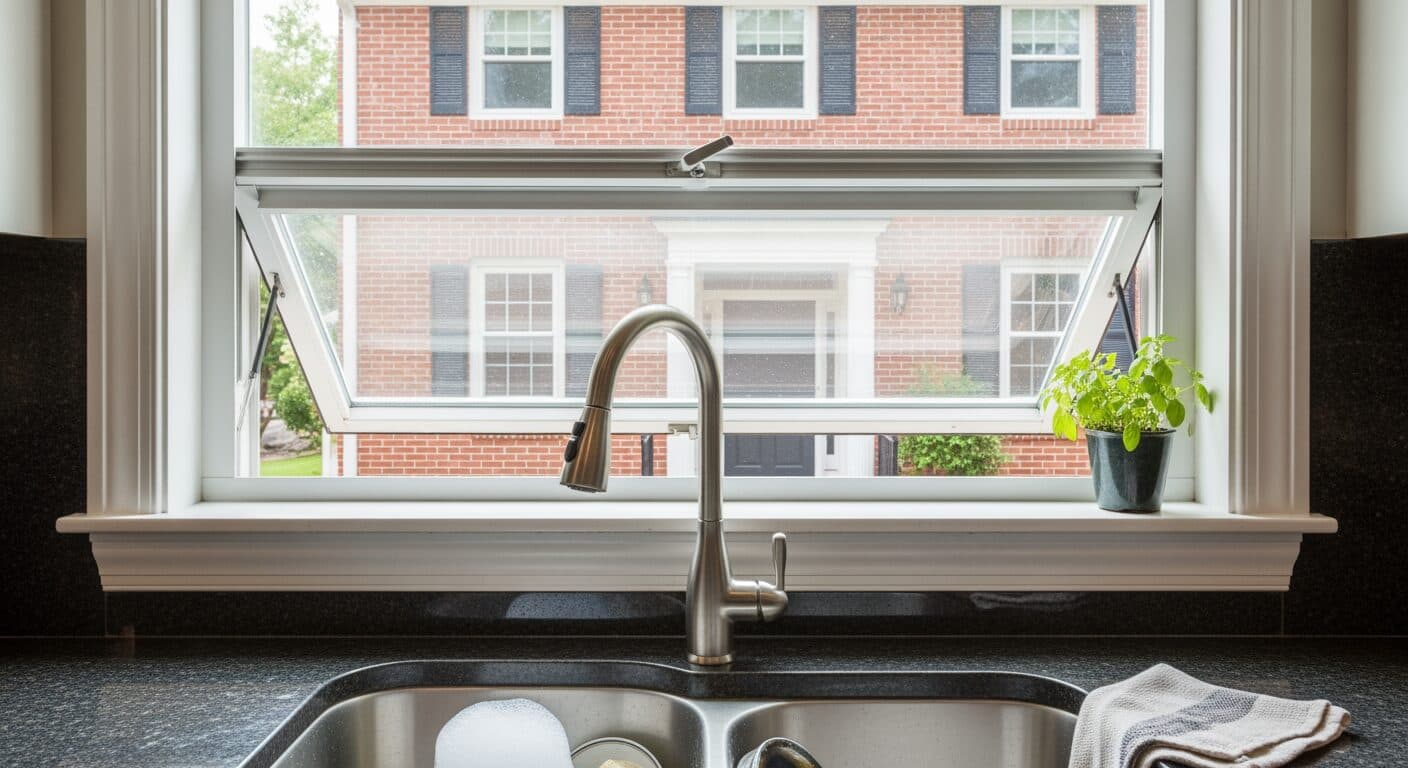
Awning windows are one of the most under-used window styles in the DC/MD/VA market. Most first-timers walk into their quote thinking double-hung everywhere, then they get to the basement, the powder room, or the high window over the kitchen sink and the conversation stalls. Awning is usually the answer in those openings, and the reason is mechanical, not stylistic.
What is an awning window?
An awning window is a single-sash unit hinged at the top that cranks open outward from the bottom. When it's open, the sash projects out from the bottom at an angle, forming a small "awning" over the opening. That shape is the entire point: rain hits the outside of the glass and runs off the bottom edge instead of dropping into the room.
Mechanically, awnings share a family with casements. Both use a crank-out operator and a compression seal (the sash presses against the frame when locked), which is the tightest air seal of any operable window. The difference is the hinge axis. Casements hinge on the side; awnings hinge on the top. That single change makes awnings the right pick for short-and-wide openings and for spots where a side-hinged sash would either be blocked or look wrong.
Glass options on awnings are the same as the rest of the operable line: double-pane Low-E with argon as the standard, triple-pane available where Zone 4 energy targets justify it, and obscured / textured glass for bathrooms. Frame materials run the same range: vinyl, fiberglass, composite, wood-clad.
[data pending: OneStep awning brand and tier list (manufacturer, line, frame material, U-factor, SHGC, VT, NFRC certification)]When does an awning window make sense?
Awning windows make sense in three specific opening types, and they outperform other styles in each.
Basements. DC row house basements, MD colonial basements, and VA Cape Cod garden levels all share the same problem: small horizontal openings at or just above grade where you want light and air without compromising security. An awning sits high on the wall, projects outward when open (so a person can't easily climb through), and keeps water out during a Mid-Atlantic thunderstorm. A horizontal slider in the same opening will let water track in through the bottom track.
Bathrooms. Frosted-glass awning windows above a tub or in a powder room give you ventilation and privacy in the same unit. You crank it open from below, with no reaching up to push a heavy sash. The outward swing also means there's no inward-projecting sash to bump your head on when you're stepping into a shower under the window.
Above other windows or over sinks. Stacked configurations (a picture window with an awning above it, or a tall picture flanked by awnings) are common in mid-century ranchers and Cape Cod dormers across Falls Church, Bethesda, and Annapolis. The awning gives you operable ventilation in an opening where reaching a double-hung's top sash would be impractical. Same logic applies to a high window over a kitchen sink: a casement crank is workable, but an awning crank is easier when the window sits high and you're leaning across the counter.
There are a few places awnings are not the right call. In a bedroom that needs egress (escape in a fire), an awning usually fails the building code clear-opening requirement; egress almost always wants a casement or double-hung. On a wide horizontal opening, a slider gives you more clear glass for the same outside dimension. And on a tall opening, double-hung or casement wins for proportions.
Awning vs. casement vs. hopper
These three are the operable styles that get confused most often.
| Style | Hinge | Opens | Best opening type | Energy seal |
|---|---|---|---|---|
| Awning | Top | Outward, bottom swings out | Short and wide, high on wall | Excellent (compression) |
| Casement | Side | Outward, full sash swings out | Tall and narrow, accessible | Excellent (compression) |
| Hopper | Bottom | Inward, top tilts in | Basement, below grade | Good |
Casements and awnings share the same operator hardware and the same compression seal, so they perform nearly identically on U-factor and air infiltration. The choice between them is almost entirely about opening shape and where the hinge wants to live. Hoppers are the inverted cousin (bottom-hinged, opens inward) and are still used in older basements and commercial buildings, but most new residential basement installs in DC/MD/VA now spec awning instead.
A deeper side-by-side on the operable styles lives at /windows/casement and on the broader type decision at /windows.
See it on your own house first
Preview a clean replacement on a photo of your actual window and get itemized pricing before you decide.
What awning windows cost in DC/MD/VA
Awning windows price similarly to casement windows of the same size because they share the operator hardware and the compression seal. Per-window installed cost is largely a function of size, glass package, and frame material, not the style itself.
[data pending: OneStep awning per-window installed price range by tier (budget vinyl / mid-tier vinyl / premium vinyl / fiberglass / wood-clad)]Three real cost drivers within a tier:
- Size. Most basement awnings are small and sit at the low end of the operable range. Larger awnings used above picture windows can run 1.5 to 2x a small basement awning.
- Glass. Obscured / textured glass for bathrooms typically runs [data pending: obscured glass upcharge per awning unit] over clear. Triple-pane in Zone 4 generally isn't worth the upcharge unless the opening is on a north or west wall and you're already at premium tier.
- Operator hardware. Folding crank handles (which tuck flat against the frame when not in use) are a small upcharge over standard handles and are worth it on any awning that sits above a kitchen sink or counter, where a fixed handle would hit a backsplash or faucet.
A full cost breakdown by window type lives at /cost.
What to look for on the spec sheet
The spec sheet on an awning window matters more than first-timers expect. Three numbers do most of the work.
- U-factor. Lower is better. Measures how much heat the window loses. In Zone 4 (DC/MD/VA), aim for [data pending: recommended awning U-factor for DC/MD/VA Zone 4] on a mid-tier vinyl awning. Premium fiberglass and clad-wood lines can hit lower numbers.
- SHGC (Solar Heat Gain Coefficient). Lower is better in our climate for west- and south-facing openings (less summer heat gain). Higher SHGC can be desirable on north-facing openings where you want passive winter warming. Most stock awnings ship with a Zone 4 climate-appropriate SHGC by default; ask if you're unsure.
- Air infiltration. The compression seal on a quality awning should give you a very low air infiltration number, typically lower than any double-hung in the same line. This is the single best argument for an awning in a drafty basement.
A glass-package and U-factor walkthrough lives at /cost. If you want to talk through a specific opening before you talk to anyone in person, our window consultant Zig has read every catalog in our system.
How awning windows fit into a OneStep project
OneStep is direct-to-consumer. The flow for an awning window is the same as every other style: measure your opening with your phone, pick the style and tier in our 3D configurator, and get an itemized price before anyone shows up at your house. No in-home pitch, no scheduled sales visit you have to sit through to learn the number.
For an awning over a kitchen sink in a Bethesda colonial, that often means choosing a mid-tier vinyl awning with a folding crank handle and obscured glass if the window faces a neighbor, and the whole spec gets locked in before a measurement tech ever visits. For a row of awnings over a picture window in a Falls Church rancher, the configurator can preview the trio together so you see the proportions before committing.
Awnings are part of OneStep's full operable lineup, alongside double-hung, casement, picture, and sliding windows. The parent commercial page for everything we sell is at /window-replacement.
Frequently asked questions
Are awning windows good for basements?
Yes, awning windows are one of the best window styles for DC/MD/VA basements. They sit high on the wall, project outward when open (which limits intruder access), and the top-hinged design keeps rain out during Mid-Atlantic thunderstorms. The compression seal also gives you a tighter air seal than a slider or hopper in the same opening.
Can you leave an awning window open in the rain?
In light rain, yes, and that's one of the main reasons people specify awning windows. The outward-projecting sash acts as a small awning over the opening, so water hits the glass and runs off the bottom edge. In a heavy sustained downpour with wind, you should still close it, because water can be driven against the seal and through the opening.
What's the difference between an awning window and a casement window?
Both crank open outward and use the same compression seal, so they perform nearly identically on energy and air infiltration. The hinge is the difference: awning windows hinge at the top and open outward from the bottom (good for short-wide openings high on a wall). Casement windows hinge on the side and the whole sash swings out (good for tall-narrow openings within easy reach).
Do awning windows meet egress requirements?
Usually not. Most awning windows fail the clear-opening dimension requirement for bedroom egress in DC, Maryland, and Virginia building codes. If the window is the primary escape opening for a bedroom, you almost always need a casement or double-hung instead. Basement awnings in non-bedroom spaces don't have the same requirement.
How much do awning windows cost compared to double-hung?
Awning windows generally cost slightly more than a comparable double-hung in the same line and frame material, because the crank-out operator hardware is more expensive than balance-based hardware. The exact gap varies by manufacturer and tier.
Can you get awning windows with obscured glass for a bathroom?
Yes, obscured (textured) glass is a standard option on awning windows from most major manufacturers. It typically adds a small per-unit upcharge over clear glass. Common patterns include rain, frost, satin, and reed. The obscured glass still works with the same Low-E coating and argon fill as clear glass, so energy performance is unchanged.
How long does it take to install an awning window?
Industry data from Angi puts the active replacement work at 30 to 60 minutes per window for a straightforward insert install, though the full visit runs longer once you add demo of the existing unit, trim work, and cleanup. A full-frame install (down to the rough opening) takes meaningfully longer per opening and is necessary if the existing frame is rotted or you're changing the opening size.