Double hung replacement windows
Double hung replacement windows have two operable sashes that both slide vertically in the same frame. They are the historically correct choice for DC/MD/VA colonials, capes, and row houses, and the most-replaced window style in this market. They cost a little more than single-hung, seal a little less than casement, and suit more facades than any other operating style.

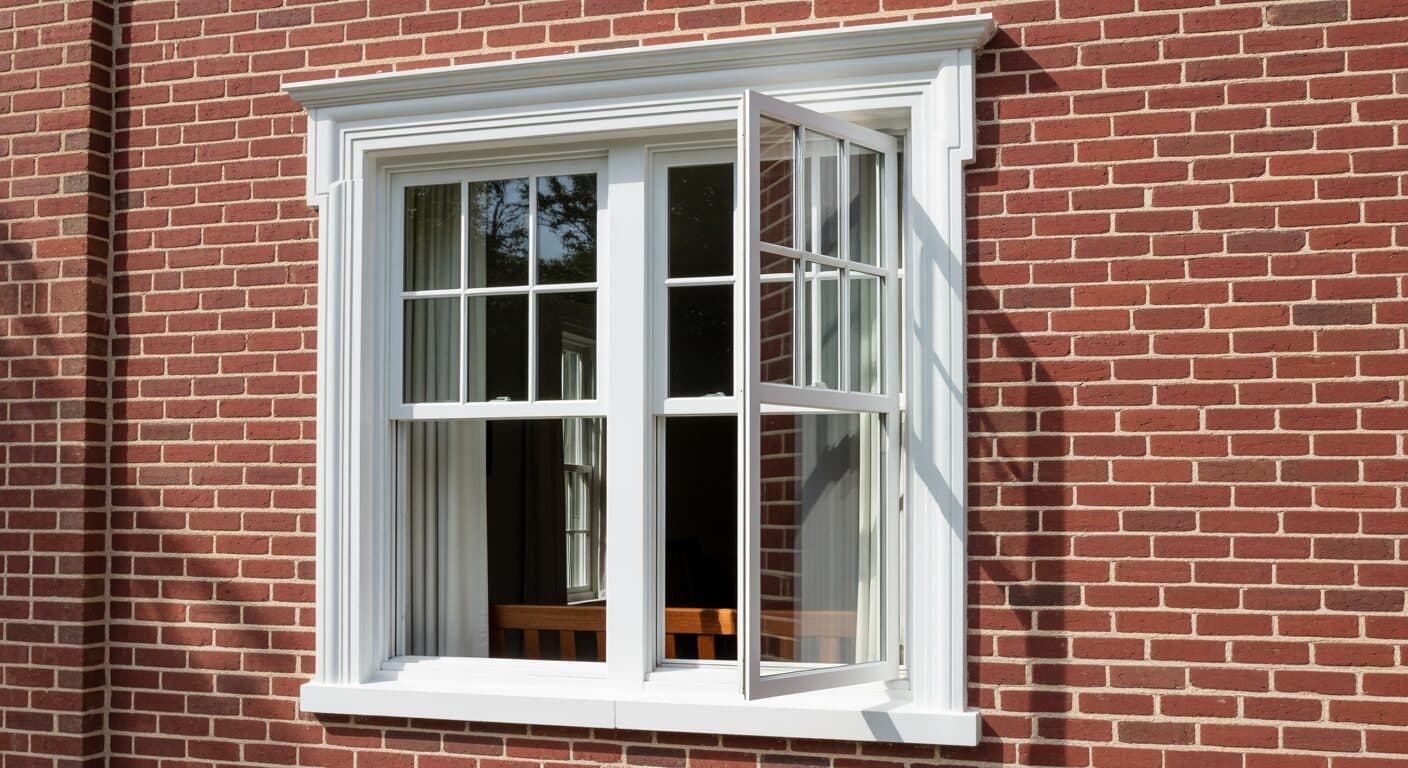
If you've been told a double-hung is "the standard" window and left it at that, the in-home rep moved on before you got the information you actually need. Double-hung is the right call for most colonials in this market, but not for every opening in that colonial. I spent 2.5 years at Renewal by Andersen sitting across from homeowners who'd been sold double-hungs for kitchen sink openings, wide picture openings, and egress windows where a casement would have worked better and cost less. This page is the honest version: where double-hungs win, where they don't, what they should cost, and the spec to ask for.
What makes a double-hung different from a single-hung
Both styles look identical from across the street. A double-hung has two movable sashes; a single-hung has a fixed upper sash and an operable lower sash only.
That distinction matters for two reasons. First, ventilation: with both sashes movable you can raise the upper sash and lower the lower sash simultaneously, letting hot air vent from the top while cooler air enters at the bottom. For a second-floor bedroom in a Bethesda colonial on a humid August night, that stack effect makes a measurable difference. Second, cleaning: a true double-hung tilts both sashes inward, so you can wipe exterior glass from inside. On a second- or third-story window in a Georgetown row house, not having to lean out a window or set up a ladder is a real benefit.
The trade-off: double-hungs cost more than single-hungs, typically [data pending: double-hung vs single-hung price premium, per-window installed in DC/MD/VA] more for an equivalent spec. And there is one more weatherstrip line where the two meeting rails lock, which means marginally higher air-infiltration rates compared to a casement or a fixed picture window. In the consultations I observed at Renewal by Andersen, the majority of colonial homeowners chose double-hung regardless. Historical accuracy and the cleaning convenience carry the argument for most buyers in this market.
When a double-hung is the right call
Double-hung windows are the right call for any opening on a colonial, cape, federal, or traditional DC/MD/VA home where historical accuracy matters, and especially for any window in a historic district where the preservation office specifies style and configuration.
The facade case is the strongest. A colonial was designed around double-hung proportions: the vertical meeting rail, the equal upper and lower sash sizes, the grid pattern that divides each sash into smaller lites. Dropping a casement or a slider into that opening reads as wrong even when the homeowner can't name why. For front-facing windows on any pre-1970 home in this market, double-hung is almost always the historically appropriate choice.
The historic district case is non-negotiable in many neighborhoods. DC's Historic Preservation Office, Montgomery County's historic district staff, and Alexandria's Board of Architectural Review all have jurisdiction over exterior window style on contributing properties. In most cases they require the replacement to match the original style, configuration, and divided-lite pattern. If you're in a historic district (Capitol Hill, Georgetown, Old Town Alexandria, Kensington), a quick call to the relevant HPO office before you order anything will save you an expensive mistake.
The cleaning case applies to any window on an upper story. Both sashes tilt inward on a quality double-hung, which means cleaning the exterior from inside. This is less exciting than the facade argument but more practically useful than most homeowners expect until the first time they have to deal with a second-story window that doesn't tilt.
When a double-hung is the wrong call
Double-hung is the wrong call for kitchen-over-sink openings, wide contemporary openings, and egress windows where you need the full clear opening. Here are the three situations I'd push back on:
The kitchen-over-sink opening is the clearest example. Operating a lower double-hung sash over a deep kitchen counter means reaching across the basin and lifting a sash that, on the units I sold at Renewal by Andersen, typically weighed 15 to 25 pounds. A casement with a crank operator solves that problem completely: you turn a handle from a comfortable arm position. Casements also seal tighter than double-hungs, which matters near cooking steam and grease. For most kitchen-over-sink openings, casement is the right answer.
A wide opening on a contemporary or mid-century home is the second situation. A double-hung's horizontal meeting rail breaks up horizontal sightlines in a way that reads wrong on a ranch or a modern home. A slider opens wide without projecting into exterior space; a picture window eliminates the meeting rail entirely. The double-hung's proportional vocabulary is vertical, not horizontal.
An egress window that must meet minimum code dimensions is the third. A double-hung egress window has to be substantially larger than the IRC minimums suggest, because only one sash opens at a time. IRC R310.2.1 requires a 5.7 sq ft net clear opening, but a single sash on a double-hung delivers roughly half the total frame area. The minimum double-hung sizes that actually clear that requirement with one operable sash: [data pending: minimum double-hung frame and rough-opening sizes that satisfy IRC R310.2.1 egress, per manufacturer egress charts]. A casement swings fully clear and gives you the entire opening, which makes it the safer spec for any basement bedroom egress where you're working close to minimum dimensions. Your local building department can confirm the exact rough opening required for your home. Don't assume a stock-size double-hung will satisfy egress without doing the math.
What double hung replacement windows cost
Honest per-window installed ranges for the DC/MD/VA market:
| Tier | Brand examples | Per-window installed | When it makes sense |
|---|---|---|---|
| Budget vinyl | [data pending: budget vinyl double-hung brand examples] | [data pending: budget vinyl double-hung installed range] | Rental, flip, secondary openings |
| Mid-tier vinyl | [data pending: mid-tier vinyl double-hung brand examples] | [data pending: mid-tier vinyl double-hung installed range] | Most owner-occupied colonial replacements |
| Premium vinyl / fiberglass | ProVia, Andersen 100 Series | [data pending: premium double-hung installed range] | Long-term hold, historic homes, energy focus |
| Fiberglass / Fibrex composite | Marvin Essential, Renewal by Andersen | [data pending: fiberglass double-hung installed range] | Historic districts, high color-match requirements |
| Wood interior / clad | Marvin Signature, Pella Reserve | [data pending: wood/clad double-hung installed range] | High-end remodels, period-correct interiors |
Double-hungs in the Better tier (vinyl, double-pane with premium Low-E and argon fill, foam-filled frame) are what most owner-occupied DC/MD/VA colonial replacements land on. That tier delivers a genuine improvement over a failed original and avoids the steep markup at the premium end. For a whole-home replacement (in the projects I quoted at Renewal by Andersen, a colonial in this market typically ran 12 to 20 windows), the per-unit price on a Better-tier vinyl usually drops meaningfully compared to a single-window replacement.
A deeper price breakdown by size, glass package, and installation type lives at /cost. For the bigger picture on what drives an itemized quote (insert versus full-frame, color and grid upcharges, brand markup), see the first-time window replacement guide.
Get an honest price, no salesperson
Tell us your address and window and get itemized pricing — no in-home pitch, no surprises.
The spec sheet that actually matters
Double-hungs have four specs worth reading carefully before signing anything: U-factor, SHGC, air infiltration, and balance system quality. The first three are NFRC-certified and comparable across brands. The fourth is what separates a double-hung that still operates smoothly in year 20 from one that needs balance replacements by year 12.
- U-factor. Lower is better. For DC/MD/VA's Zone 4 mixed-humid climate, target [data pending: recommended double-hung U-factor for Zone 4] or lower on a mid-tier vinyl. Triple-pane units reach [data pending: triple-pane double-hung U-factor range].
- SHGC (solar heat gain coefficient). South- and west-facing windows want lower SHGC to keep summer heat out. For most DC/MD/VA orientations, [data pending: recommended SHGC range for DC/MD/VA double-hung] is the right range.
- Air infiltration. This is the double-hung's relative weakness versus casement. A quality double-hung typically reaches [data pending: typical double-hung air infiltration rating] cfm/sq ft, acceptable but higher than a casement's compression-seal rating. On a drafty DC March day, a double-hung installed into a tight opening with quality weatherstripping performs well; an install with gaps at the jamb extensions does not.
- Balance system. The spring, block-and-tackle, or spiral balance holds each sash in position when partially open. Budget balances fail early. Quality balances from brands like ProVia, Andersen, and Marvin use constant-force or block-and-tackle systems that hold a specific weight range and last significantly longer. Ask your installer what balance type is spec'd for the sash weight in your opening.
[IMAGE: Close-up of a double-hung tilt-latch and balance mechanism, viewed from the interior with one sash tilted inward for cleaning. Alt: "Double-hung window tilt-latch and balance mechanism with sash tilted inward showing interior cleaning position."]
Double hung vs. the other operating styles
If you're deciding between double-hung and another style for the same opening:
- Double-hung vs. casement. Casement seals tighter and operates easier for hard-to-reach openings; double-hung looks right on more facades and has a lower-profile balance mechanism with no crank hardware. For front-facing colonials and historic facades, double-hung. For kitchens, baths, and second-story bedrooms where easy operation matters, casement.
- Double-hung vs. awning. Awnings are hinged at the top and open outward at the bottom, so they ventilate in light rain and suit wide, lower openings. Double-hungs suit traditional proportions. For a bathroom window in a non-historic home, awning can work; for any window on a colonial facade, double-hung.
- Double-hung vs. slider. Sliders open horizontally with no projection into exterior space, which is right for walkway-adjacent openings and contemporary homes. Double-hungs open vertically. For a traditional home, double-hung. For a contemporary home or any opening within arm's reach of a walkway, slider.
- Double-hung vs. picture. Picture is fixed: no opening, lowest cost per square foot, best energy performance because nothing moves. Double-hung opens. For any opening where ventilation matters, double-hung. For a large focal window where you want unobstructed glass, pair a fixed picture unit with flanking double-hungs.
The full guide to picking type by room and home style is at /windows.
Installation considerations specific to double-hungs
Most double-hung replacements in DC/MD/VA are insert (pocket) installations: the existing jamb and exterior trim stay, and a new double-hung unit slides into the opening. Insert installs preserve interior trim and cost less than full-frame; Angi puts the active replacement work at 30 to 60 minutes per window, with demo, trim, and cleanup time on top of that. The downside: you lose approximately [data pending: insert replacement glass area loss, double-hung] of glass area on each side as the new frame sits inside the existing one.
Full-frame replacement removes everything down to the rough opening. It's required when the existing frame is rotted, when you're changing the window size, or when the existing installation has moisture damage that needs to be addressed before the new window goes in. Budget an additional [data pending: full-frame vs. insert cost premium, double-hung] per opening compared to insert for full-frame work in this market.
One detail that surprises first-time buyers: when an installer quotes a tilt-in double-hung, confirm both sashes tilt, not just the lower. Some budget units tilt only the lower sash. For upper-story windows, that detail matters every time you clean.
[IMAGE: Two double-hung windows installed side-by-side in a white colonial facade with six-over-six grid patterns, viewed from the exterior. Alt: "Two double-hung windows with six-over-six grid pattern installed side-by-side in a white colonial home exterior."]
Frequently asked questions
Are double-hung windows the right choice for a colonial home?
For most colonials, capes, federals, and traditional DC/MD/VA homes, yes. The double-hung is the historically correct operating style for these facades, and preservation offices in DC, Alexandria, and Montgomery County typically require double-hung style on contributing properties. The main exception is kitchen-over-sink openings, where a casement is easier to operate.
How much do double-hung replacement windows cost?
Installed double-hung windows in DC/MD/VA range widely by tier and brand. Mid-tier vinyl is the most common choice for owner-occupied colonial replacements, and premium fiberglass and composite tiers like Marvin and Renewal by Andersen run significantly higher. Quantity discounts apply on whole-home projects.
How long do double-hung windows last?
Frame and glass age on different clocks: the InterNACHI life-expectancy chart puts vinyl and fiberglass window frames at 20 to 40 years, while the sealed insulating glass unit typically fails sooner, at 8 to 20 years. The balance system (the spring or block-and-tackle mechanism) often needs replacement after 10 to 20 years, depending on sash weight and balance quality. A well-maintained wood double-hung can serve 30-plus years, sometimes much longer.
What's the difference between insert and full-frame replacement?
Insert replacement (also called pocket replacement) keeps the existing frame and exterior trim in place, so it's faster, less disruptive, and less expensive. Full-frame replacement removes everything down to the rough opening and is required when the frame is rotted, when you're changing window size, or when there's moisture damage behind the existing frame. Most healthy DC/MD/VA colonials qualify for insert.
Do double-hung windows qualify for the federal energy tax credit?
Not for installs after December 31, 2025. The federal 25C window credit terminated at the end of 2025, so double-hungs installed in 2026 do not qualify even if they meet the ENERGY STAR Most Efficient U-factor and SHGC thresholds. Check for live state or utility rebates and confirm current rules with your tax professional.
Can I replace a double-hung with a casement in the same opening?
Yes, but it's more work than a like-for-like replacement. Swapping style usually requires a full-frame replacement rather than insert, because the frame configurations differ. On a front-facing colonial window visible from the street, a casement will read as stylistically wrong even if the rough opening size is compatible, though on a rear or side elevation the change is usually fine.
Why does my double-hung window have a gap at the meeting rails?
A gap at the meeting rails, where the top of the lower sash meets the bottom of the upper sash, is the most common air-infiltration point on a double-hung. On new windows it usually indicates a warped sash or an improperly adjusted balance system, and on older windows it typically means the weatherstripping has compressed or worn through. Either way, it's the reason double-hungs have higher air-infiltration ratings than casements.
Are double-hung windows more secure than single-hung?
Double-hungs and single-hungs offer similar security for the lower sash lock. The difference is the upper sash, which on a double-hung can be locked independently at its own position, so you can leave it cracked open without leaving the lower sash unlocked. Most mid-tier and premium double-hungs include dual cam locks on the meeting rail.
Next step
The most useful thing you can do before talking to any installer is to see real numbers for double-hungs at your specific opening sizes and home configuration. Our 3D configurator pulls up your home, lets you place windows where you actually want them, and gives you an itemized price, without a rep coming to your home.
See it on your own house first
Preview a clean replacement on a photo of your actual window and get itemized pricing before you decide.
If you're not sure whether double-hung, casement, or awning is right for a specific opening, particularly in a kitchen, bath, or second-story bedroom, ask Zig, our window consultant who has the full spec catalog and can match the style to your room, climate zone, and budget.
The parent commercial page for everything we do is window replacement, and all eight window types we install live at the windows hub. The honest cost breakdown by style and tier is at /cost. The person behind every page on this site is at /about/anthony-moorman.