Noisy windows: why they whistle in the wind and let road noise through
Noisy windows come from one of three things: air leaking past a worn seal or gasket (the whistle you hear in a winter gust), a gap left behind a bad installation, or the glass itself being too thin to block sound (the road noise you hear year round). The whistle is usually a cheap fix. The constant road noise usually is not. Diagnosing which one you have decides whether you caulk it or replace it.

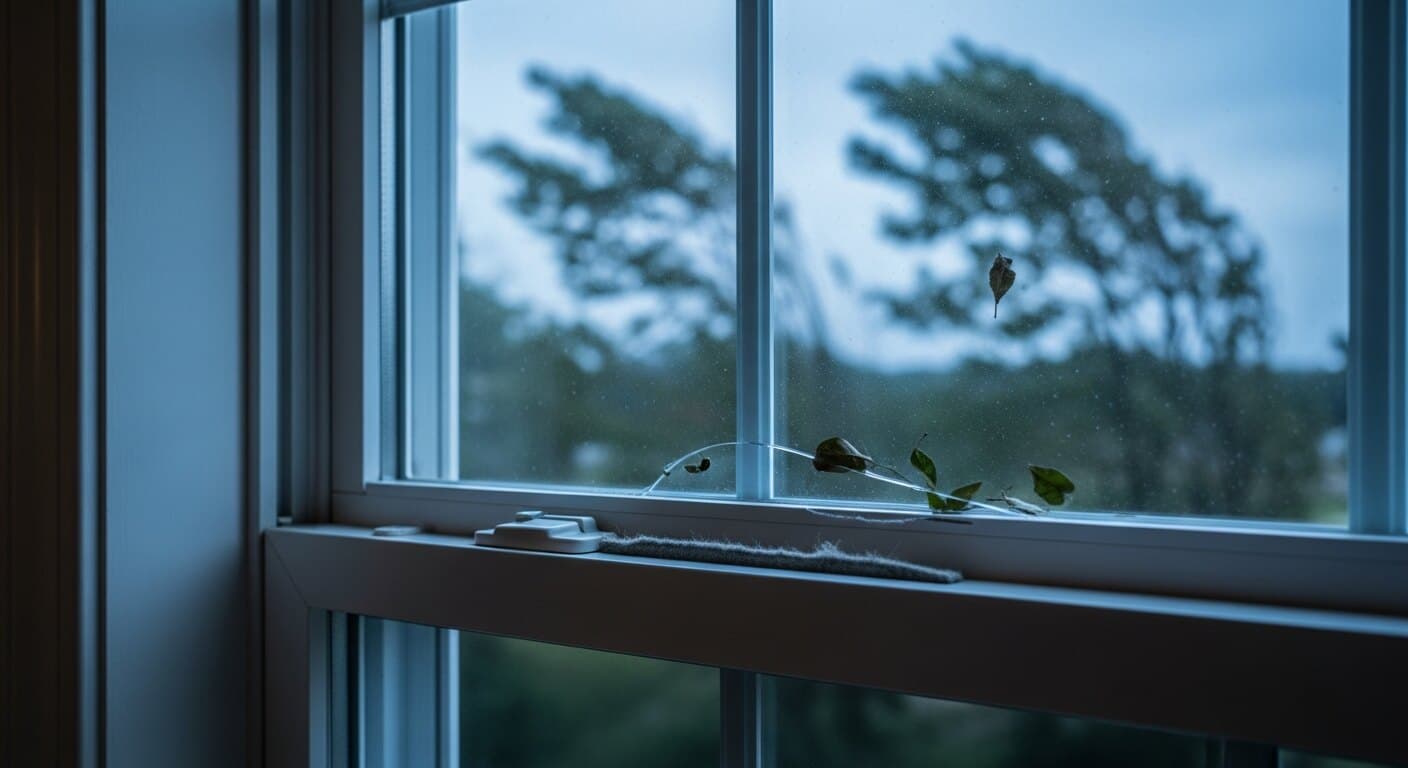
Across 2.5 years selling windows for Renewal by Andersen, "noisy" meant two completely different problems, and homeowners rarely separated them. One person meant a high whistle that only shows up when the wind hits the house a certain way. The other meant traffic they can hear from the couch all day. Those are not the same failure and they do not have the same fix, so the first job is always to split them apart. That is the lens for this page: air infiltration versus an install gap versus the unit itself, and how to tell which one is making your noise before you spend a dollar.
Why are my windows whistling? The two faces of noisy windows
A whistle is almost always air being forced through a narrow gap under pressure, and steady noise is almost always sound passing through glass that is too thin to stop it. Same complaint, two physical causes, and you treat them differently.
Air whistling happens when wind raises the pressure on one side of the window and the air has a small, tight path to escape through: a flattened weatherstrip, a worn sash gasket, a gap where the sash meets the frame, or a hole where a lock or balance used to seal. The narrower and tighter the gap, the higher the pitch, which is exactly why a tiny leak can be louder and more annoying than a big one. Sound transmission is different. Outside noise (traffic, lawn equipment, an HVAC condenser, a flight path) is airborne energy that pushes on the glass and re-radiates inside. A single thin pane is a poor barrier, so you hear it. The clue is timing. A whistle that comes and goes with the wind is an air leak. A drone you hear in still air, day and night, is the glass.
How do I tell where the noise is coming from?
Run three quick tests in order, because each one rules out a layer: a paper test for the seal, a visual and feel check for an install gap, and a same-air listen for the glass. Five minutes of diagnosis saves you from buying the wrong fix.
Here is the sequence I would run at your own window:
- The paper test (is it the seal?). Close the window on a dollar bill or a strip of paper and pull. If it slides out with almost no drag at any point around the perimeter, the weatherstrip or gasket at that spot is not sealing. That spot is your whistle.
- The incense or candle test (where is the air moving?). On a breezy day, run a lit stick of incense or a candle flame slowly around the edges. Where the smoke streams sideways or the flame bends, air is moving through. Mark it.
- The install-gap check (is it behind the trim?). Pop off a piece of interior stop or trim, or just feel along the casing on a windy day. Cold air or a whistle coming from behind the trim, not from the sash, points to a gap in the rough opening that was never insulated. That is an installation defect, not a worn part.
- The same-air listen (is it the glass?). Stand inside with the window shut and the room quiet. If you still clearly hear steady outside noise with no draft and no whistle, the sound is coming straight through the glass, and no amount of caulk fixes that.
If you want a second read, you can describe what you are hearing to Zig in the chat and it will help you sort an air leak from a glass problem before you call anyone.
Air infiltration: the whistle you hear in a winter gust
If the noise is a whistle that rises and falls with the wind, it is air infiltration, and it is the cheapest of the three to fix. Worn weatherstripping, a hardened sash gasket, or a sash that no longer pulls tight against the frame are the usual culprits, and most are a same-day repair.
This is the good-news diagnosis. Replacement weatherstripping in V-strip, foam, or a rubber gasket profile is inexpensive and sold at any hardware store, and on most double-hung and casement windows you can swap it yourself in an afternoon. A casement or awning that whistles often just needs its compression gasket replaced or its hardware adjusted so the sash pulls in tighter against the frame when you crank it shut. A double-hung that whistles at the meeting rail (where the two sashes overlap) usually needs the sash lock adjusted or a new interlock weatherstrip, because the lock is what draws the two sashes together into a seal. None of that is a new window.
Spend the money only after the paper test and the smoke test agree on where the leak is. Replacing every weatherstrip in the house when one flattened gasket is the whole problem is the kind of over-fix I talked people out of constantly. The window industry measures this leakage as an air infiltration rate (AI) on the NFRC label, where a lower number is tighter. [data pending: typical NFRC air infiltration (AI) value for a new replacement double-hung vs an aging window, cfm/ft2]
When the whistle is really an installation gap
If the whistle or cold air is coming from behind the trim rather than from the sash itself, the window unit is probably fine and the installation is the problem. A gap in the rough opening that was never insulated or flashed lets air move around the window, and no new sash or gasket will fix it.
That space is supposed to be packed with low-expansion foam or insulation and sealed, and on a rushed install it sometimes is not. The tell is location: pull a piece of interior stop or run your hand along the casing on a windy day, and if the air is moving behind the trim, the unit is not your problem. The fix is to remove the trim, properly insulate and seal the perimeter, and re-trim. On a window still under an installation warranty, that is the installer's bill, not yours, which is one more reason to figure out the cause before you let anyone sell you a replacement. For what a correct install actually involves, our window installation guide walks the perimeter sealing step by step, and the drafty windows page covers the same leak-hunting in more depth.
Noisy windows from road noise: when it is the glass
If you hear steady outside noise in still air with no draft, the problem is the glass, and this is the one case where new noisy windows genuinely earn their cost. A single thin pane is a weak sound barrier, and the fix is more glass, more mass, and dissimilar pane thicknesses, which a sealing repair cannot deliver.
Sound control is rated by Sound Transmission Class (STC), where a higher number blocks more noise. Per Pella's sound-control guidance, a standard dual-pane window lands around STC 26, a laminated-glass package reaches the mid-30s, and triple-glazing falls in the low-30s (Pella, soundproof windows), and Soundproof Windows' published STC comparisons align with those bands. An older single-pane window is well below that. The jump that actually matters for traffic noise is not adding a third pane, it is laminated glass: a plastic interlayer bonded between two glass layers damps the vibration that carries sound, which is why laminated packages outperform plain triple-pane for road noise despite having fewer panes. If you live on a busy DC/MD/VA arterial, near a Metro line, or under a Reagan National flight path, that is the upgrade to ask about. Triple-pane helps with both energy and sound but costs more, so see our triple-pane window cost breakdown before you assume it is the answer. If your goal is purely noise, laminated dual-pane is usually the smarter spend. Ask Zig which glass package fits your specific noise source.
Get an honest price, no salesperson
Tell us your address and window and get itemized pricing — no in-home pitch, no surprises.
What each fix costs, honestly
The three causes sit at very different price points, which is exactly why diagnosing first saves money. A whistle is usually tens of dollars, an install-gap reseal is a service call, and a glass upgrade for road noise is a full or partial window replacement.
| Cause | Typical fix | Rough cost | Who does it |
|---|---|---|---|
| Worn weatherstrip / gasket (the whistle) | Replace the strip or gasket | $10 to $50 in materials | DIY in an afternoon |
| Loose sash / misadjusted lock | Adjust hardware, replace interlock | $0 to a short service call | DIY or handyman |
| Uninsulated install gap | Remove trim, foam and seal, re-trim | Service call, or free under install warranty | Installer |
| Road noise through thin glass | Laminated or upgraded-glass window | Full replacement pricing | Replacement company |
The pattern is the same one I gave every homeowner who would listen: the loud, intermittent whistle is almost always the cheap end of this table, and the steady drone is almost always the expensive end. Do not let anyone sell you off the bottom row when your problem lives on the top row. For full per-window numbers across materials, see the single-window replacement cost page and the broader window replacement cost guide. If you are weighing the glass upgrade for energy as well as noise, the energy-efficient windows guide covers how the glass packages overlap.
Start your measurement in 5 minutes
Snap a photo with your phone, get AI measurements and an honest price — no salesperson, no in-home pitch.
Can I just live with it, or does it get worse?
A whistle from a worn seal will slowly get worse and costs you energy the whole time, but it is not urgent. Road noise through thin glass will not damage anything, so that is purely a comfort call. The one noise you should not ignore is air coming from behind the trim, because that gap can carry water too.
A flattened weatherstrip does not heal itself. The gap that whistles is also the gap that leaks conditioned air, so the longer you wait, the more you pay on heating and cooling in our climate, even if the noise itself is tolerable. There is no safety clock on it, though, so fix it when convenient. Pure road noise is the same: annoying, not damaging, so you replace for comfort or you do not, and either choice is defensible. The exception is the install-gap case. A perimeter that was never sealed against air was probably never flashed against water either, and a path for air is a path for water, so if your whistle traces to behind the trim, treat it as more urgent and see the water leaking around windows page. When the noise is just one tired old window among several you have been meaning to deal with, it is worth reading the window problems hub to see whether you are looking at one repair or a whole-home pattern.
Frequently asked questions
Why does my window whistle when it's windy?
Wind raises the air pressure on one side of the window, and that air forces its way through a small tight gap, usually a worn weatherstrip, a hardened sash gasket, or a sash that no longer pulls tight against the frame. The narrower the gap, the higher the whistle. It is almost always a cheap weatherstripping or hardware fix, not a new window.
How do I stop my windows from whistling?
First find the leak with a paper test and a candle or incense flame around the edges on a windy day. If a spot fails, replace the weatherstrip or gasket there, or adjust the sash lock so the sash seals tighter. Only the spot that leaks needs the fix, so you rarely have to redo the whole window.
Why can I hear so much road noise through my windows?
Steady outside noise in still air, with no draft, means the sound is coming through the glass itself. A single thin pane is a weak sound barrier. The most effective upgrade for traffic noise is laminated glass, which bonds a plastic interlayer between two panes to damp the vibration that carries sound.
Does triple-pane glass block more noise than double-pane?
It can help, but for road noise, laminated glass usually beats plain triple-pane despite having fewer panes, because the plastic interlayer damps sound vibration directly. Triple-pane is mainly an energy upgrade. If noise is your only goal, a laminated dual-pane package is often the smarter spend.
Is a whistling window an emergency?
Usually no. A worn-seal whistle wastes energy and slowly gets worse, but there is no safety clock on it, so fix it when convenient. The exception is air coming from behind the trim rather than the sash, because an unsealed install gap can let water in too, and that is worth addressing sooner.
Can soundproofing a window be done without replacing it?
For a whistle from air leaks, yes, sealing the gap fixes it completely. For road noise through the glass, no caulk or weatherstrip will help, because the sound is passing through the pane, not around the sash. Reducing that noise meaningfully requires a glass upgrade or a secondary interior storm panel.
Next step
The honest way to settle a noisy window is to figure out which of the three causes you have before anyone quotes you a replacement. If it is a whistle from a worn seal, that is a hardware-store fix and you should keep the window. If it is road noise through thin glass, see real numbers on a laminated-glass replacement for your actual openings, with no sales visit.
See it on your own house first
Preview a clean replacement on a photo of your actual window and get itemized pricing before you decide.
Keep diagnosing: the window problems hub sorts every common symptom from repair to replace, the drafty windows and foggy windows pages cover the leaks and seal failures that often show up alongside noise, and the person behind every page here is Anthony Moorman.