Window replacement in Washington DC
Window replacement in Washington DC usually means a rowhouse facade, not a suburban tear-out: tall, narrow double-hung openings across two or three stories of Federal, Victorian, or Wardman brick. If your home sits in one of the District's historic districts, the permit and the historic review are the same step. Most non-designated homes skip that review entirely. Regional pricing runs a few hundred to several thousand dollars per window installed.

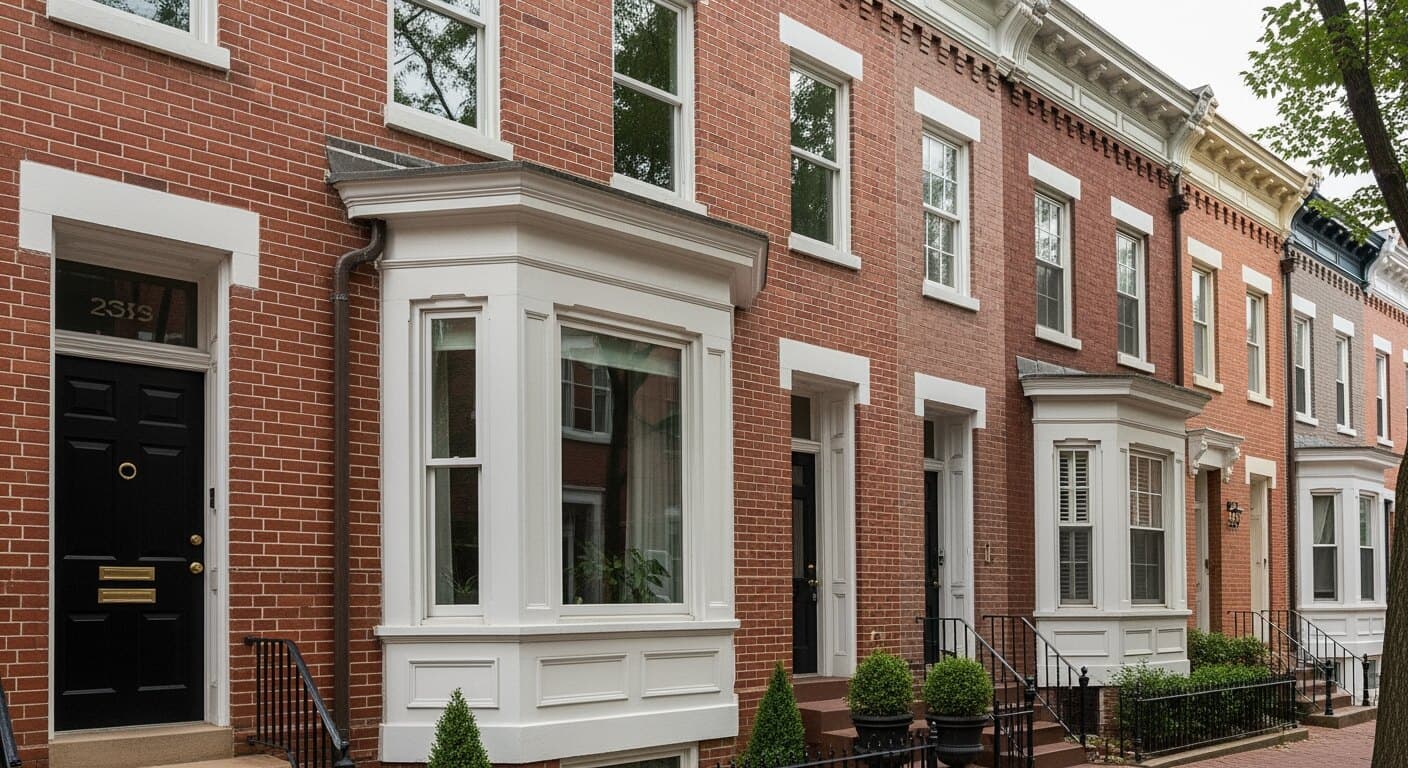
Here is what most homeowners get wrong about the District: there is no separate "historic permit" to chase. If your address is a designated landmark or sits in a historic district, the Historic Preservation Office clearing your building permit application is the historic approval. One filing, not two. That mechanic reshapes how you scope and budget a DC window job, and it is why the District behaves nothing like the Maryland or Virginia suburbs next door. Most non-designated homes never touch that layer at all. As a realtor I have spent years inside Capitol Hill and Petworth rowhouses, so the rest of this page is built around that brick-and-narrow-opening stock.
What window replacement in Washington DC usually looks like
Most DC jobs are rowhouse facades, not whole-home suburban tear-outs. From my realtor years inside these rows, a typical project is a single attached house with roughly 6 to 12 tall, narrow openings across two or three stories, often with a projecting bay on a Victorian row. The residential core is masonry rowhouses in three broad eras, and each points to a window style:
- Federal-style rowhouses (roughly 1780 to 1830), flat brick facades with small openings, common in Georgetown and parts of Capitol Hill. These read best with simple symmetrical double-hung windows.
- Victorian rowhouses (roughly 1865 to 1900), the most prevalent type, with projecting bays, oriels, and ornate brickwork in Logan Circle, Shaw, Dupont Circle, and Columbia Heights. A projecting bay window is often original to the facade here.
- Wardman rowhouses (roughly 1905 to 1930), red-brick Georgian and Federal-Revival rows in Petworth, Bloomingdale, and 16th Street Heights, again predominantly double-hung.
Detached colonials, Tudors, and bungalows show up in upper Northwest, where you see larger whole-home jobs closer to a suburban scope. Double-hung does the heavy lifting on almost every DC facade; casement, picture, and awning units fill in kitchens and stairwells.
Do you need historic approval for window replacement in Washington DC?
It depends entirely on whether your address is a "historic property." By the DC Office of Planning's count, Washington, D.C. has about seventy designated historic districts, more than thirty of which are local neighborhood districts, overseen by the DC Historic Preservation Review Board (HPRB) and the Historic Preservation Office (HPO).
The mechanic again, because it is the whole game in DC: historic review is folded straight into the building permit. Exterior window replacement on a historic property requires a building permit, and the Historic Preservation Office's clearance of that application is itself the preservation approval. Postcard permits may not be used on a historic property, so there is no shortcut around HPO sign-off. Under the D.C. Construction Code (12 DCMR 105.2.5), a permit is required to replace windows in a historic landmark or any building within a historic district.
The District has gone further than most jurisdictions and codified actual Window Standards as Chapter 23 of Title 10-C DCMR, adopted by HPRB under the Historic Landmark and Historic District Protection Act of 1978. Two rules matter most:
- You cannot shrink the historic opening. Under DCMR 10-C 2305.5, replacement windows must fill the historic opening and may not increase the exterior framing or reduce the glazing dimensions; downsizing an opening with trim or panels is prohibited.
- The standards run strict-to-flexible by elevation. The strictest matching standard applies to landmarks and the primary, street-facing elevations of contributing buildings, while secondary elevations not visible from a street or public space get more flexibility in material and finish (DCMR 10-C 2305.9, 2308.3, 2309.3). That is why many DC owners split scope: period-appropriate units on the street facade, more economical choices on the rear or alley side.
For the specific material rule the code applies on a street-facing facade (what it actually requires you to match), see [data pending: dc-vinyl-window-policy: DCMR 10-C Chapter 23 wood-for-wood / metal-for-metal matching rule and whether vinyl is named, from the Window Standards PDF]. And for whether HPO clearance is the only filing or whether a separate Certificate of Appropriateness can be involved, see [data pending: dc-certificate-of-appropriateness: confirm the HPO-clearance-is-the-approval mechanism vs any HPRB Certificate of Appropriateness step, from planning.dc.gov].
The relief most homeowners get: historic review is triggered only for a designated landmark or a home inside a designated historic district. A property that is neither needs no HPO or HPRB review at all. The standard DC building permit still applies, but the historic layer does not attach. If you are unsure which bucket you are in, confirm your address with the Historic Preservation Office first.
What does a Washington DC project cost, and how OneStep prices it
Pricing in the District tracks the rest of the DC/MD/VA metro: a single installed replacement window generally runs from a few hundred dollars at the budget-vinyl end to several thousand at the wood-clad premium end, with most owner-occupied homes in mid-tier vinyl. There is no real DC-specific premium; the metro prices roughly uniformly. For a verified number on your exact openings, see [data pending: OneStep itemized per-window price for the buyer's Washington DC address] from the configurator rather than a headline figure.
The real cost lever in DC is not the metro, it is the elevation. On a contributing building, the street-facing facade has to match the historic material, which often pushes those units toward wood or clad instead of vinyl, while the rear or alley elevation, where the standards loosen, can take a cheaper unit. So budget a DC rowhouse as two numbers, not one: a stricter price for the front, a looser one for the back. Most of these jobs are facade refits, fitting period-correct units into openings you are required to keep, not the gut-and-resize tear-outs of new construction, which keeps structural surprises lower than owners expect.
There is also no commissioned rep and no quote that shifts based on how a visit goes. You measure with your phone and the configurator returns one itemized number per opening, which is what lets you compare the front-facade and rear-elevation costs side by side before committing. We will not be cheapest on every job, but the figure you see is the figure you pay.
How the OneStep process works for a Washington DC homeowner
OneStep buys windows the way Carvana sells cars: you do the whole thing online, and a real itemized price comes back. The two tools that make that work matter more in DC than almost anywhere, because the housing stock is so unforgiving.
Phone-video measurement earns its keep on rowhouse openings. The tall, narrow sashes on a Wardman row are rarely uniform: parlor-floor, bedroom, and top-floor openings can each differ in height once a hundred-year-old brick wall has settled. Walking each floor with your phone captures those dimensions opening by opening, which is what you want before ordering units you are required to fit into the existing frame. The 3D configurator then sets the style for each one, double-hung down a Petworth row, a projecting bay on a Victorian facade, and prices every opening on its own line. That per-opening pricing is why it handles the front-versus-rear split cleanly: spec wood up front and a cheaper unit out back, and watch each number move. Unsure which glass package suits our mixed-humid IECC Zone 4 summers, or which material clears a contributing facade? Ask Zig, the window consultant, before locking anything in. The one thing to plan around is lead time: roughly 4 to 6 weeks from order to install.
Get an honest price, no salesperson
Tell us your address and window and get itemized pricing — no in-home pitch, no surprises.
See it on your own house first
Preview a clean replacement on a photo of your actual window and get itemized pricing before you decide.
Frequently asked questions
Do I need a permit to replace windows in Washington, D.C.?
Yes, a DC building permit is required to replace windows. If your home is a designated landmark or sits in a designated historic district, the Historic Preservation Office's clearance of that permit is also the historic approval, and postcard permits cannot be used. If your home is neither, only the standard permit applies and no historic review attaches.
Does a Capitol Hill or Georgetown rowhouse need historic approval for new windows?
Almost certainly yes, because both sit in designated historic districts. On a historic property, exterior window replacement requires a building permit the Historic Preservation Office must clear, and DC's Window Standards in Chapter 23 of Title 10-C DCMR govern what is allowed. Confirm your specific address with the office before ordering.
Can I make my historic window opening smaller in a DC historic district?
No. Under DCMR 10-C 2305.5, replacement windows must fill the historic opening and may not increase the exterior framing or reduce the glazing dimensions. Reducing the size of a historic window opening with trim or panels is prohibited on a historic property.
What window styles are most common in Washington DC homes?
Double-hung dominates, because DC's Federal, Victorian, and Wardman rowhouses have tall, narrow openings that suit it. Victorian rows often carry a projecting bay or oriel on the facade. Casement, picture, and awning units handle kitchens and stairwells, while larger detached homes in upper Northwest run bigger whole-home jobs.
Why is a Washington DC window quote split between the front and rear of the house?
On a contributing building in a historic district, the strictest matching standards apply to the street-facing facade, so those units often have to be wood or clad and cost more. Secondary elevations not visible from the street get more flexibility and can take a cheaper unit. Pricing the two separately is how DC owners keep a historic job affordable.
How long does DC historic preservation review add to a window project?
It varies by case, and the District does not publish a fixed turnaround for every address. Because historic review is folded into the building permit rather than handled as a separate application, the clearance happens during permit processing. Confirm the current timeline for your property with the Historic Preservation Office before planning an install date.
Does my HOA or condo association also have to approve replacement windows in DC?
Possibly. A historic-district address answers to the Historic Preservation Office, but a separate condo association, co-op, or HOA can have its own architectural rules governing window appearance, and those apply on top of any historic review. Check your association's governing documents alongside the permit question, since the two approvals are independent.
Keep researching
A DC rowhouse decision usually comes down to a handful of follow-up questions. For the workhorse style on most facades, read up on classic double-hung windows, then look at a projecting bay window for a Victorian front if your row has one. If a contributing facade forces a wood or clad match, check what wood windows cost before you spec the street side. And since vetting matters more when historic review is in play, here is how to choose a window replacement contractor. Researching a different metro address instead? Start from our DC, Maryland, and Virginia city guides.