Window replacement in Fairfax, VA
Window replacement in Fairfax answers to one of three regimes by address: the independent City of Fairfax runs its own Board of Architectural Review over the Old Town overlay, the surrounding Fairfax County has a separate Architectural Review Board over its Historic Overlay Districts, and most post-WWII brick homes sit in neither and typically need no permit for a direct swap. Regional pricing runs a few hundred to several thousand dollars per window.

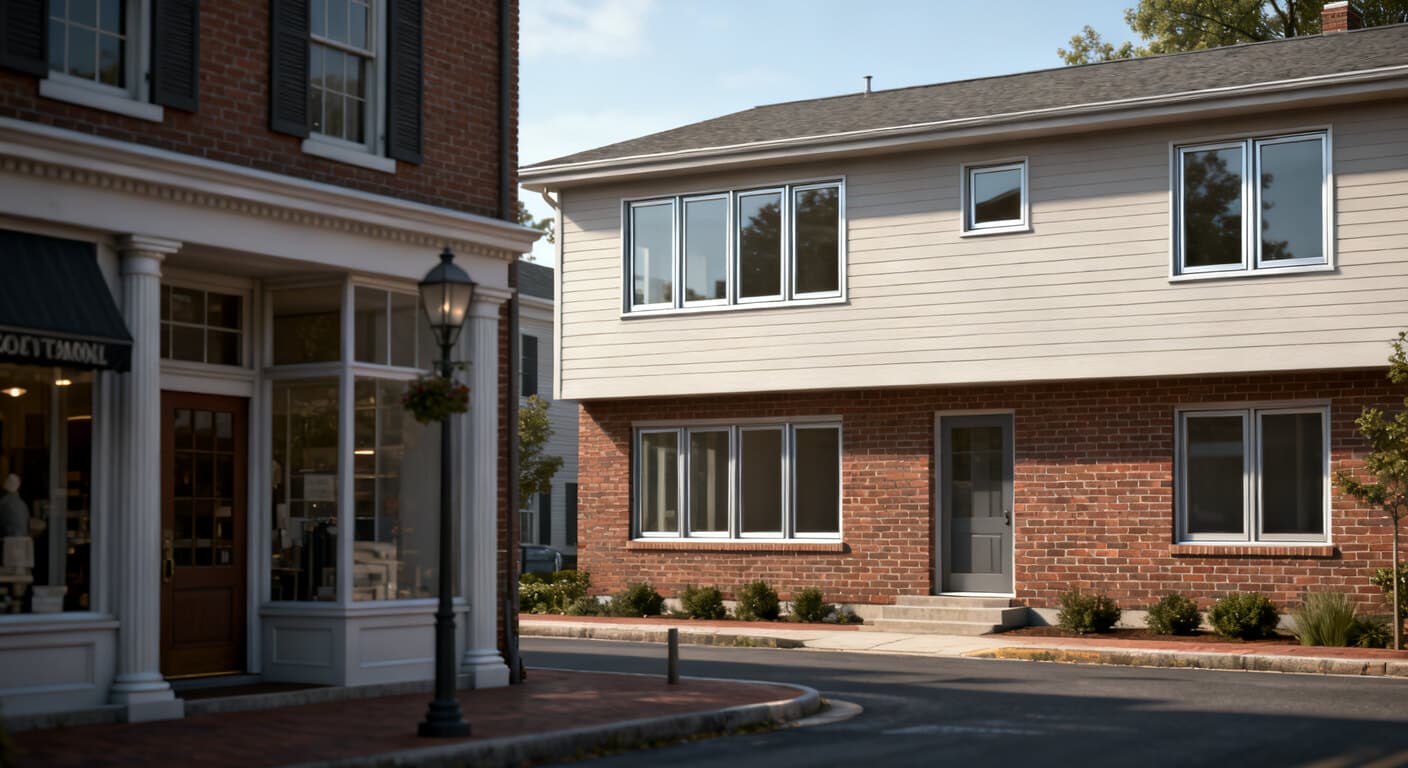
Walk into almost any Fairfax County subdivision built in the postwar boom and you are looking at a lot of glass. A brick colonial on a quarter-acre lot carries openings on all four elevations, and across Mosby Woods, Mantua, or Kent Gardens that adds up fast: the typical job here is not one bad window, it is twenty at once. Tucked inside that suburban sea is something different, a small old-town historic core in the independent City of Fairfax where a handful of streets answer to a design-review board the county subdivisions never touch. I am a licensed Virginia real-estate agent, and the first thing I check on any Fairfax address is which of those two worlds it sits in. This page sorts that out before you order.
What window replacement in Fairfax usually looks like
Most Fairfax homes are solid-brick mid-century houses, so the typical project is a whole-home swap of original 1950s-60s units. Fairfax County grew explosively after World War II, and the prevailing stock reflects it: Cape Cods, one-story brick ramblers, split-levels and split-foyers, and brick Colonials and Colonial Revivals, plus later subdivision colonials and townhomes from the 1970s onward. Recognizable mid-century neighborhoods include Mosby Woods, Mantua, and Kent Gardens, alongside the area's modernist enclaves at Holmes Run Acres and Truro. The independent City of Fairfax centers on a walkable Old Town with late-19th and early-20th-century Colonial Revival buildings, such as the 1900 Old Town Hall, ringed by 1950s-60s neighborhoods.
Whole-home replacement dominates this market. The Fairfax colonials, split-levels, and ramblers I show as a Virginia agent typically run 15 to 25 windows, so a 10-plus-window project is the norm rather than the exception, and many of these homes still carry their original 1950s-60s aluminum or single-pane wood units. Larger-lot homes in Fairfax Station and newer subdivisions push the upper end of that count. Style mix on a job like this is rarely uniform: double-hung carries the bedrooms and the colonial front, a casement or a grouped picture unit shows up on the mid-century living room, sliders sit over wider openings, and a bay or bow projection appears wherever a 1960s floor plan opened up a wall.
Do you need historic approval for window replacement in Fairfax?
Usually no, but it depends entirely on which side of the city line you sit on and whether your lot is inside a designated district. The independent City of Fairfax runs its own Board of Architectural Review (BAR). All physical changes to a property in the Old Town historic overlay district that are visible from the street or other public places are subject to architectural review, and that explicitly includes exterior window replacement. Per the City of Fairfax, the city established a seven-block core as its Old and Historic District in 1964 and later expanded it (in 1977 and 1986); work in that overlay requires a Certificate of Appropriateness, either a minor COA handled administratively for smaller items or a major COA that goes to a BAR hearing.
The relief for most city owners is that single-family detached houses outside the Historic Overlay Districts are exempt from BAR review of exterior changes, so a typical out-of-district City of Fairfax home needs no Certificate of Appropriateness to replace windows.
The surrounding Fairfax County is a separate jurisdiction with its own Architectural Review Board (ARB), which reviews exterior alterations requiring a building permit within the county's Historic Overlay Districts. Homes outside those districts fall outside the ARB's jurisdiction entirely. Fairfax County's Historic Overlay District program dates to a 1969 zoning ordinance amendment and today counts 15 districts, per the county, including the Centreville Historic Overlay District in the Fairfax area. Even at a county-district address, the county's land-development guidance lists direct replacement of existing windows and doors as no-permit work, and the ARB reviews only alterations needing a permit, so a true direct swap generally stays outside ARB review; check with the county if your project changes the opening. The practical takeaway: the great majority of Fairfax's post-WWII brick homes sit outside any district and face no design review, and a county-side direct swap needs no permit either.
What does window replacement in Fairfax cost, and how OneStep prices it
Pricing in Fairfax tracks the wider DC/MD/VA metro rather than carrying a city premium. A single installed replacement window generally runs from a few hundred dollars at the budget-vinyl end to several thousand at the wood-clad premium end, with most owner-occupied homes landing in mid-tier vinyl. The metro prices roughly uniformly, so there is no Fairfax delta to invent. For a verified per-window figure on your exact openings, pull [data pending: OneStep itemized per-window price for the buyer's Fairfax address] from the configurator.
What actually moves the Fairfax math is window count and whether you are in a regulated overlay. On the typical out-of-district brick rambler, split-level, or colonial, a mid-tier vinyl insert across the whole count is the low-friction path, and that count is the main driver of the total. Inside the City of Fairfax Old Town overlay or a county Historic Overlay District, you add the Certificate-of-Appropriateness or ARB review window before the install clock starts, and regional review boards commonly steer historic facades toward higher-spec materials that raise the per-unit cost.
The other cost layer is the sales model, and on a 20-window job it matters. When a traditional in-home seller quotes a whole-home Fairfax project, the rep visit, the dispatch overhead, and the time-limited promotion all ride inside that one big number, and a single bundled total is where the markup hides. OneStep prices the other way around. No rep is sent to your house. You measure with your phone, build the job in 3D, and get a line item for every opening, so the bedroom double-hung, the living-room casement, and the bay each carry their own visible figure instead of dissolving into one lump sum.
Get an honest price, no salesperson
Tell us your address and window and get itemized pricing — no in-home pitch, no surprises.
How the OneStep process works for a Fairfax homeowner
You can get a real, itemized number for window replacement in Fairfax remotely: no in-home rep, an AI phone-video measurement step, and a 3D configurator.
On a Fairfax whole-home job, those two tools earn their keep on the count. Hand-measuring 20 openings across four elevations is the chore most owners stall on, so instead you record a phone-video walkthrough and the measurement step reads each size off the footage. The configurator then lets you assemble the actual mix this housing stock takes: a wall of double-hung for a brick colonial, a casement or grouped picture unit for a mid-century front, a slider over a wide opening, a bay where the living room steps out. Every unit gets its own price, so you can see what a premium glass package on the street-facing elevation does to the total before committing. If you are unsure whether your address falls under the City of Fairfax BAR, the Fairfax County ARB, or neither, or which glass fits our mixed-humid IECC Zone 4 climate, ask Zig, our window consultant. The honest limit to plan around is lead time: figure roughly 4 to 6 weeks from order to install, plus the review window if you are inside a historic overlay.
See it on your own house first
Preview a clean replacement on a photo of your actual window and get itemized pricing before you decide.
Frequently asked questions
Do I need approval to replace windows in Fairfax, VA?
It depends on your exact address. In the independent City of Fairfax, a window change visible from the street in the Old Town historic overlay needs a Certificate of Appropriateness from the Board of Architectural Review, while single-family detached homes outside that overlay are exempt. In surrounding Fairfax County, only homes inside a designated Historic Overlay District fall under the county Architectural Review Board. Most Fairfax homes sit outside any district, and Fairfax County's land-development guidance lists direct replacement of existing windows and doors as work that needs no permit.
Is the City of Fairfax the same as Fairfax County for permits?
No. The City of Fairfax is a separate independent jurisdiction with its own government and its own Board of Architectural Review, and the surrounding Fairfax County has a separate Architectural Review Board. Which body reviews your project, if any, depends on which side of the city line your home sits on and whether it is inside a designated historic district.
How long does Certificate of Appropriateness review add to a window project in Old Town Fairfax?
It depends on whether your change qualifies as a minor Certificate of Appropriateness, handled administratively by City of Fairfax staff, or a major one that goes before a Board of Architectural Review hearing. A hearing track adds weeks to months ahead of any install, since it runs on the board's meeting calendar. Confirm the current timeline and which track your work falls under with the City of Fairfax before ordering.
Does a like-for-like window swap in a Fairfax County Historic Overlay District trigger Architectural Review Board review?
Generally not. The county Architectural Review Board reviews exterior alterations that require a building permit within a designated Historic Overlay District, and Fairfax County's land-development guidance lists direct replacement of existing windows and doors as no-permit work, which keeps a true like-for-like swap outside ARB review. Confirm with Fairfax County if your project enlarges or relocates the opening. Homes outside any designated district fall outside ARB jurisdiction entirely.
How much does a whole-home window replacement cost in Fairfax?
Per-window pricing tracks the wider DC, Maryland, and Virginia market, from a few hundred dollars for budget vinyl to several thousand for wood-clad premium, with most owner-occupied homes in the mid-tier vinyl range, and no real Fairfax premium. Because the homes I tour here typically run 15 to 25 openings, your total is driven far more by that count than by any local price difference. For a verified number on your exact openings, pull the itemized configurator quote for your address.
How many windows does a typical Fairfax home need replaced?
In my walkthroughs as a Virginia real-estate agent, a typical single-family Fairfax colonial, split-level, or rambler runs roughly 15 to 25 windows, so whole-home projects of 10 or more openings are the norm here rather than the exception. Many of these mid-century brick homes still carry original 1950s-60s aluminum or single-pane wood units that get replaced in one project. Larger-lot homes in places like Fairfax Station push toward the high end of that count.
Keep researching
A few next steps make the Fairfax math concrete. Since the area's brick colonials and ramblers almost always carry tall double-hung openings, settle the proportions first with our guide to double-hung window options. Because the window count is the real cost driver here, run the numbers on replacing every window in a house. Deciding between vinyl, fiberglass, and wood on a mid-century brick home comes down to the window material trade-offs, and if your original aluminum units have gone cloudy, our breakdown of foggy windows covers whether that means repair or replacement. Browsing a different part of the DC, Maryland, and Virginia metro? Step back to our city-by-city window guides.