Window replacement in Baltimore, MD
Window replacement in Baltimore turns on one question before any other: which jurisdiction is your address in, and is your block designated? A street-facing rowhouse inside a city CHAP district or a Baltimore County historic district needs historic review and often historically matched sash. Most non-designated homes do not. Regional pricing runs a few hundred to several thousand dollars per window installed.

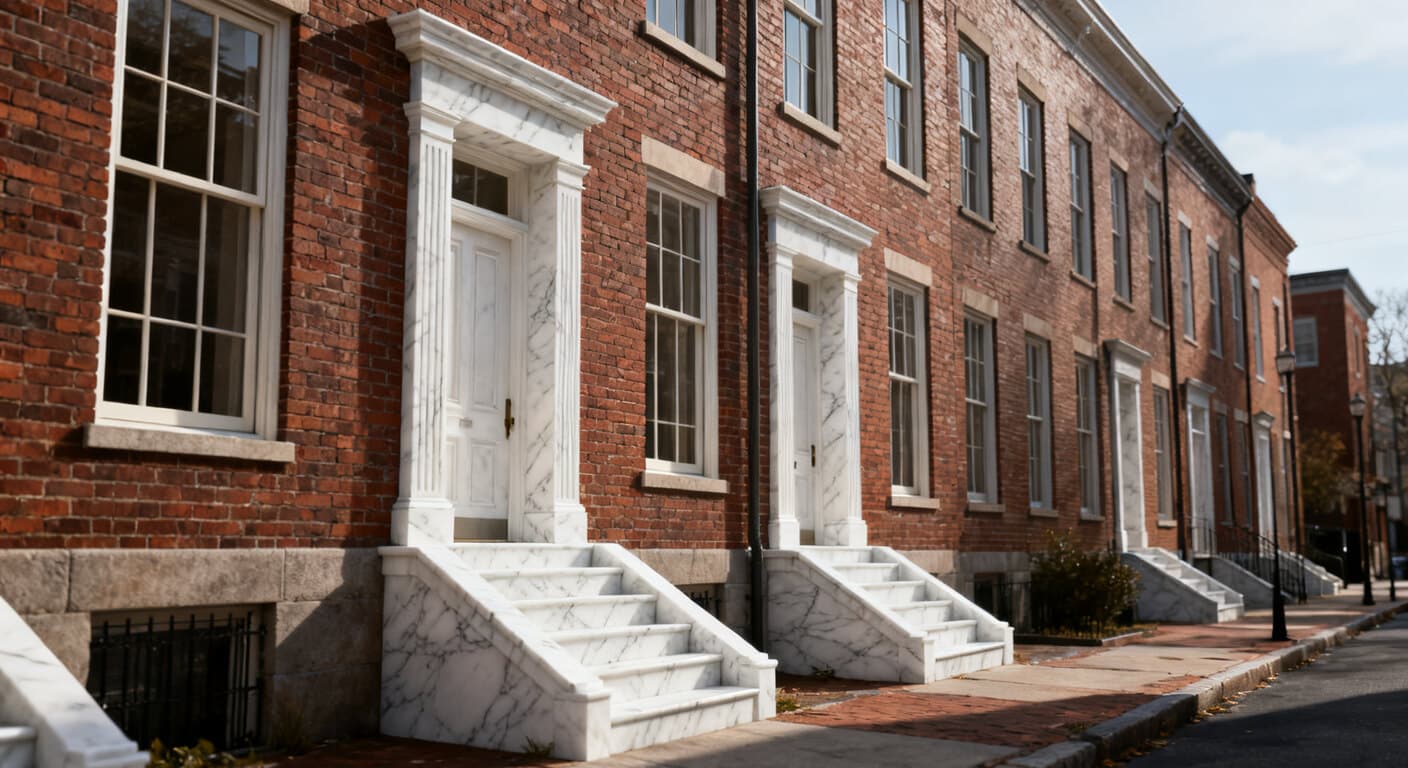
Stand on almost any Baltimore block and the facade tells you the job before you knock: a continuous run of marble-stepped brick rows, each a tall, narrow party-wall front with two to four openings per floor, some troweled over with Formstone. Two things govern whether you can just swap those windows. The first is egress: any bedroom window you replace has to keep a code-sized opening for escape, which limits how small a replacement sash can get. The second is whether your block sits inside one of the Commission for Historical and Architectural Preservation (CHAP) districts, where a street-facing window is no longer only your call. As a Maryland-licensed realtor of 12+ years, I read those two signals on every listing I tour. This page sorts both out before you order a single window.
What window replacement in Baltimore usually looks like
A Baltimore job is usually a single-rowhouse facade, not a sprawling whole-home swap. In the rowhouses I tour as a Maryland realtor, a narrow two- or three-story brick or Formstone row typically carries only two to four tall, narrow openings per street-facing floor, so a whole-rowhouse project is often 6 to 12 windows front and rear, against the 15 to 25 I see in detached county and suburban stock. That smaller, taller-window count is the defining scope here.
The housing stock points straight at specific styles. Baltimore is overwhelmingly a continuous-brick, party-wall rowhouse city: narrow Federal-era homes near the Inner Harbor gave way to the dominant 19th-century Italianate row (ornate cornices, tall narrow windows), then Greek Revival and Queen Anne rows, plus rounded "swell-front" bays. Two local signatures sit on these fronts: marble entry steps and Formstone, the faux-stone stucco troweled onto facade after facade in neighborhoods like Highlandtown and Little Italy. You see this stock in Fells Point, Federal Hill, Canton, Mount Vernon, Bolton Hill, Hampden, and Patterson Park.
- The tall, narrow rowhouse opening reads best as a symmetrical double-hung window with the original proportions kept.
- A swell-front parlor or a rounded bay wants a projecting bay unit on the front elevation.
- Outside the dense core, early-1900s streetcar-suburb and county stock (daylight rows, porch-front brick, detached and semi-detached colonials and bungalows) also takes casement and grouped picture glass.
Do you need historic approval for window replacement in Baltimore?
It depends entirely on whether your address is designated, and by which authority. Baltimore City and Baltimore County are two separate jurisdictions with two separate historic regimes, so the first task is figuring out which one (if either) your block falls under. For most non-designated homes, a like-for-like swap needs only a standard building permit, no historic review at all.
Inside the city, the authority is the Commission for Historical and Architectural Preservation (CHAP), established in 1964, which by its own published count oversees 38 local historic districts and more than 200 individual landmarks. If your property sits in a CHAP district or is a local Landmark, exterior work, window replacement included, must be approved through an Authorization to Proceed application before you start. Under CHAP's design guidelines, replacement windows on publicly visible, street-facing elevations must duplicate the historic window's proportion, profile, light configuration, and material. In practice that means painted-wood sash with real structural muntins (or matching simulated divided lights), not snap-in grilles, and vinyl does not meet that standard on a street-facing facade. Bolton Hill, a CHAP district, is explicit: street-facing windows must be wood, with exceptions possible only for rear openings.
Exactly what material your address can use, including whether aluminum-clad wood or simulated-divided-light units are accepted and how the rear-versus-street-facing line is drawn, varies by district and by property. Do not assume a single citywide rule: [data pending: chap-material-by-address: confirm allowable window materials with CHAP staff for the specific property].
Baltimore County is its own world. Its Landmarks Preservation Commission (LPC) reviews exterior alterations, windows included, on landmark-listed properties and structures in county historic districts under Article 32, Title 7 of the County Code, voting whether to issue a Certificate of Appropriateness. Any exterior alteration subject to LPC review also requires a county building permit, whether or not the work would otherwise need one.
The relief for most owners is that the rules are designation-based. A home in neither a CHAP district nor a county historic district nor an individual landmark generally falls outside historic review for a like-for-like swap ([data pending: non-designated-property-permit-only: CHAP does not publish this as an affirmative rule; confirm the address against the CHAP district map]). Because designation is set by address, check your property against the CHAP district map or the county's historic inventory first.
What does window replacement in Baltimore cost, and how OneStep prices it
Pricing in Baltimore tracks the rest of the DC/MD/VA metro rather than carrying a city premium. A single installed replacement window generally runs from a few hundred dollars at the budget-vinyl end to several thousand at the wood-clad premium end, with most owner-occupied homes in mid-tier vinyl. I will not invent a Baltimore price delta, because the metro prices roughly uniformly. For a verified figure on your exact openings, pull [data pending: OneStep itemized per-window price for the buyer's Baltimore address] from the configurator.
Two facade realities move the Baltimore number more than window count does. Egress sizing comes first: a code-sized escape opening on a bedroom can rule out the cheapest stock sash and push you to a wider or custom unit. CHAP material rules are the bigger swing. On a street-facing designated front, the guidelines steer you to historically matched units, frequently wood with true divided lights, which run above budget vinyl and add the Authorization-to-Proceed (or county Certificate-of-Appropriateness) review to your timeline before any install date is set. Budget for that combination if your front faces a designated street.
Then there is the layer nobody itemizes for you: the cost of the visit itself. In a traditional sale, a company dispatches a rep, books the appointment, and the overhead of that production gets folded back into your quote. OneStep takes that out. Nobody is sent to your rowhouse. You walk your openings with your phone, build them in 3D, and read a fixed line-item cost for each one. That will not be the lowest number on every job, but it is a real figure you can compare, not a starting position to haggle below.
Get an honest price, no salesperson
Tell us your address and window and get itemized pricing — no in-home pitch, no surprises.
How the OneStep process works for a Baltimore homeowner
OneStep runs the whole quote remotely: no rep at your door, phone-video measurement, and a 3D configurator that prices each opening on its own. Here is what those two tools buy you on Baltimore stock. The phone-video walkthrough matters because a rowhouse front is not uniform. Tall parlor-floor openings rarely match the shorter sash two stories up, and a Formstone front can hide a frame depth a clipboard tape would miss, so reading sizes off the video catches the variation opening by opening. The configurator then lets you treat each window as its own line: a proportion-correct wood double-hung on the street-facing front where CHAP review is in play, a projecting bay on a swell-front parlor, and a plain insert on the rear elevation the commission never sees, all on one project and priced separately. Plan on roughly 4 to 6 weeks from order to install, plus the historic review window first if your block is designated. Unsure which jurisdiction your address answers to? Ask Zig, our window consultant, to sort it out with you.
See it on your own house first
Preview a clean replacement on a photo of your actual window and get itemized pricing before you decide.
Frequently asked questions
Do I need a permit to replace windows in Baltimore, MD?
A standard building permit applies to window replacement. If your home sits in a Baltimore City CHAP historic district or is a city Landmark, you also need an Authorization to Proceed from CHAP before work begins. In Baltimore County, landmark and county-district properties need a Certificate of Appropriateness from the Landmarks Preservation Commission, plus a county building permit. A non-designated home needs no historic review for a like-for-like swap.
Can I put vinyl windows in a Baltimore historic district home?
Not on a street-facing facade in a CHAP district. CHAP design guidelines require replacement windows on publicly visible elevations to duplicate the historic proportion, profile, light configuration, and material, which generally means painted-wood sash with real muntins, not vinyl with snap-in grilles. Rear windows are sometimes treated more flexibly. Confirm what your specific address allows with CHAP staff before ordering.
Is my Baltimore home in a historic district?
Maybe. By CHAP's own count, Baltimore City has 38 local historic districts and more than 200 individual landmarks, and Baltimore County maintains its own separate historic inventory. Many homes fall outside both and need no historic review for ordinary window replacement. Because designation is set by address, check your specific property against the CHAP district map or the county's historic listings before you order.
What is the difference between Baltimore City and Baltimore County historic rules?
They are two separate jurisdictions. Baltimore City uses CHAP, which requires an Authorization to Proceed for exterior work in its districts and on landmarks. Baltimore County uses its Landmarks Preservation Commission, which votes on a Certificate of Appropriateness and also requires a county building permit for any exterior alteration under its review. Which one applies depends entirely on whether your address is in the independent city or the surrounding county.
What window styles are most common in Baltimore rowhouses?
Double-hung windows dominate, because the city's Federal, Italianate, Greek Revival, and Queen Anne rowhouses were built with tall, narrow double-hung sash. Swell-front and rounded-bay rows often carry a projecting bay on the parlor floor. Outside the dense rowhouse core, county and streetcar-suburb homes also use casement, picture, and sliding units.
How much does window replacement cost in Baltimore?
Pricing tracks the wider DC, Maryland, and Virginia market: a few hundred dollars per window for budget vinyl up to several thousand for wood-clad premium, with most homes in the mid-tier vinyl range. Baltimore carries no city premium on its own. What lifts the real number here is the rowhouse facade: a code-sized egress opening on a bedroom can rule out the cheapest stock sash, and a CHAP-reviewed street-facing front often requires matched wood units that run well above vinyl. Window count alone understates both.
Do replacement windows have to meet egress rules in a Baltimore bedroom?
Yes. A bedroom needs an emergency escape and rescue opening, so the replacement sash must keep a code-minimum clear opening to get out. On narrow rowhouse openings that can rule out the smallest budget unit, because shrinking the frame to fit may fall below the required clear dimension. Confirm bedroom opening sizes with your permit reviewer before ordering.
How long does Baltimore historic review add to a window project?
The build itself runs roughly four to six weeks from order to install. If your block is in a CHAP or Baltimore County historic district, the Authorization to Proceed or Certificate of Appropriateness review happens before that build clock starts, so plan for review time on top. Its length depends on the office's schedule and whether your case goes to staff or a hearing, so confirm current timing with the reviewing office for your address.
Keep researching
A few next reads map onto the Baltimore decisions above. Since the rowhouse front is almost always a tall double-hung, start with the double-hung window options and the proportions a CHAP-reviewed facade holds you to. Before you accept any figure across your 6 to 12 openings, sanity-check it against our regional window replacement cost breakdown. And because the jurisdiction tangle makes installer vetting high-stakes here, work through how to choose a window replacement contractor who can navigate CHAP or county review. Researching another Maryland, DC, or Virginia city next? Browse the rest of the cities OneStep serves.