Why does bay window replacement cost so much more than a regular window?
Bay window replacement cost runs well above a single double-hung because a bay isn't one window. It's a three-unit assembly that projects from the wall, with a head board, a seat board, exterior cladding, a roof cap, and usually structural support carrying the cantilevered load. In the bay quotes I itemized selling windows in-home, the glass was often less than half the bill. The rest is the projection.

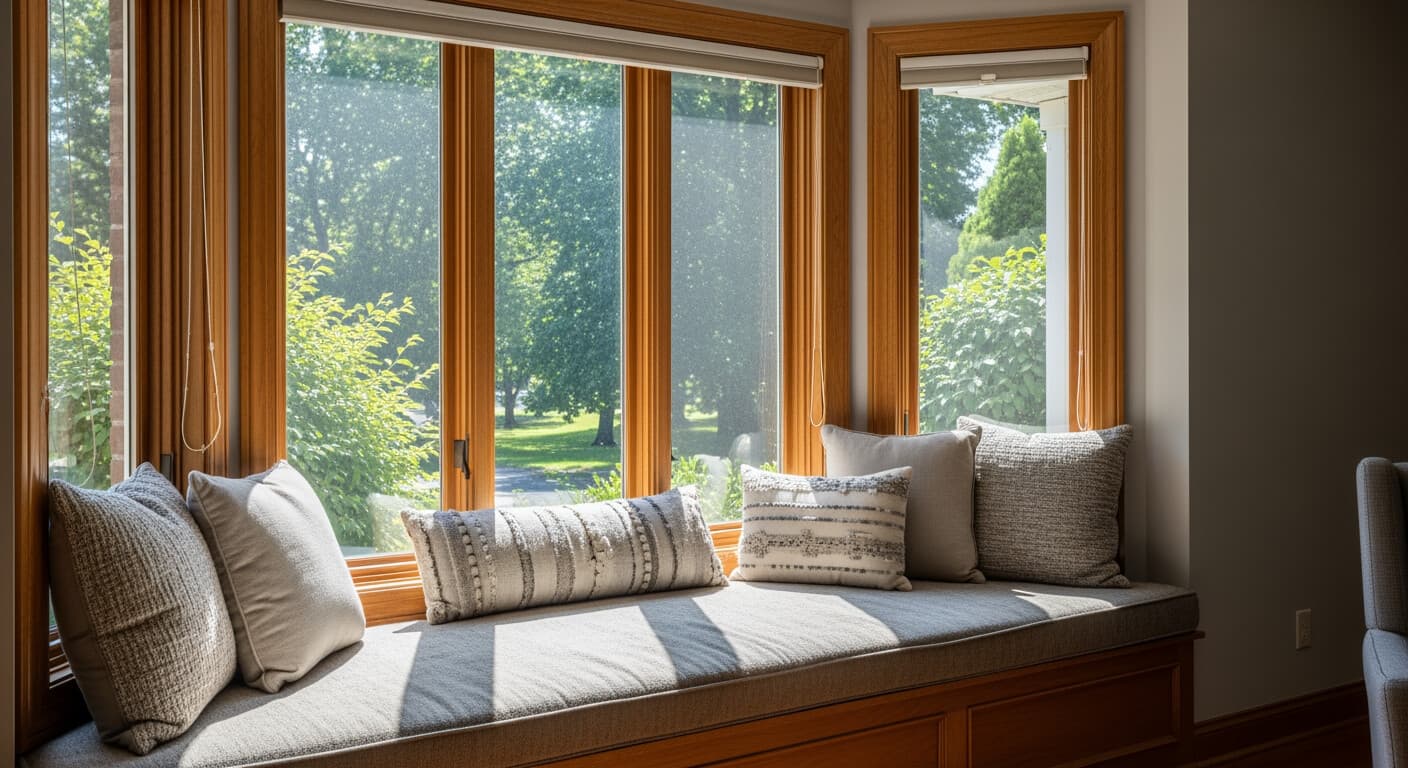
If you got a bay window quote and the number knocked the wind out of you, this page is the verification pass. A bay reads like one window from the curb, so the price feels wrong next to a single double-hung. But you're not buying one window. You're buying three sashes, a head and seat board, cladding on the projection, a little roof, and the brackets or cables that hold the whole thing off the wall. Selling premium windows in-home, the bay was the line item homeowners disputed most, almost always because nobody itemized what they were paying for. Here's how to read your own.
What does bay window replacement cost actually include?
A bay window replacement cost is a stack of line items, not a window price: the three window units, the head and seat boards, the exterior cladding, a roof cap, and the structural support. Each one is real work, and each one is a place a quote can hide markup.
The reason a bay costs multiples of a flat window is geometry. A flat window transfers its weight straight down through the frame. A bay hangs out past the wall, so its weight cantilevers, and that load goes either up into steel cables anchored in the framing or down onto exterior knee braces. Add the small roof that sheds water off the projection, the cladding wrapping the exterior faces, and the boards finishing the interior alcove, and you have a small bumpout, not a window swap.
For the structural anatomy of a bay (angles, flankers, seat depth, roof tie-in), see bay windows, and for how it differs from its curved cousin, bow windows.
What's in a bay quote, line by line?
A fair bay quote breaks the assembly into its parts so you can see where the money goes. The table below is the structure to demand from any installer. If it comes back as one bundled number, that's information.
| Line item | What it is | Why it costs | Typical share of the bay |
|---|---|---|---|
| Window units (×3) | Fixed center picture + two operating flankers | Three sashes, not one; the center is a large piece of glass | [data pending: window-unit share of total bay cost, %] |
| Head + seat boards | The interior ledge and top of the alcove | Material, fabrication, finish; granite/quartz tops add cost | [data pending: head/seat board share of total bay cost, %] |
| Structural support | Cables or exterior knee braces carrying the projection | Engineering and framing for the cantilevered load | [data pending: structural support share of total bay cost, %] |
| Roof cap + flashing | Small sloped roof shedding water off the projection | Roofing labor + the leak-critical head flashing detail | [data pending: roof cap share of total bay cost, %] |
| Exterior cladding | Wraps the three projecting faces and the underside | Matching the facade so it doesn't read as a bolt-on | [data pending: cladding share of total bay cost, %] |
| Install labor | Setting the unit, integrating, finishing | Multi-day job; interior drywall/paint patch often separate | [data pending: install labor share of total bay cost, %] |
The actual dollar total depends on which of two jobs you have, which is the next question, and it's the single biggest driver of bay window replacement cost.
Bay-for-bay swap vs. flat-to-bay conversion
The biggest cost fork is whether you already have a bay. Replacing an existing bay where the structure is in place is dramatically cheaper than turning a flat opening into a bay, because the second one is a small addition, not a replacement.
On a bay-for-bay swap, the header is already reinforced, the brackets or cables are there, the roof tie-in exists. You're swapping the unit into a structure that already carries it, the low end of the range by a wide margin.
On a flat-to-bay conversion, you're cutting a larger opening, reinforcing the header to span it, adding cables or knee braces to carry a load the wall never carried, building a small roof, and cladding a projection that didn't exist. In the conversion quotes I priced, the window unit was often less than half the project. If a conversion looks priced like a swap, something is missing, usually the structural scope, which returns as a change order.
| Scenario | What you're paying for | Per-bay installed |
|---|---|---|
| Bay-for-bay swap | Unit, head/seat board, insulation, exterior trim | [data pending: bay-for-bay swap installed range, mid-tier vinyl, DC/MD/VA] |
| Flat-to-bay conversion, single story | Above + header reinforcement, support, roof tie-in, cladding | [data pending: flat-to-bay conversion installed range, single story, DC/MD/VA] |
| Flat-to-bay conversion, two story | Above + more involved roof and flashing detail | [data pending: flat-to-bay conversion installed range, two story, DC/MD/VA] |
| Premium tier unit | Full structural scope + higher-tier window and warranty | [data pending: premium bay installed range, DC/MD/VA] |
Get an honest price, no salesperson
Tell us your address and window and get itemized pricing — no in-home pitch, no surprises.
What makes one bay window replacement cost more than another?
Beyond swap-vs-conversion, four choices move a bay quote: the glass package, the projection angle, the flanker style, and the board material. They compound, because the bay multiplies most of them by three.
- Glass package. The center panel is the biggest piece of glass on the unit, so a triple-pane or upgraded Low-E spec costs more on a bay than on a flat window. In DC/MD/VA (IECC climate zone 4, mixed-humid), double-pane Low-E with argon is the baseline; a lower U-factor (winter heat loss) and a tuned SHGC (summer solar gain) are worth paying for on west- and south-facing bays. For most DC/MD/VA addresses, which fall in ENERGY STAR's North-Central climate zone, the ENERGY STAR Version 7.0 specification puts certification at a U-factor of 0.25 or lower and an SHGC of 0.40 or lower.
- Projection angle. A 45-degree bay projects further and carries more cantilevered load than a 30-degree bay, adding to structural cost: [data pending: 45 vs 30 degree bay structural cost delta, %].
- Flanker style. Double-hung flankers read traditional and suit MD colonials; casement flankers seal tighter and read contemporary, a modest cost difference next to the structural work.
- Board material. A laminate-top MDF seat board is the baseline; solid hardwood, quartz, or a cushioned bench seat each add cost, and matter most when the seat is load-bearing on the decision (a kitchen breakfast nook).
Are there tax credits or incentives that lower bay window replacement cost?
Not federally, not anymore. The federal §25C Energy Efficient Home Improvement Credit for windows (30% of cost, capped at $600/year) was terminated for property placed in service after December 31, 2025 under the 2025 federal tax law (Public Law 119-21). For a 2026 bay install there is no federal window tax credit, and a salesperson still citing one is working from an outdated script.
What can still move the math is utility and local programs plus the energy itself. A bay is a lot of glass on one wall, so a well-insulated unit changes the comfort and heating load of that room. The under-seat cavity has to be insulated or the seat becomes the coldest spot in a Zone 4 living room in February. For any current incentive, confirm before relying on it: [data pending: current DC/MD/VA utility or state/local window incentives, 2026]. The payback case for a bay is comfort and curb appeal more than a credit, so price it that way.
How OneStep prices a bay without the sticker-shock games
OneStep shows the bay as an itemized, no-rep price before anyone talks to you. The 3D configurator lets you pick the projection angle, flanker style, board material, and glass package, then shows the price impact of each, and for a flat-to-bay conversion it flags the structural work as its own line rather than burying it in the unit price.
That's this page applied to our own quote: we won't print a fake "bay windows from $X" headline, because a bay's number depends on whether you're swapping or converting, single or two story, and which glass and boards you choose. You measure with your phone, the configurator prices your opening, and a short call confirms the structural scope on conversions before the number locks. For the broader take, see window replacement cost; for what we do overall, window replacement and the full windows lineup.
See it on your own house first
Preview a clean replacement on a photo of your actual window and get itemized pricing before you decide.
Frequently asked questions
Why does bay window replacement cost so much more than a normal window?
Because a bay isn't one window. It's three window units plus a head board, a seat board, exterior cladding on the projection, a small roof cap, and structural support carrying the cantilevered load. In the bay quotes I itemized during my in-home sales years, the glass often came to less than half the bill, with the rest going to the projecting structure a flat window doesn't have.
How much does bay window replacement cost installed?
A bay-for-bay swap, where the structure is already in place, sits at the low end of the range. A flat-to-bay conversion runs significantly higher because you're cutting a larger opening and adding header reinforcement, support, a roof tie-in, and cladding, which makes it a small structural bumpout rather than a window swap.
Why is converting a flat window to a bay so expensive?
Because it's a small addition, not a replacement. You enlarge the opening, reinforce the header, add cables or knee braces to carry a load the wall never carried, build a small roof, and clad the projection. The window unit itself is often the smaller share of the project cost.
Is there a tax credit for a bay window in 2026?
No federal one. The section 25C window credit (30% of cost, up to $600 per year) was terminated for property placed in service after December 31, 2025 under Public Law 119-21. Check for current utility or state/local incentives in your area, but don't count on a federal window credit for a 2026 install.
How can I tell if my bay window quote is fair?
A fair bay quote is itemized: the three units, the boards, the structural support, the roof cap and flashing, the cladding, and labor as separate lines, not one bundled lump sum. If it's a flat-to-bay conversion priced like a simple swap, the structural scope is probably missing and will return as a change order.
Does a bigger projection angle cost more?
Yes. A 45-degree bay projects further than a 30-degree bay and its brackets or cables carry more cantilevered load, adding to the structural cost. The wider angle also gives a deeper interior seat and a more dramatic facade, so it's a look-versus-cost trade.
Next step
The fastest way to verify a bay quote is to see a real, itemized number for your own opening, with the structural line items most quotes hide shown separately. OneStep's configurator pulls up your home, lets you build the bay you want, and prices it per line.
See it on your own house first
Preview a clean replacement on a photo of your actual window and get itemized pricing before you decide.
Related: the cost hub for tier-by-tier breakdowns, window replacement cost for the master pricing logic, and bay and bow for the window-type details. The person behind every page on this site is at Anthony Moorman.